Stereotype

Stereotype

Stereotype

Personal adornment in prehistory
personal adornment in prehistory

Stereotype

I love it when personal adornment, dress and equipment open a window on the world of its wearers. And that’s even more fantastic if those wearers lived in prehistoric times some 4,000 years ago! That window can only be opened when these items of personal presentation are analyzed in a wider context, and that is exactly what the research in Stereotype does.

Stereotype is the result of the PhD research by Karsten Wentink. The research addresses grave goods in prehistory, in particular the Corded Ware and Bell Beaker cultures. Now before you think ‘wait, what, archaeology? Pots and flint? I came here for adornment!’ – the research pivots on the presentation of the self, the careful creating of a persona by choosing a specific type of outfit. In the chapter ‘Presentation and perception’, the author zooms in on this very aspect. Based on the work of Goffman, the chapter walks us through the use of personal appearance as a means to convey intentions and to interact with others. An example in the book is that of the business suit: there’s a reason these all look alike (sorry, fashion designers), as wearing them sets the scene for a specific social interaction: doing business. Wearing a suit creates a visual framework that elicits a particular type of social comportment, so the dress code informs you about the social code that is expected in this setting. (there’s a reason you’re not expected to show up in flip-flops and your favourite Hawaii-print for a business meeting!) This dress code is understood beyond your own social group: when you’re doing business internationally, the suit will be worn by all participants. Even if you do not speak each other’s language, you share common ground in the way you dress, which reconfirms you’re all there for the same reason and will adhere to the social rules associated with that reason: your personal appearance conforms to a larger social front. I found this chapter to be particularly interesting, as it illustrates how personal appearance, dress and adornment form part of the weave of social fabric, up to a point that they not only fit in with a certain social event, but can even be used to set the scene and to steer the direction of social interaction.

 Now, on to the objects themselves. The author takes this premise of the social power of adornment and appearance, and uses it to reconstruct the world of the people buried well over 4,000 years ago. What outfit did they bring along on their last journey, and what did they want to communicate through it? In short: what was their ‘business suit’ aimed at? In three chapters, the author picks apart all types of objects deposited in graves. Beakers, flint weapons, archery equipment, and ornaments in amber, bronze and gold are all carefully discussed and analyzed. Working from the starting point of personal appearance, this also includes looking at these grave goods from another perspective. Why do archery sets appear in one of two cultures studied, but not in the other? What use is an archery set anyway, seeing as it’s never complete and ready for use? Does the inclusion of flint weapons automatically make the deceased a ‘warrior’? What to think of gold and amber jewellery found in some graves: does this make the owner a ‘prince’ of ‘princess’? When looking at these items not individually per grave, but in the wider scheme of burial practices of these periods, they appear to share a common denominator: the materials used to make them come from distant places. What if this distance were the decisive factor here, instead of asserting individual martiality or wealth?

As in the case of the business suit, the items brought along by the dead conform to a larger social front. This is where that window on a past world opens. The author argues that the personal appearance of the dead reflects a world where travel, exchange and meeting strangers was the norm. The ‘outfit’ of the dead resembled that of a traveler: vessels to offer and share a drink with, practical items like firelights, but also items that came from afar and served as proof of journeys accomplished and long-distance relations maintained. Large-scale migration has been attested through ancient DNA research and a remarkable similarity in some aspects of material culture all over Europe, so as an ‘archaeological fact’ this interconnectivity was already established. Through the personal appearance of the dead on their last journey however, we learn that traveling and being a gracious host or guest mattered to them, that giving and receiving hospitality was held in high value, and that contact with strangers did not scare them, but was sought after and appreciated.

There is much more to this research, obviously: in order to reach his conclusions, the author has also analyzed the orientation of graves, the placement of grave goods within the burial, use-wear analyses to see whether objects had been used in life or were created just for the burial set – all building blocks that help to read the intentions behind the choice of grave goods. I enjoyed this book because it combines personal appearance and adornment with archaeology, and in doing so is a great example of the insights to be gained from studying how a person chooses to present him/herself, whether it is a few decades or several millennia ago!

 Stereotype. The role of grave sets in Corded Ware and Bell Beaker funerary practices, by Karsten Wentink. 296 pp, with colour illustrations, in English.

The book was purchased through Sidestone Press, where it is also available for online reading.

Talking with…Dr Reem el Mutwalli

Talking with…Dr Reem el Mutwalli

talking with

Dr. Reem el-Mutwalli

In 2021, I had the pleasure of speaking with Dr. Reem el Mutwalli, founder of the Zay Initiative. Dr. El Mutwalli has over 30 years of experience in art and cultural heritage. Since the early 1980s, at the Cultural Foundation Abu Dhabi, she has been contributing to the establishment of cultural & art departments; advising on museum displays, leading and driving projects, hosting seminars, undertaking cultural tasks of different capacities and curating exhibitions. And in addition to all that, she is a most warm and caring person who generously shares her vast knowledge! We talked about collecting, about sharing and about the responsibilities that come with managing a unique collection.

Your core collection is the Sultani Collection. What made you decide to invest in a collection in the first place?

To clarify The Sultani Collection (presently at 530 articles) relates to the United Arab Emirates (UAE) in particular and it is the core of the larger more comprehensive Zay collection (1350 and growing) that aspires to encompass samples from the entire Arab world.

I began gathering the UAE collection (Sultani) organically as I grew up in the UAE and personally experienced wearing many of them. Eventually, as I worked on my doctorate, I found myself in the fortunate position of being the recipient of many of the dresses illustrated in my thesis that later was published in a book; Sultani, traditions renewed; Changes in Women’s Traditional Dress in the UAE during the reign of Shaykh Zâyid bin Sultân Âl Nahyân 1966-2004. Making it the first and only published collecting in the UAE.

I think a key aspect of what my mother, Buthaina Al Kadi, instilled in me is a keen eye for constantly searching, identifying and valuing traditional objects as well as the general appreciation of art and culture. Continuing this notion of preservation of tradition and the protection of heritage is a major component of what the Zay Initiative stands for and where much of my focus lies at present.

You have an active call on the platform for people to participate and share their heritage, be it actual pieces of dress or the stories that go with it. How is the response so far? What trends do you see developing since you first launched the initiative?

Having published the book and as I sporadically exhibited the collection, I noticed this attracted many followers and with the onset of the web & social media world I started first the Instagram account @sultanibookuae. This generated a direct and immediate interactive platform populated with daily dialogues related to the topic. What used to take me years in research became at my fingertips in hours. Live arguments and varied answers to questions stimulated conversation between followers that led to connections with likeminded people. This snowballed to people seeking me out to donate items belonging to their loved ones. Or directing me to individuals that might have such items to seek out.

Let me share an example of Shaikha al Suwaidi, a young lady in her twenties, who approached me through Instagram. She wanted to donate her paternal grandmother’s Kandūrah (UAE tunic dress). Her grandmother Hamdah al Miri had passed away in her eighties in 1980. She had held on to this article of dress and in 2018 found in us the right custodians to honour her memory. She had one condition though, to keep a vial of her grandmother’s scent together with this article, which touched me even more as I am a believer in the power of scent and memory. I drove three hours to get to the remote area where Shaikha lives to collect this article, I got to meet her mother and bond with both. I believe it is these human moments that enrich me personally and illustrates the intrinsic value of the Zay Initiative. You can view this object on the Zay web site in The Collection (ZI 500256 K UAE).

Consequently, it is this body of cultural and historical significance that prompted the creation of the second Instagram account @thezayinitiative widening our reach, as we began to engage with a larger audience, collect facts and document Arab culture. This then culminated into the blog and the digital archive collectively creating The Zay Initiative.

What challenges do you encounter in managing such a large collection?

Collecting as a hobby is one thing and collecting with the intention to seriously document and share culture is another. The latter comes with great responsibility and quite an institutional perspective. Crossing that bridge is a daily learning process which is both enlightening and overwhelming at the same time.

Deciding to create the initiative as a non-profit organization grounded the project, yet opened doors to a whole set of administrative, technical and manpower obligations. From what was once a personal passion overnight evolved into a continuous team effort that requires dedicated and spirited individuals to record, catalogue, maintain, preserve, store, photograph, animate, research, write, translate, edit, create content, input data etc.. the list is endless.

Leading to the need to look beyond the present, in order to find the experts and the funds to sustain the work, to make it available to the general public and generations to come. It is truly a totally consuming endeavor that requires passion, perseverance and lots and lots of patience!

What roles do you envisage for the collection in the future? In your ideal vision, what will The Zay Initiative have developed into, say 10 years from now?

Ultimately the dream is to become a beacon for the art of Arab dress or fashion. I am always confronted by the seeming split between traditional dress history and the contemporary fashion industry. However, I see them go very much hand in hand, for the later cannot exist without the former. Especially after we come out of this global pandemic, I feel the new normal will more likely prompt us to reflect and appreciate the past, look at ways we can recycle and sustain what we inherit and use it to find better solutions for our shared future.

I feel the Zay Initiative is an ideal vassal to help industry learn from history for true creativity to flourish. But as the saying goes: the journey of a thousand miles begins with one step! We are taking it one step at a time as we fulfill what we identified as our 5 pillars:

  • Collect, document and conserve Arab dress and adornment.
  • Present and contextualize it through a digital archive and blog.
  • Encourage intercultural dialogue to highlight a shared humanity.
  • Inspire and educate designers to create for a sustainable future.
  • Empower women regionally and globally by bringing their untold stories to life.

Having said this, I feel that the Zay Initiative is a collective work open to anyone who is passionate about this cause to participate or contribute. Be it as you do, by writing one blog a month, I really can’t thank you enough for the effort you put into this. Volunteering to help with back end work. Becoming a friend of the Zay Initiative, or subscribing to our mailing list, engaging with us through social media and spreading the word. Donating an article to celebrate a loved one, or generously donating (we have just added a donate button where you can give as little as the cost of one cup of coffee a week) to help us sustain the legacy.

Tell us a bit more about your plans for the online archive? It is already established and growing, but I’m sure there is much more in store for everyone interested in traditional dress from the Arab world in the future!

We call it The Collection (Digital archive), where the vision for this dual language digital platform (as it can be accessed in both English and Arabic), stems from the idea of a memory closet where visually it delineates details of each article and brings it to life by recording the names and narrating the stories of those who created or wore it, thus preserving it through out time. Many articles will further be animated through short-narrated video clips.

On another level it serves as a reliable platform for scholars and designers to reference accurate information as well as find inspiration. As you know the Arab world is vast and encompasses a multitude of ethnicities and influences that directly lead to variances in terms and terminologies. Such discrepancies are difficult to navigate and can easily be misunderstood.

Interestingly, the body of work in this field was written in 1845 by Dozy: Dictionnaire détaillé des noms des vêtement chez les arabes. Since then not much has developed. This prompted us to work on a glossary to clarify and at the same time preserve these terms. It is exhilarating that today through the Zay Initiative we seek to provide such a global digital platform that I hope can continue to grow.

For more information, see

The Zay Initiative: www.zay.org

Sultani Book: Sultani, traditions renewed; Changes in Women’s Traditional Dress in the UAE during the reign of Shaykh Zâyid bin Sultân Âl Nahyân 1966-2004.

Brand New Vintage

Brand New Vintage

Brand New Vintage

is it real or not?
pieces in the twilight zone

Brand New Vintage

For many collectors, a key aspect is whether a piece of jewellery has been used. Signs of wear are welcomed (to a certain extent, though; damage is often a bridge too far), and jewellery pieces that do not display any wear are sometimes dismissed as ‘too new’. With the presence of wear and age, it seems, comes the notion of authenticity. There is a category in between however, that is both brand new and old: pieces that have been purchased when they were new, but that have never been used. Is wear a reliable factor in determining authenticity?

Two examples

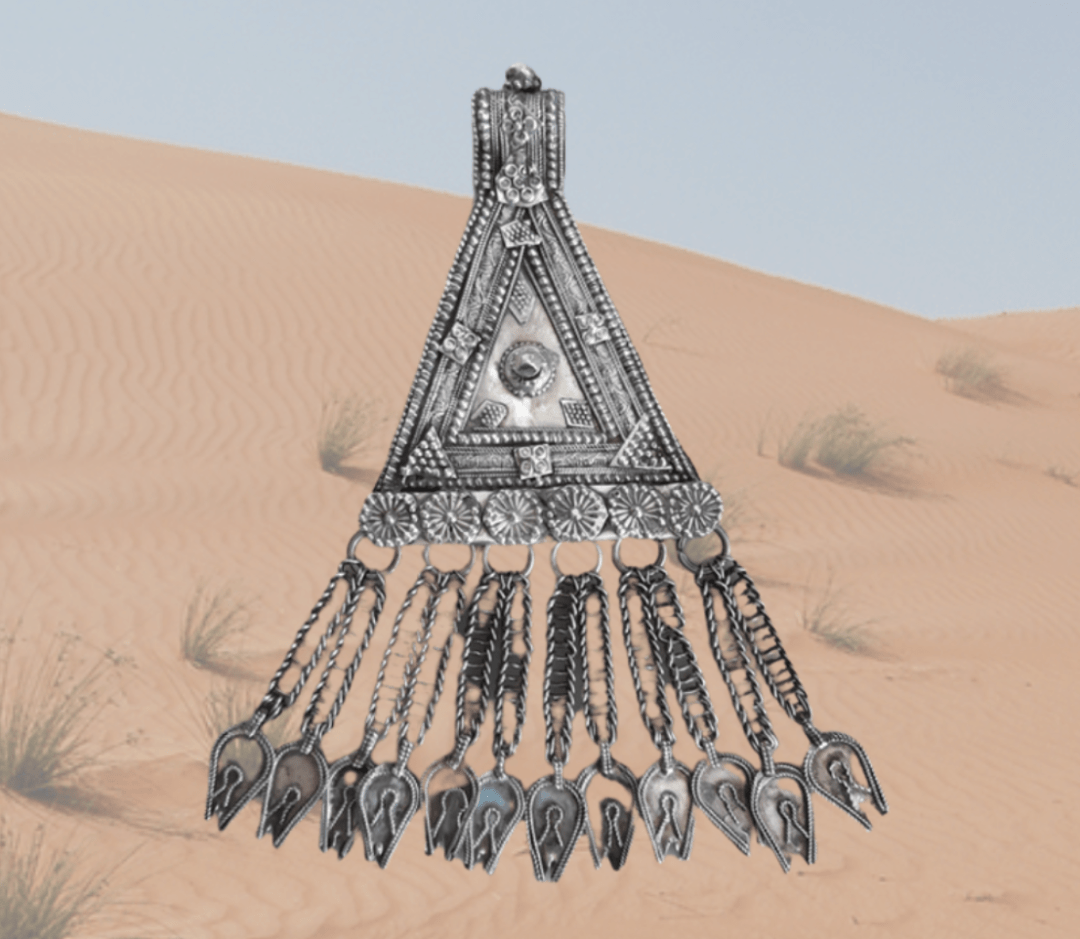
Featured below is a silver pendant from Oman, that would have been one of a pair. Both were worn on either side of the head, suspended from a leather or silver strap. This particular style of head jewellery was worn in the region of Sur. Now this pendant here has never been used. It feels sharp to the touch: the dangles are as edgy as the day they were made, and each raised decoration on the body of the ornament is still pristine. Yet, this item was purchased roughly 30 years ago.

The same is true for these five silver braid ornaments, also from Oman. Ornaments like these were worn in the region of Dhofar, but these five have never been worn as such. They come from the personal possessions of Shirley Temple-Black, and were most likely acquired during her years of service as a diplomat during the 1970’s and the 1980’s.

So are these real?

Yes, they are. An important thing to keep in mind is that by collecting vintage jewellery, you train your eyes to look specifically for signs of age. After all, collectors do not want to be duped into buying newly made copies that are passed off as vintage. That means that the absence of these signs of age (rounded edges, worn decoration, soft patina, to name but a few) casts doubt over the authenticity of a piece. Yet, there is a category of pieces that is new, but not produced recently.

The time of collecting

This category stems from the early days of collecting. Most traditional silver jewellery from the Arab world started to be collected in large numbers from the 1960’s onwards. The first wave was during the hippie-age, when many people flocked to the Middle East, a trend which then continued during the oil boom. That timeframe saw massive changes in clothing and adornment nearly everywhere in the world: traditional jewellery slowly ceased to be worn, but was still produced, old silver was traded in for gold, and jewellery items ended up for sale. This was before large scale tourism, before the Internet, and before the spike in interest for disappearing material culture: jewellery was still being created, but not especially for tourists, as a souvenir. Jewellery items newly bought in those years are now 60 years old.

The murky field of authenticity

Authenticity is one of the most debated topics within the field of material culture. A first observation is who determines what is, and what is not ‘authentic’ – I will talk about that in a future post. For jewellery, older objects are quicker to be accepted as authentic (‘this is at least 120 years old, it must be authentic’), but also in the past, things were passed off as traditional or specifically created to cater to the demand by others. Authenticity is not solely dependent on temporal aspects (age), but rather the intended interaction between the object and people is a vital aspect. Both jewellery examples shown above have been produced locally, to be part of a local attire that was still worn regularly, but were purchased by a non-local when they were still brand new. They are for all intents and purposes authentic parts of Omani culture: they just have never been used.

But how to discern between old-new and new-new…?

This category of newly made items that have been collected half a century ago depends mainly on sound documentation to attest its provenance. It’s a catch-22: without signs of age, it’s near impossible to tell whether it has been made yesterday or decades ago. Stylistic analysis may help: certain techniques are not mastered as well these days as half a century ago, the size of an object can be an indicator, or the materials used. But more than anything, this category depends on its documentation to connect it to its proper timeframe. So, if you own such a piece and you do remember more or less when and where you bought it, make a note of it. Very helpful are additions like an old photograph of the piece hanging on a wall in your house, for example, or a picture of you yourself wearing it. Both serve to confirm a timeframe when this piece was created, and help preventing misinterpretations when you are no longer there to share its story. This is especially important as this category has an unexpected added value.

A hidden value

Jewellery items like these might prove to possess an additional value: they are among the few surviving old pieces that are new. All jewellery once was new, of course, but after having been worn a lifetime, the surviving majority nowadays shows signs of wear. From a perspective of material studies, it is interesting to be able to compare a new item and a worn item that are of the same age. Having the original, newly made piece to compare to a similar piece that has been worn a lifetime provides another layer of information about the everyday life of the person who once wore this jewellery. Because after all, the story of jewellery is a story of people!

References

Authentic: of undisputed origin; genuine

For more on Omani silver jewellery, see www.omanisilver.com

Jones, S. & T Yarrow 2013, Crafting authenticity: An ethnography of conservation practice, in: Journal of Material Culture, March 2013, Vol.18(1), pp.3-26

Broekhoven & A. Geurds 2013. Creating authenticity : authentication processes in ethnographic museums. Sidestone Press (read online for free)

Sigrid van Roode

Sigrid van Roode is an archeologist, ethnographer and jewellery historian. She considers jewellery heritage and a historic source. She has authored several books on jewellery from North Africa and Southwest Asia, and on archaeological jewellery. Sigrid has lectured for the Society of Jewellery Historians, the National Museum of Antiquities in Leiden and the Sultan Qaboos Cultural Center, among many others. She curates exhibitions and teaches online courses on jewellery from North Africa & Southwest Asia.

Cleaning: what to think of

Cleaning: what to think of

How to avoid disaster

Cleaning: what to think of

Updated Jan 11, 2024

Cleaning jewellery can be so satisfactory! To see those layers of grime and dirt dissolve and the soft shine of silver reveal itself…and seeing your newly acquired item for the first time in all its splendour!

Cleaning jewellery is necessary from a maintenance point of view: it will help you prevent corrosion and subsequent damaging of your item. But, before you give your piece that first deep clean, here are four things you really need to consider!

Before you clean: consider information loss

Yes, the research begins even before it’s bath time! Those dirty patches and accumulations may actually contain part of the history of your piece.

Take these two Maria Theresia Thalers shown above for example: they have spent a lifetime together, which is visible in their wear pattern. Halfway the lower coin, a trace of blackish patina follows the curve of the upper coin. It allows you to place them exactly as they would have sat together, tightly pressed together.

I found these two in Jordan, and they have most likely been part of a Palestinian headdress: even though only these two coins remain, their wear pattern bears testimony to the piece they once belonged to.

Another example is this plait ornament from the Draa Valley, Morocco. The coral beads on top (look on the left and the right top beads of the ornament) still show patches of brownish paste.

This would have been scented paste, used to style and fragrance the hair for festive occasions. It no longer bears any fragrance, but its presence adds a visible memory of an invisible aspect of personal adornment that is all too easy to discard, and eventually forget, if you are not familiar with its existence in the first place.

Imagine scrubbing all of that history, scent, laughter and festivity vigourously off…!

Before you clean: write it all down

So what to do before you start cleaning your ethnic jewellery? The simplest way to document these bits and pieces of information is to take a picture before and after cleaning.

That can be as easy as taking a snap with your smartphone (I’ve got you covered with these 5 easy tips to make good jewellery photos with your phone). Include these before and after shots in your documentation: it’s always useful to have a record of any treatment of your pieces. Plus these make great content on social media, should you be looking for ideas.

Note down anything you’d want to record, for example if the layer you want to remove is sticky or dry, grainy or fine, its colour…

Finally, add a few notes on how you have cleaned it, with which products and utensils.

All of this may come in handy later, for example in the unhappy event your new jewellery starts to show a reaction to cleaning: having a record of what has been done with it, is instrumental in attempting any follow-up treatment.

Before you clean: consider the silver content

This is important! Especially for older pieces, a guaranteed silver content is not standard. The percentage of actual silver can vary greatly, and so do the components of copper, nickel or other materials.

Silver was obtained by melting down older pieces (with their variable compositions) and coins. Hallmarks indicating sterling silver (925), 800 or 600 have only been in use for a century or so.

Read more on the varying silver content of ethnic jewellery from North Africa and the Middle East and how to navigate descriptions here.

This is important when cleaning jewellery with no hallmarks or known silver content: you will want to know how your cleaning method will affect other metals in the mix, and how in turn this will impact your piece in general.

It is also why I generally avoid the toothpaste-method or the squeezed lemons-method: both can lead to too aggressive results and damage your jewellery. Who knows what exactly is in toothpaste these days, anyway?

Before you clean: get a handle on the materials in your jewellery

There is more than just the silver content to be aware of when cleaning jewellery. And that is also where your cleaning attemps may go epically wrong, so this, too, is important.

If your piece consists of other materials, be sure to familiarize yourself with their properties and to identify their vulnerabilities.

Coral cabochons on a bracelet for example, or coral beads in a necklace. Coral is a porous animal product (see more here), not to be confused with solid material like stones: the properties of this material bring a new set of parameters to the table. Using the wrong cleaning agent may cause your coral to sustain heavy damage.

Traditional jewellery from the Arab world can contain a plethora of materials that all come with their own challenges: teeth, horns, claws, wood, scented paste beads, textile backings, and not to forget the stringing itself.

When you come across a composite piece, it’s a good idea to have a good look at all elements before attempting to clean it. You may either want to take it apart completely and reassemble it later, or bring it to a professional restorer instead.

With these four tips, I hope you will enjoy a new look at what stories your jewellery holds, and how to make sure they remain a part of its history!

Wondering how to clean and what method will yield the best results? Read this post on cleaning jewellery: 3 proven methods you can use at home – with their pro’s and con’s!

More practical tips on managing your collection? Browse them all here!

Would you like to quote this article? Please do! Here’s how:

S. van Roode, [write the title as you see it above this post], published on the Bedouin Silver website [paste the exact link to this article], accessed on [the date you are reading this article and decided it was useful for you].

Sigrid van Roode

Sigrid van Roode is an archeologist, ethnographer and jewellery historian. Her main field of expertise is jewellery from North Africa and Southwest Asia, as well as archaeological and archaeological revival jewellery. She has authored several books on jewellery. Sigrid has lectured for the National Museum of Antiquities in Leiden, Turquoise Mountain Jordan, and many others. She provides consultancy and research on jewellery collections for both museums and private collections, teaches courses and curates exhibitions. She is not involved in the business of buying and selling jewellery, and focuses on research, knowledge production, and education only.

Silk Roads

Silk Roads

Silk Roads

Peoples, Cultures, Landscapes
cultural connections

Silk Roads

The Silk Roads…one of my favourite topics. The importance of Central Asia as a corridor for languages, inventions, sciences, and religions has been fundamental for the world we know today. As I traveled more and more through Central Asia, I gradually learned that for several centuries, this was the centre of the universe. I visited abandoned universities of the Middle Ages, marveled at astrolabia in museums (still can’t reproduce how they actually work, though) and explored both Greek and Buddhist complexes on the Uzbek-Afghan border on the same day. I followed the Oxus river all the way to its sources in the Tajik Pamir and (after I had recovered from a bout of altitude sickness) wondered how it could be that I still found myself within the reach of a 4th century Roman road map. Here, religions, technologies and people connected. On an unparalleled scale, writings from various cultures were translated into one and the same language, shared and improved upon. It is in this vast region that the foundations for many scientific methods and processes were laid, book printing enabled the spread of literature and scientific works even further, and art styles mingled and fused. In the last decade many excellent studies have appeared into this finely mazed, interconnected system of exchange. In 2019, Thames & Hudson added the heavy volume Silk Roads: Peoples, Cultures, Landscapes, edited by Susan Whitfield. And what a volume it is!

The approach chosen follows the various landscapes over and through which the networks existed. The main framework of the book are the sections Steppe, Mountains and Highlands, Deserts and Oases, Rivers and Plains, and Seas and Skies. I like how the landscape is the binding agent in this book, instead of the ubiquitous chronology. But what I really, really like is the how the editor has unlocked the rich variety in this book by cross-referencing material culture with categories in the table of contents. The material culture is divided over the categories cities/buildings/archaeological sites, ceramics and glass, coins and money, metalware and semi-precious stones, manuscripts, books and other writings, sculptures and paintings, textiles and ‘other’. Each of these is cross-referenced with the categories religion, military, clothing and accoutrement, and science. This allows you to search and find almost anything that meets your fancy, and I feel it perfectly illustrates the interconnectivity of the Silk Roads-system itself.

On to the lay-out: you will want to keep exploring these pages, as there is so much room for illustrations. The entire book is for the most part full-colour and shows sweeping views of the various landscapes, (details of) objects and maps. Every page is another invitation to read and see, to explore and learn.  Especially in this online day and age (because let’s face it, I’m writing this on a website and you’re here reading it) when investing in visuals in a book is not as self-evident as it used to be, this is a very welcome visual feast. I particularly enjoy the maps: I can look at them for hours, tracing how it all fits together. 

And besides photographs, what does this book offer? I would say it creates a larger context for an important part of history and puts individual finds in perspective. Over 75 contributors, each experts in their fields, have provided longer and shorter entries within the landscape framework. Each of the landscape chapters mixes a total of circa 20 angles in longer texts and box texts, in which specific objects or locations are the focus of attention. These are in turn tied in with the larger framework through references to other entries. One example is a well-known helmet found in the southern part of The Netherlands, highlighted in The Steppe and the Roman World. For The Netherlands, it is a unique find, but it is placed here in the larger context of cultural contacts between the Romans and the Sassanians. A Viking tapestry, found in Oseberg, shows a Buddhist ‘endless knot’, indicating contacts with Central Asia. That these existed is illustrated by means of the Samanid coin hoards, from current-day Uzbekistan and Tajikistan, found in Scandinavia as well as a bronze Buddha statuette found in Helgo, Sweden. The book links back and forth internally and externally to finds, ideas, technologies, religions and people connecting through time. What I particularly like is that every single entry ends with a few suggestions for further reading. It has definitely been a major piece of work for the editors to ensure that all of these bits and pieces of information are tied together instead of forming a loose bundle of trivia.  

The only thing that I found interesting but could do without, is the short introduction in the beginning about early photography in Central Asia. As much as I like old photographs and the pioneering days of this once new documentation art, this introduction did not do much for me in the overall view on the Silk Roads network – but it does make for beautiful illustrations.

All in all, this is a book to explore. Due to its encyclopedic approach with a multitude of entries, it will not be a book that you will read in one go from cover to cover. Rather, I found myself cherrypicking topics that I wanted to read about from that wonderfully cross-referenced table of contents, and then wandering from there throughout the book. An Islamic glass dish found in China led me to Buddhist relic keeping, and from Parthian textiles on the steppe I found myself back in Palmyra.  Silk Roads allows you to explore many narratives from many disciplines. For me, this way of weaving topics, places, people and cultures reflects the multi-layered capacity of history: there is not one linear story, not one fixed set of events. A book to treasure on many rainy afternoons!

Silk Roads: Peoples, Cultures, Landscapes. Edited by Susan Whitfield. 480 pages, 450 colour images and 200 b/w images.

See more images and views inside the book on the publishers’ website here.

The book is a gift from one of the contributors to the volume.