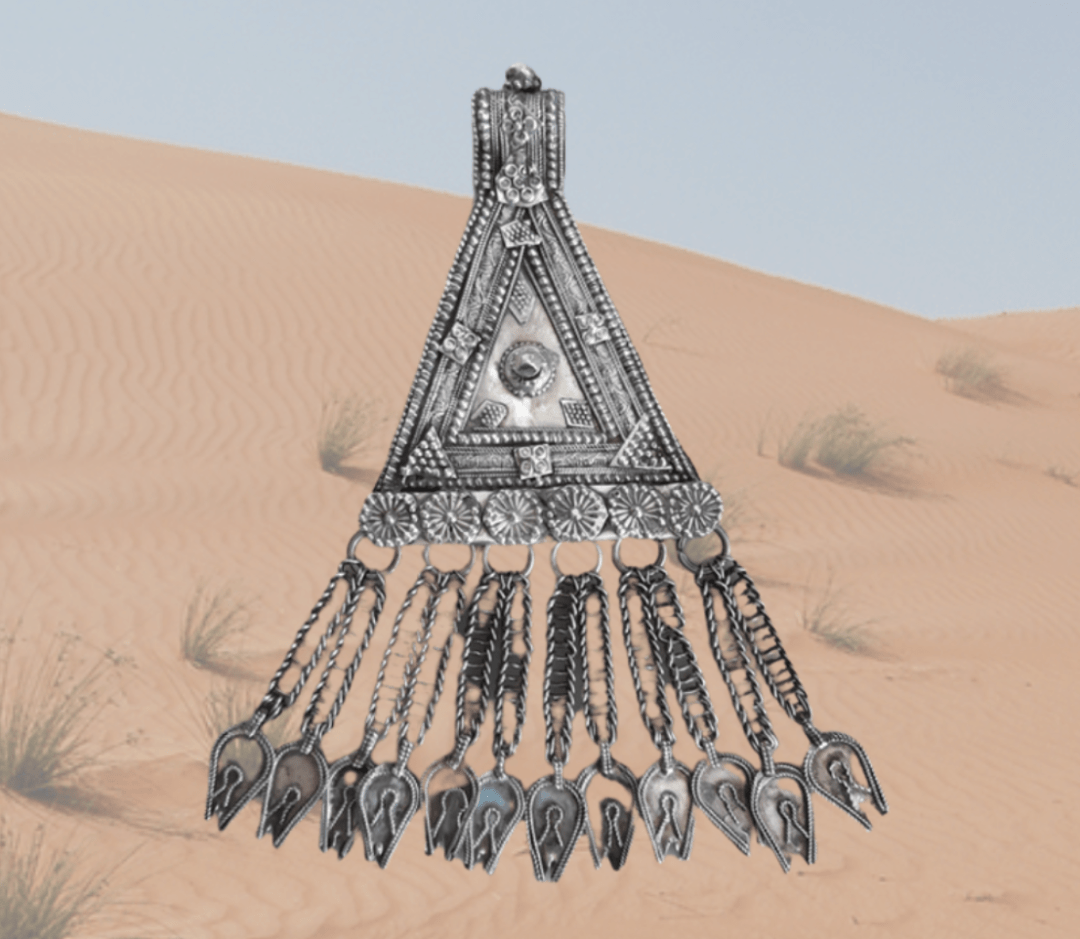
How to clean ethnic silver

How to clean ethnic silver

three methods

How to clean ethnic silver

Updated Jan 10, 2024

How to clean ethnic silver jewellery? And should silver even be cleaned in the first place? This article gives 3 practical methods – and what mistakes to avoid!

Should I clean ethnic silver jewellery?

Jumping right in here: that dull layer with which you found it in that antique store or in that dusty market stall…? That is not ‘authentic’ or ‘original’: the previous wearer would have taken pride in her jewellery glinting in the sunlight. Wearing it on a daily basis would itself have contributed to that shine. So yes, I do recommend to clean your jewellery.

Also, that dark coating you may have found it with, is not ‘patina’: this is just plain dirt. Seeing people claim that you should not clean darkened, dusty silver because of its ‘patina’ just makes me want to scream, in all honesty. Such lack of insight is actually endangering the quality of your jewellery.

Over-cleaning, however, should be avoided. Once the major layers of dirt and grime have been removed, a little tarnish actually protects your silver. Every time you clean it, you remove just the tiniest bit of the surface, leaving your silver exposed to another ‘tarnish-attack’.

You will want to keep an eye on how it develops, but don’t clean it too often.

And finally: proper cleaning of a heritage item is a professional’s job. You don’t attempt to restore a painting by yourself, either, right? The above considerations by the way all stem from my experience in the museum world. That includes the fabulous work restorers do, and how wrong choices regarding object maintenance gives them nightmares.

In any case: when you do need to clean silver, here are 3 methods that you can use at home, along with their advantages and disadvantages.

Before you start cleaning your ethnic jewellery…

read this, if you haven’t already. There are a few things to consider before cleaning, that have to do with the silver content of your jewellery, loss of information and proper documentation.

The tips I’m sharing with you below are relevant to jewellery entirely made of good silver. If your jewellery contains any other materials such as wood, enamel, coral, beads, or is of an unknown alloy, bring it to a professional instead.

Another check to do before you start cleaning is the construction of the piece. Hollow pieces, such as amulet containers or anklets, should not be in contact with water: when water gets in, it is very difficult to get out and it may damage your piece from the inside out. For these, I recommend seeking help of a professional cleaner, too.

Because as I said earlier, cleaning and restoring jewellery is an actual profession. It requires years of study and a serious understanding of chemistry, metallurgy, gemmology and much more.

Anything more complex than a solid silver piece benefits from the care of a professional, so if you do own complex or composite pieces, or are having doubts whether your should attempt to clean anything yourself: do yourself a favour and treat your jewellery to a spa day with someone who knows what they’re doing. Ok?

Method 1: cleaning cloth

Silver can show discoloration after a while. It gets a little duller, and may show a yellowish or dark hue. This is easily remedied by buffing it with a silver cleaning cloth: all you do is rub firmly. Usually when your fingers start to hurt, this is a good sign you’re well on your way and you will see the silver surface return to its soft shimmer. This is sufficient for most jewellery as part of your regular upkeep.

Pro: easy to do

Con: basically nothing, although those fingers hurting is real

Method 2: polishing

When silver has turned black, you may need to polish it using an agent. Precipitated chalk works wonders. The chalk needs to be mixed with water to create a thick paste. Start with three teaspoons of chalk and add a quarter to half a teaspoon of water, stir the water in and continue to add small amounts of water as much as needed until you have a paste.

Rub the paste on the silver using a cotton pad (or a super soft toothbrush, like for babies, for intricate silverwork such as granulation) and gently polish the surface. After polishing, rinse the object thoroughly and make sure no dried chalk is left.

This method is unsuitable for hollow objects, as the rinsing may cause water and chalk residu to end up inside your ornament. Bring these to a professional.

Pro: works really wel

Con: chalk needs to be extremely finely ground to avoid scratching, your brush may also cause scratching, intricate designs need to be rinsed thoroughly, can not be used on hollow objects. Removes a bit of the surface: it will tarnish faster if not stored well.

Method 3: baking soda

The black tarnish can also be removed by submerging it in a baking soda bath. This reverses the process that caused the tarnishing.

Line a bowl with aluminum foil, add a couple of tablespoons of baking soda, sprinkle in some salt and add boiling water. When the water calms down after bubbling, submerge your silver items and let soak.

Again: do not use this method on items that contain anything else than silver, like beads, coral, enamel etcetera, or on hollow pieces.

Once you put your item in, you will see it cleaning up within seconds. Take the silver out as soon as the tarnish disappears (use gloves!), rinse under lukewarm water, dry thoroughly with a soft cloth and polish with a polishing cloth.

Pro: cleans very fast 

Con: unsuitable for hollow objects, pieces you don’t know the silver content of, and pieces with anything else than silver. Removes a bit of the surface: it will tarnish faster if not stored well.

Cleaning ethnic jewellery: keep track of what you did

And finally, make a note of your cleaning treatment in your object files. What you will want to note here are the date and the type of treatment, and if needed a before-and-after picture. This will help you keep up with  your routine checks on your collection: silver should be polished as little as possible, and a cleaning log helps to keep track!

Cleaning ethnic silver jewellery: the round-up

So, as you see, the decision to clean ethnic jewellery is one that requires some thought. Don’t start overcleaning it, but don’t let it get too dirty, either. One thing is certain: leaving it grimy is not authentic, and even outright damaging to your jewellery. And when in doubt, bring your jewellery to a professional restorer – this way, you’ll have the best of both worlds!

More tips for collectors? Browse them all here!

Join the Jewellery List and find regular jewellery news in your inbox!

References

Read more here on treatment of silver and copper alloy objects (opens a pdf)


Would you like to quote this article? Please do! Here’s how:

S. van Roode, [write the title as you see it above this post], published on the Bedouin Silver website [paste the exact link to this article], accessed on [the date you are reading this article and decided it was useful for you].

Sigrid van Roode

Sigrid van Roode is an archeologist, ethnographer and jewellery historian. Her main field of expertise is jewellery from North Africa and Southwest Asia, as well as archaeological and archaeological revival jewellery. She has authored several books on jewellery. Sigrid has lectured for the National Museum of Antiquities in Leiden, Turquoise Mountain Jordan, and many others. She provides consultancy and research on jewellery collections for both museums and private collections, teaches courses and curates exhibitions. She is not involved in the business of buying and selling jewellery, and focuses on research, knowledge production, and education only.

Collecting ethnic jewellery: 4 filters

Collecting ethnic jewellery: 4 filters

collecting traditional jewellery

Collecting ethnic jewellery: 4 filters you may not be aware of

Collecting jewellery and dress: we do it because we believe these items to be important, and we want to ensure their passing on into the future. But there is one aspect of collecting that can turn it into a double-edged sword. On the one hand, yes, these items sometimes only survive because of collecting. But an overlooked aspect of collecting is its other side: collecting inevitably is destructive as well. How does that work, and should we be worried?

Selection filter 1: the course of history

First off, no material culture survives in its entirety. That is already visible within your own lifetime: who still has everything (and I mean everything) like clothing, toys, books etc. from their youth? At some point, you have decided to keep some things and give others away. A process that repeats itself again and again: selecting is a natural process. That goes for adornment and dress, too. Whether it is family heirlooms passed down generations or pieces offered for sale to cultural outsiders, whatever survives to this day is based on selections. Even what you inherit from your grandmother is her personal selection: at least I’m assuming she did not own all jewellery in existence.⁠ So, when you collect jewellery, this is already a selection as a result of the choices made during the wearer’s life. These choices do not have to be voluntarily: people displaced as a result of war and violence may not have been able to hang on to anything at all.

Jewellery selection filter 2: demand and supply

Whatever ends up being offered to buyers, is filtered a second time. This is where it gets interesting. Because buyers get offered what sells: as with any market, here as well demand is tied to offer.⁠ And that second filter is incredibly important. Pieces that do not ‘sell well’ slowly disappear from the material record. An example is jewellery that has been partly dismantled when its wearer needed to sell some of it. These ‘damaged goods’ are not always recognized for what they are: a historic source.⁠ After all, buyers, especially if these are cultural outsiders, rarely appreciate dented and broken pieces. As a result, these are the first to go. They are melted down, reused, and any material traces of the use of jewellery as financial asset and savings account vanish with them.

Jewellery selection filter 3: focusing on published, well-known pieces

The next stage is that the selected pieces, the ones that sell well, then become the norm. These are the pieces that get shown in exhibitions, that are published in books and shared online. That fame creates a third filter, because it increases demand into these better-known pieces. The flip side of this is that relatively unknown pieces never make the cut: they do not sell well, as they are not all that familiar to the prospective buyer. I often get asked whether a certain piece is ‘real’ as it has no parallels in books, and I know of several books that are used as a collectors’ manual. That is not to say books are useless! Quite the contrary, I love books and all sorts of publications on jewellery: the more the better to help spread awareness that this is heritage. The point is to be aware that there is more out there than books can accommodate.

Another symptom is the rejection of pieces that are not exactly similar to well-known parallels: a whole new set of parameters for ‘authentic’ pieces emerges based on publications, while the original wearers did not consider such distinctions relevant and worked with what they had at hand. It’s an endless loop that results in the gradual loss of both things and information.

Jewellery selection filter 4: collecting only things, not their context

That last element, information, is the fourth filter. The focus on collecting objects and not necessarily on all the information that comes with it, in turn deletes that information over time. Things without context are just that: random things. They lose their capacity to speak and their function as a historic source. If collectors don’t write down what they know about their pieces, how will the next generation know what they’re looking at…?⁠ I have addressed a few examples of how that lack of knowledge results in misinformation being spread here. It is incredibly important to preserve not only things, but also what they stand for – while being aware that this is only a fraction of a much wider world.

Building a meaningful jewellery collection: actionable things you can do today

Collecting is by definition selecting. We only see part of the material culture, and that does not even have to be a representative part. No matter how beautiful or extensive a collection is: you’re always working with a result of a chain of selections, never with the original dataset. That is simply the way it is, and thank goodness that not every single thing is kept – what would we do with it? My point is that it is important to be aware of this process when collecting, buying or selling.

Your actions in each of these steps actively contribute to the safeguarding of heritage jewellery. Here are a few things you can start with today:

Write down those stories of your jewellery travels.

Digitize those receipts (if you have any).

Jot down a few lines in your notebook when a seller shared a piece of information with you.

Download my free guide to organize your collection step by step here and start building not just a collection, but your legacy.

Every little bit helps. It’s in these seemingly small acts that you can contribute a great deal to the preserving of jewellery and the world it comes from!

Do you own a collection? Please do try and document it as much as possible. Every little note helps! A free guide on how to get started with that is here.

Are you wondering how your collection might benefit the communities whose heritage this is? Please consider the work of the Qilada Foundation, my non-profit initiative aimed at reconnecting jewellery collections with their communities of origin.

References

An introductory article on the history of collecting as a phenomenon is W.G.Burgess 2020, State of the Field: The History of Collecting, in: History

The Society for the History of Collecting covers the concept collecting from many angles: see more here

Sigrid van Roode

Sigrid van Roode is an archeologist, ethnographer and jewellery historian. She considers jewellery heritage and a historic source. She has authored several books on jewellery from North Africa and Southwest Asia, and on archaeological jewellery. Sigrid has lectured for the Society of Jewellery Historians, the National Museum of Antiquities in Leiden and the Sultan Qaboos Cultural Center, among many others. She curates exhibitions and teaches online courses on jewellery from North Africa & Southwest Asia.

Talking with…Dr Reem el Mutwalli

Talking with…Dr Reem el Mutwalli

talking with

Dr. Reem el-Mutwalli

In 2021, I had the pleasure of speaking with Dr. Reem el Mutwalli, founder of the Zay Initiative. Dr. El Mutwalli has over 30 years of experience in art and cultural heritage. Since the early 1980s, at the Cultural Foundation Abu Dhabi, she has been contributing to the establishment of cultural & art departments; advising on museum displays, leading and driving projects, hosting seminars, undertaking cultural tasks of different capacities and curating exhibitions. And in addition to all that, she is a most warm and caring person who generously shares her vast knowledge! We talked about collecting, about sharing and about the responsibilities that come with managing a unique collection.

Your core collection is the Sultani Collection. What made you decide to invest in a collection in the first place?

To clarify The Sultani Collection (presently at 530 articles) relates to the United Arab Emirates (UAE) in particular and it is the core of the larger more comprehensive Zay collection (1350 and growing) that aspires to encompass samples from the entire Arab world.

I began gathering the UAE collection (Sultani) organically as I grew up in the UAE and personally experienced wearing many of them. Eventually, as I worked on my doctorate, I found myself in the fortunate position of being the recipient of many of the dresses illustrated in my thesis that later was published in a book; Sultani, traditions renewed; Changes in Women’s Traditional Dress in the UAE during the reign of Shaykh Zâyid bin Sultân Âl Nahyân 1966-2004. Making it the first and only published collecting in the UAE.

I think a key aspect of what my mother, Buthaina Al Kadi, instilled in me is a keen eye for constantly searching, identifying and valuing traditional objects as well as the general appreciation of art and culture. Continuing this notion of preservation of tradition and the protection of heritage is a major component of what the Zay Initiative stands for and where much of my focus lies at present.

You have an active call on the platform for people to participate and share their heritage, be it actual pieces of dress or the stories that go with it. How is the response so far? What trends do you see developing since you first launched the initiative?

Having published the book and as I sporadically exhibited the collection, I noticed this attracted many followers and with the onset of the web & social media world I started first the Instagram account @sultanibookuae. This generated a direct and immediate interactive platform populated with daily dialogues related to the topic. What used to take me years in research became at my fingertips in hours. Live arguments and varied answers to questions stimulated conversation between followers that led to connections with likeminded people. This snowballed to people seeking me out to donate items belonging to their loved ones. Or directing me to individuals that might have such items to seek out.

Let me share an example of Shaikha al Suwaidi, a young lady in her twenties, who approached me through Instagram. She wanted to donate her paternal grandmother’s Kandūrah (UAE tunic dress). Her grandmother Hamdah al Miri had passed away in her eighties in 1980. She had held on to this article of dress and in 2018 found in us the right custodians to honour her memory. She had one condition though, to keep a vial of her grandmother’s scent together with this article, which touched me even more as I am a believer in the power of scent and memory. I drove three hours to get to the remote area where Shaikha lives to collect this article, I got to meet her mother and bond with both. I believe it is these human moments that enrich me personally and illustrates the intrinsic value of the Zay Initiative. You can view this object on the Zay web site in The Collection (ZI 500256 K UAE).

Consequently, it is this body of cultural and historical significance that prompted the creation of the second Instagram account @thezayinitiative widening our reach, as we began to engage with a larger audience, collect facts and document Arab culture. This then culminated into the blog and the digital archive collectively creating The Zay Initiative.

What challenges do you encounter in managing such a large collection?

Collecting as a hobby is one thing and collecting with the intention to seriously document and share culture is another. The latter comes with great responsibility and quite an institutional perspective. Crossing that bridge is a daily learning process which is both enlightening and overwhelming at the same time.

Deciding to create the initiative as a non-profit organization grounded the project, yet opened doors to a whole set of administrative, technical and manpower obligations. From what was once a personal passion overnight evolved into a continuous team effort that requires dedicated and spirited individuals to record, catalogue, maintain, preserve, store, photograph, animate, research, write, translate, edit, create content, input data etc.. the list is endless.

Leading to the need to look beyond the present, in order to find the experts and the funds to sustain the work, to make it available to the general public and generations to come. It is truly a totally consuming endeavor that requires passion, perseverance and lots and lots of patience!

What roles do you envisage for the collection in the future? In your ideal vision, what will The Zay Initiative have developed into, say 10 years from now?

Ultimately the dream is to become a beacon for the art of Arab dress or fashion. I am always confronted by the seeming split between traditional dress history and the contemporary fashion industry. However, I see them go very much hand in hand, for the later cannot exist without the former. Especially after we come out of this global pandemic, I feel the new normal will more likely prompt us to reflect and appreciate the past, look at ways we can recycle and sustain what we inherit and use it to find better solutions for our shared future.

I feel the Zay Initiative is an ideal vassal to help industry learn from history for true creativity to flourish. But as the saying goes: the journey of a thousand miles begins with one step! We are taking it one step at a time as we fulfill what we identified as our 5 pillars:

  • Collect, document and conserve Arab dress and adornment.
  • Present and contextualize it through a digital archive and blog.
  • Encourage intercultural dialogue to highlight a shared humanity.
  • Inspire and educate designers to create for a sustainable future.
  • Empower women regionally and globally by bringing their untold stories to life.

Having said this, I feel that the Zay Initiative is a collective work open to anyone who is passionate about this cause to participate or contribute. Be it as you do, by writing one blog a month, I really can’t thank you enough for the effort you put into this. Volunteering to help with back end work. Becoming a friend of the Zay Initiative, or subscribing to our mailing list, engaging with us through social media and spreading the word. Donating an article to celebrate a loved one, or generously donating (we have just added a donate button where you can give as little as the cost of one cup of coffee a week) to help us sustain the legacy.

Tell us a bit more about your plans for the online archive? It is already established and growing, but I’m sure there is much more in store for everyone interested in traditional dress from the Arab world in the future!

We call it The Collection (Digital archive), where the vision for this dual language digital platform (as it can be accessed in both English and Arabic), stems from the idea of a memory closet where visually it delineates details of each article and brings it to life by recording the names and narrating the stories of those who created or wore it, thus preserving it through out time. Many articles will further be animated through short-narrated video clips.

On another level it serves as a reliable platform for scholars and designers to reference accurate information as well as find inspiration. As you know the Arab world is vast and encompasses a multitude of ethnicities and influences that directly lead to variances in terms and terminologies. Such discrepancies are difficult to navigate and can easily be misunderstood.

Interestingly, the body of work in this field was written in 1845 by Dozy: Dictionnaire détaillé des noms des vêtement chez les arabes. Since then not much has developed. This prompted us to work on a glossary to clarify and at the same time preserve these terms. It is exhilarating that today through the Zay Initiative we seek to provide such a global digital platform that I hope can continue to grow.

For more information, see

The Zay Initiative: www.zay.org

Sultani Book: Sultani, traditions renewed; Changes in Women’s Traditional Dress in the UAE during the reign of Shaykh Zâyid bin Sultân Âl Nahyân 1966-2004.

Brand New Vintage

Brand New Vintage

Brand New Vintage

is it real or not?
pieces in the twilight zone

Brand New Vintage

For many collectors, a key aspect is whether a piece of jewellery has been used. Signs of wear are welcomed (to a certain extent, though; damage is often a bridge too far), and jewellery pieces that do not display any wear are sometimes dismissed as ‘too new’. With the presence of wear and age, it seems, comes the notion of authenticity. There is a category in between however, that is both brand new and old: pieces that have been purchased when they were new, but that have never been used. Is wear a reliable factor in determining authenticity?

Two examples

Featured below is a silver pendant from Oman, that would have been one of a pair. Both were worn on either side of the head, suspended from a leather or silver strap. This particular style of head jewellery was worn in the region of Sur. Now this pendant here has never been used. It feels sharp to the touch: the dangles are as edgy as the day they were made, and each raised decoration on the body of the ornament is still pristine. Yet, this item was purchased roughly 30 years ago.

The same is true for these five silver braid ornaments, also from Oman. Ornaments like these were worn in the region of Dhofar, but these five have never been worn as such. They come from the personal possessions of Shirley Temple-Black, and were most likely acquired during her years of service as a diplomat during the 1970’s and the 1980’s.

So are these real?

Yes, they are. An important thing to keep in mind is that by collecting vintage jewellery, you train your eyes to look specifically for signs of age. After all, collectors do not want to be duped into buying newly made copies that are passed off as vintage. That means that the absence of these signs of age (rounded edges, worn decoration, soft patina, to name but a few) casts doubt over the authenticity of a piece. Yet, there is a category of pieces that is new, but not produced recently.

The time of collecting

This category stems from the early days of collecting. Most traditional silver jewellery from the Arab world started to be collected in large numbers from the 1960’s onwards. The first wave was during the hippie-age, when many people flocked to the Middle East, a trend which then continued during the oil boom. That timeframe saw massive changes in clothing and adornment nearly everywhere in the world: traditional jewellery slowly ceased to be worn, but was still produced, old silver was traded in for gold, and jewellery items ended up for sale. This was before large scale tourism, before the Internet, and before the spike in interest for disappearing material culture: jewellery was still being created, but not especially for tourists, as a souvenir. Jewellery items newly bought in those years are now 60 years old.

The murky field of authenticity

Authenticity is one of the most debated topics within the field of material culture. A first observation is who determines what is, and what is not ‘authentic’ – I will talk about that in a future post. For jewellery, older objects are quicker to be accepted as authentic (‘this is at least 120 years old, it must be authentic’), but also in the past, things were passed off as traditional or specifically created to cater to the demand by others. Authenticity is not solely dependent on temporal aspects (age), but rather the intended interaction between the object and people is a vital aspect. Both jewellery examples shown above have been produced locally, to be part of a local attire that was still worn regularly, but were purchased by a non-local when they were still brand new. They are for all intents and purposes authentic parts of Omani culture: they just have never been used.

But how to discern between old-new and new-new…?

This category of newly made items that have been collected half a century ago depends mainly on sound documentation to attest its provenance. It’s a catch-22: without signs of age, it’s near impossible to tell whether it has been made yesterday or decades ago. Stylistic analysis may help: certain techniques are not mastered as well these days as half a century ago, the size of an object can be an indicator, or the materials used. But more than anything, this category depends on its documentation to connect it to its proper timeframe. So, if you own such a piece and you do remember more or less when and where you bought it, make a note of it. Very helpful are additions like an old photograph of the piece hanging on a wall in your house, for example, or a picture of you yourself wearing it. Both serve to confirm a timeframe when this piece was created, and help preventing misinterpretations when you are no longer there to share its story. This is especially important as this category has an unexpected added value.

A hidden value

Jewellery items like these might prove to possess an additional value: they are among the few surviving old pieces that are new. All jewellery once was new, of course, but after having been worn a lifetime, the surviving majority nowadays shows signs of wear. From a perspective of material studies, it is interesting to be able to compare a new item and a worn item that are of the same age. Having the original, newly made piece to compare to a similar piece that has been worn a lifetime provides another layer of information about the everyday life of the person who once wore this jewellery. Because after all, the story of jewellery is a story of people!

References

Authentic: of undisputed origin; genuine

For more on Omani silver jewellery, see www.omanisilver.com

Jones, S. & T Yarrow 2013, Crafting authenticity: An ethnography of conservation practice, in: Journal of Material Culture, March 2013, Vol.18(1), pp.3-26

Broekhoven & A. Geurds 2013. Creating authenticity : authentication processes in ethnographic museums. Sidestone Press (read online for free)

Sigrid van Roode

Sigrid van Roode is an archeologist, ethnographer and jewellery historian. She considers jewellery heritage and a historic source. She has authored several books on jewellery from North Africa and Southwest Asia, and on archaeological jewellery. Sigrid has lectured for the Society of Jewellery Historians, the National Museum of Antiquities in Leiden and the Sultan Qaboos Cultural Center, among many others. She curates exhibitions and teaches online courses on jewellery from North Africa & Southwest Asia.

Cleaning: what to think of

Cleaning: what to think of

How to avoid disaster

Cleaning: what to think of

Updated Jan 11, 2024

Cleaning jewellery can be so satisfactory! To see those layers of grime and dirt dissolve and the soft shine of silver reveal itself…and seeing your newly acquired item for the first time in all its splendour!

Cleaning jewellery is necessary from a maintenance point of view: it will help you prevent corrosion and subsequent damaging of your item. But, before you give your piece that first deep clean, here are four things you really need to consider!

Before you clean: consider information loss

Yes, the research begins even before it’s bath time! Those dirty patches and accumulations may actually contain part of the history of your piece.

Take these two Maria Theresia Thalers shown above for example: they have spent a lifetime together, which is visible in their wear pattern. Halfway the lower coin, a trace of blackish patina follows the curve of the upper coin. It allows you to place them exactly as they would have sat together, tightly pressed together.

I found these two in Jordan, and they have most likely been part of a Palestinian headdress: even though only these two coins remain, their wear pattern bears testimony to the piece they once belonged to.

Another example is this plait ornament from the Draa Valley, Morocco. The coral beads on top (look on the left and the right top beads of the ornament) still show patches of brownish paste.

This would have been scented paste, used to style and fragrance the hair for festive occasions. It no longer bears any fragrance, but its presence adds a visible memory of an invisible aspect of personal adornment that is all too easy to discard, and eventually forget, if you are not familiar with its existence in the first place.

Imagine scrubbing all of that history, scent, laughter and festivity vigourously off…!

Before you clean: write it all down

So what to do before you start cleaning your ethnic jewellery? The simplest way to document these bits and pieces of information is to take a picture before and after cleaning.

That can be as easy as taking a snap with your smartphone (I’ve got you covered with these 5 easy tips to make good jewellery photos with your phone). Include these before and after shots in your documentation: it’s always useful to have a record of any treatment of your pieces. Plus these make great content on social media, should you be looking for ideas.

Note down anything you’d want to record, for example if the layer you want to remove is sticky or dry, grainy or fine, its colour…

Finally, add a few notes on how you have cleaned it, with which products and utensils.

All of this may come in handy later, for example in the unhappy event your new jewellery starts to show a reaction to cleaning: having a record of what has been done with it, is instrumental in attempting any follow-up treatment.

Before you clean: consider the silver content

This is important! Especially for older pieces, a guaranteed silver content is not standard. The percentage of actual silver can vary greatly, and so do the components of copper, nickel or other materials.

Silver was obtained by melting down older pieces (with their variable compositions) and coins. Hallmarks indicating sterling silver (925), 800 or 600 have only been in use for a century or so.

Read more on the varying silver content of ethnic jewellery from North Africa and the Middle East and how to navigate descriptions here.

This is important when cleaning jewellery with no hallmarks or known silver content: you will want to know how your cleaning method will affect other metals in the mix, and how in turn this will impact your piece in general.

It is also why I generally avoid the toothpaste-method or the squeezed lemons-method: both can lead to too aggressive results and damage your jewellery. Who knows what exactly is in toothpaste these days, anyway?

Before you clean: get a handle on the materials in your jewellery

There is more than just the silver content to be aware of when cleaning jewellery. And that is also where your cleaning attemps may go epically wrong, so this, too, is important.

If your piece consists of other materials, be sure to familiarize yourself with their properties and to identify their vulnerabilities.

Coral cabochons on a bracelet for example, or coral beads in a necklace. Coral is a porous animal product (see more here), not to be confused with solid material like stones: the properties of this material bring a new set of parameters to the table. Using the wrong cleaning agent may cause your coral to sustain heavy damage.

Traditional jewellery from the Arab world can contain a plethora of materials that all come with their own challenges: teeth, horns, claws, wood, scented paste beads, textile backings, and not to forget the stringing itself.

When you come across a composite piece, it’s a good idea to have a good look at all elements before attempting to clean it. You may either want to take it apart completely and reassemble it later, or bring it to a professional restorer instead.

With these four tips, I hope you will enjoy a new look at what stories your jewellery holds, and how to make sure they remain a part of its history!

Wondering how to clean and what method will yield the best results? Read this post on cleaning jewellery: 3 proven methods you can use at home – with their pro’s and con’s!

More practical tips on managing your collection? Browse them all here!

Would you like to quote this article? Please do! Here’s how:

S. van Roode, [write the title as you see it above this post], published on the Bedouin Silver website [paste the exact link to this article], accessed on [the date you are reading this article and decided it was useful for you].

Sigrid van Roode

Sigrid van Roode is an archeologist, ethnographer and jewellery historian. Her main field of expertise is jewellery from North Africa and Southwest Asia, as well as archaeological and archaeological revival jewellery. She has authored several books on jewellery. Sigrid has lectured for the National Museum of Antiquities in Leiden, Turquoise Mountain Jordan, and many others. She provides consultancy and research on jewellery collections for both museums and private collections, teaches courses and curates exhibitions. She is not involved in the business of buying and selling jewellery, and focuses on research, knowledge production, and education only.

5 must haves

5 must haves

Study jewellery like a boss

5 must-haves

Updated Jan 12, 2024

As a jewellery researcher, I have found that jewellery pops up in the most unexpected places! It’s why I carry a few items around in my handbag that have proven to come in very handy when there is jewellery to be looked at. They are lightweight, easy to bring along and indispensable for impromptu jewellery encounters.

1) Gloves

Handling silver, especially when it is not cleaned but still dirty and dusty, blackens your fingers. Apart from that, your fingers leave grease and stains on the silver in return. I always carry a pair of bamboo gloves: these are lightweight and breathing, and do not feel as uncomfortable as rubber gloves. I found these with a shop in medical supplies for burned skin.

2) Magnifier

To see just a little more detail, a magnifier is indispensable. Checking hallmarks, decoration details and damage becomes easier with only a little magnification of 5x. I carry an antique magnifier that I found in a thriftstore, but a jeweller’s loupe is a must-have!

3) Notebook (the unplugged version)

I always carry a small notebook to jot down everything: book titles, for example, but also details of jewellery I come across, information from museum labels in an exhibition, or notes to go with photos I take, to remind myself what the purpose of the picture was.

4) Photo scale and colour ruler

A lightweight ruler is perfect for photographing smaller pieces of jewellery, like the pendants of my PhD-research for example. A 45 degrees-angle makes straightening out photos on a laptop much easier and the colourscheme helps with calibrating the image.

5) Polishing cloth

This is available in every jewellery store and ideal for a quick first rub. When you rub away a layer of dirt and the material underneath becomes visible, it is easier to distinguish between base metal and silver: silver will show its characteristic glow when rubbed.

And a bonus must-have!

Finally, also practical are hand wipes, if you are somewhere where washing hands is not immediately possible. All of this takes up little or no space in your purse, but allows you to get an amazing amount of basic observation and registration work done with it!

Would you like to quote this article? Please do! Here’s how:

S. van Roode, [write the title as you see it above this post], published on the Bedouin Silver website [paste the exact link to this article], accessed on [the date you are reading this article and decided it was useful for you].

Sigrid van Roode

Sigrid van Roode is an archeologist, ethnographer and jewellery historian. Her main field of expertise is jewellery from North Africa and Southwest Asia, as well as archaeological and archaeological revival jewellery. She has authored several books on jewellery. Sigrid has lectured for the National Museum of Antiquities in Leiden, Turquoise Mountain Jordan, and many others. She provides consultancy and research on jewellery collections for both museums and private collections, teaches courses and curates exhibitions. She is not involved in the business of buying and selling jewellery, and focuses on research, knowledge production, and education only.