Engraved Gems

Engraved Gems

the guy ladriere collection

Engraved Gems

One of the most elusive forms of adornment from Antiquity are engraved gems. They existed in large numbers and many have survived to this day, but as these were eminently portable objects, they often lack context. Stones were taken out of rings and pendants to be fashioned into another jewel, and endless cycle that continues until today. By studying engraved gems carefully however, there is a lot to be learned about the world they come from. L’École, School of Jewelry Arts, exhibited a large private collection in 2022, accompanied by the book Engraved Gems. Cameos, Intaglios and Rings from the Guy Ladrière Collection.


This large and beautifully designed book starts out with an interview with the collector himself. The choices and preferences of the collector are a most important element of any collection, as they are imperative to our understanding what the collection represents. Where the major and important collection of cameos by Derek Content for example was built specifically to be representative and show the full range of quality found across the Empire [1], in the interview with Guy Ladrière we learn that his choices were based on beauty and personal preferences. That results in a different selection, and I enjoyed the passion shining through in the interview: many collectors will relate to his anecdotes of having, holding, missing out on, and wearing.

The first chapter takes us along in the world of words: what exactly is the difference between cameo and intaglio again, how were they created and from which stones? The treaty on terminology used for a variety of gemstones is particularly useful as it presents an overview of the convoluted history of these terms, and clearly states which terms will be used throughout the book. Now as terminology is notoriously complicated, I’m sure gemmology experts will have their own opinion of these choices, but specifying what is meant by ‘agate’, ‘carnelian’ etc. in the present volume does provide clarity for the understanding of the contents.

One thing that struck me as odd in this chapter is the statement, regarding garnets, that the trade routes to the East disappeared in the early Middle Ages, and so garnets were collected from Bohemia and Portugal. (p. 31). Research has shown that these trade routes did not disappear completely. Garnets in early medieval jewellery from various locations across The Netherlands have been examined in 2011. The results were fascinating: most of the garnets in these jewellery pieces came from India and Pakistan, and a single piece of jewellery could even contain garnets from several geographic locations. [2] It would be certainly interesting to examine why Portuguese and Bohemian garnets were preferred for engraved gems in this period!

Next, we dive into the collection itself. This is presented largely chronologically. Themes recur in several chapters, and where necessary, younger gems are discussed in the same chapter as older ones when it serves the theme at hand. The chapter ‘From the Phoenicians to the Sassanids: a brief history of glyptic art’ does not actually provide a brief history of glyptic art, because the earliest forms of seals like those from Mesopotamia and Egypt are not represented in the collection. What you will find here is an essay on how pre-Classical forms found their way into later pieces, such as the Egyptian scarab. This Classical-centered point of view is also present in the description of Sassanid glyptic art, of which is stated that they ‘…raised it to levels sometimes equal to the most beautiful Greek engravings’. (p. 46) Sassanid seals do obviously reflect the Hellenistic history of the region under Alexander the Great and his successors, but also draw upon older regional forms. [3] This approach tells us a little more about the collection itself: it has been compiled with loving eye for beauty, and notably Classical beauty.

Before continuing into the Classical world, the choices made by engravers in using the properties of stones, such as material and colour, are explored. Here, we see several examples of cameos created by employing the natural properties of a stone to their fullest advantage. The diachronic composition of the collection provides splendid examples of cameos from multiple timeframes, and it is interesting to see how new forms of playing with colour and structure continue to emerge through time. Intaglios as well have on occasion been selected for their colour, notably when it comes to magical gems: the present chapter mainly deals with cameos, and a later chapter in the book presents protective gems.

Graeco-Roman Egypt is represented with several beautiful cameos, of which a sardonyx piece with three superimposed portraits of Ptolemaic rulers is a remarkable piece. The discussion in this chapter highlights the pluriform culture of Graeco-Roman Egypt, where Egyptian, Greek and Roman gods merged into new deities and foreign rulers identified themselves with Egyptian gods and goddesses. Roman emperors, Alexander the Great and Medusa are presented in the next chapters in both antique and more modern gems. As classical Antiquity continued to fascinate in later centuries, these portraits were popular in the 17th, 18th and 19th centuries as well. A noteworthy chapter is that on replicas, pastiches and copies: here, we learn about the blurred lines between original and reproduction. The detective work involved in tracing the original or model for a later reproduction reveals a little of the larger world behind these miniature masterpieces. Original pieces from Antiquity, but also paintings and prints served as blueprint for carved gems.

Apart from individual carved stones, the collection also holds many rings. We see a selection of these in the chapter in icons, rings and seals in the Byzantine Empire, as well as in the chapter on two thousand years of rings. Both show absolutely stunning examples of rings, which are discussed in depth in the accompanying texts. The ring theme continues with a chapter on protective gems, which were often worn set in a ring, and a chapter on the very personal nature of engraved gems. Notably rings were gifted as personal jewellery, and may contain inscriptions that wished the wearer well or spoke of love. An example in the collection is catalogue nr. 306, a Roman ring, which carries a cameo inscription (see image included above). Of this, the author writes that it is ‘not very legible here, but speaks of sweetness (dulcis, suavis)’ (p. 170). I would propose the reading ‘dulcis vita’ – a sweet life. The thing with these particular texts is that the composition pays more attention to the even display of individual letters than to how we would separate words. Add to that that the execution of the letters themselves is crude, and they do indeed become difficult to read. Here, the division of letters over the gem is 2 sets of 2 letters on each long side, and 1 letter on both short ends. The spelling, starting from the upper right corner and reading counterclockwise, would thus seem to be DU-LC-I-SV-IT-A, wishing the wearer a sweet life. [4]

The journey through time continues with gems from the Renaissance, the 17th century and Neoclassicism. Individual artists, the significance and meaning of forms and the echoes of Antiquity are all discussed and placed into context.

Each chapter in this book is well referenced and as such provides an excellent starting point for further research. The references contain not only relevant literature, but also parallels: an absolute necessity and an invitation to explore further. In that respect, I was however surprised to see the collection mentioned above, of the Content cameos, missing from the bibliography. The photography is beautiful, and I really appreciated how much space is allocated for images: rings are shown from several angles and cameos from different perspectives so as to take in as many details as possible. The structure and organization of this volume are also wonderfully clear: each image in the main chapters refers to a catalogue entry. The full collection is included in the last section of the book, where details of each piece are provided, referring back to the discussion in the main text.

This is a beautiful book that illustrates the long history of engraved gems from the Classical period and their reception, imitation and emulation in later times. It contains a massive amount of information that is well written and easy to digest: I have learned quite a few things while reading this book. As substantial private collections of engraved gems are rare, this book is a valuable addition to the shelf of any researcher and a beautiful introduction into the world of gems from past to present for the interested reader.

Engraved Gems. Cameos, Intaglios and Rings from the Guy Ladrière Collection. By Philippe Malgoures, Mare & Martin/L’Ecole, School of Jewelry Arts 2022.

304 pages, full-colour, in English. Available through the publisher

The book was received as review copy by the publisher.

More books on historical jewellery? See my picks for you here, or join the Jewellery List to have book alerts sent you as they appear! And the e-course on History of Jewellery brings you 5,000 years of stunning jewellery: surround yourself with gems from Antiquity here!

References

[1] Henig, M. and H. Molesworth 2018. The Complete Content Cameos, Brepols, Brussels, p. 7

[2] Willemsen, A. 2014. Gouden Middeleeuwen. Nederland in de Merovingische wereld, ca 400 – 700 na Chr. Walburg Pers, Zutphen, p. 150-151

[3] Gyselen, R. 1997. L’Art Sigillaire Sassanide dans les collections de Leyde, National Museum of Antiquities, Leiden, p. xviii, or see Gyselen, R. 2017. Sasanian seals: owners and reusers, in: Bercken, B.J.L. van den and V.C.P. Baan (eds), 2017. Engraved Gems. From Antiquity to the Present, Sidestone Press, Leiden pp. 85-92 for an iconographic discussion of their owners’ identification

[4] See a comparable crudely executed gem from Nijmegen, with a similar pattern of 1-2-2-1-2-2 letters that reads SI VIS VIVAM presented in Van Roode, S. 2019. Geheimen uit Gelderse Bodem. 10.000 jaar archeologische sieraden. Blikveld Uitgevers, Zandvoort, p. 50-51

Sigrid van Roode

Sigrid van Roode is an archeologist, ethnographer and jewellery historian. She considers jewellery heritage and a historic source. She has authored several books on jewellery from North Africa and Southwest Asia, and on archaeological jewellery. Sigrid has lectured for the Society of Jewellery Historians, the National Museum of Antiquities in Leiden and the Sultan Qaboos Cultural Center, among many others. She curates exhibitions and teaches online courses on jewellery from North Africa & Southwest Asia.

Head Adornment

Head Adornment

traditional costume and identity

Head Adornment

One of the aspects of personal appearance that always stands out is what we wear on our head. Headdresses have a practical as well as a communicative and spiritual side. They protect our hair and face from the elements, but also serve to elongate our person, impress onlookers and communicate status. They are agents of transformation, and they are important all over the globe. The National Museum in Vaduz, Liechtenstein, devoted an exhibition to headdresses, curated by Irene Steiner, who also put together the accompanying catalogue Head adornment, traditional costume, and identity.

The focus of this volume is on headdress from Europe: over three quarters of the 200-page publication explores a variety of regional European head adornment. Two chapters (9 and 13), form the main matter of the book. Chapter 9 presents brief explorations highlighting the many angles of costume and dress study. From lived experiences to repurposing and revaluating traditional dress, gravestones as historic source and traditional dress on Halloween, this chapter is a collection of thoughts and observations that may further the study of dress. Chapter 13 presents a selection of regional headdress variations, each with a brief description. Surrounding these main chapters are short essays on particular headdresses like the stunning Radhaube and Reginahaube, hats, bonnets, head scarves and much more. The photographs of these headdresses worn are just stunning, as they are combined with the dress they would go with: an absolutely splendid and colourful view!

An interesting intermezzo is the photographic essay by Frank Rossbach. Here, headdress elements are worn and styled without regard for their historical ‘correctness’, and more as fashion statement. The accompanying text raises important topics like exotification and romanticizing traditional dress, along with problematic issues such as nationalization and commodification of dress and adornment. These topics are not explored, only mentioned, but their inclusion in a publication about traditional dress hopefully raises awareness that dress study is about so much more than just fabric and models.

The final two chapters provide a reflection on headdress from non-Western countries. Hair adornment from four continents is presented, followed by a selection of head ornaments (worn often over, on or in the headdress proper) from Africa and Asia. Where the previous chapters are accompanied by in-depth texts, these two chapters are for the most part visual and have an introductory paragraph that can only remain general in nature due to space constraints. The importance of hair jewellery for example, associated with the cultural significance of hair and hair styles, is not touched upon – but as the author wrote in the introduction, there is no single book that can encompass any and all head and hair jewellery.

Given the often personal and/or religious importance of head ornaments, there are a few instances in the book where I did wonder whether depicting them worn out of context is the best approach. Of course, the aim of the book is to educate and honour the cultures these head adornments come from. But in the case of for example the Oromo headdress (p. 172), the ornament carries a much a deeper significance. It is considered to be a living object, a sacral emblem. [1] In a case like this, however illustrative wearing it may be, presenting it as stand-alone object might be the more sensitive choice.

This publication offers a huge number of images, making it a valuable visual reference. The texts with each chapter vary in length and depth of discussion, but raise important points in the study of dress and adornment. Notably the need for research in private collections is addressed time and again throughout the book, a need I can only confirm from my own work with private collections. Each and every chapter in this book could easily be the central topic of book on its own, given time and resources, and I sincerely hope the opportunity to create them will arise in the near future. In the meantime, I’m sure you will enjoy this visual reference feast!

Head adornment, Traditional Costume and Identity. Europe, Asia, Africa, by Irene Steiner, 2022

201 pages, full-colour, bilingual German/English. Available with the author.

The book was gifted by the author.

More books on traditional dress and jewellery? Explore the selection here, or join the Jewellery List to receive new book alerts in your inbox!

References

[1] Megerssa, G. & A. Kassam 2019. Sacred Knowledge Traditions of the Oromo of the Horn of Africa, Fifth World Publications, Durham/Finfinnee, p. 243-244

Sigrid van Roode

Sigrid van Roode is an archeologist, ethnographer and jewellery historian. She considers jewellery heritage and a historic source. She has authored several books on jewellery from North Africa and Southwest Asia, and on archaeological jewellery. Sigrid has lectured for the Society of Jewellery Historians, the National Museum of Antiquities in Leiden and the Sultan Qaboos Cultural Center, among many others. She curates exhibitions and teaches online courses on jewellery from North Africa & Southwest Asia.

Splendour and Shine III

Splendour and Shine III

african dress and adornment

Splendour and Shine III

Jewellery and dress are not static. They change over time, sometimes only marginally, sometimes profoundly. Some are ‘frozen’ in a particular form, and some continue to inspire new forms. These changes during a lifetime and exchanges between cultures have been the central theme of the exhibition series Splendour and Shine. The focus of each exhibition shifts slightly, and the third in the series is Traditional Jewellery in Africa. It accompanies the exhibition in the Pfalzmuseum Forcheim.

As has become her trademark approach, Irene Steiner combines traditional jewellery and dress from the German-speaking world with that of the rest of the world.  Seven chapters explore this theme, ranging from geographical overviews to materials used. After the introductory chapter, first a geographical approach is used. This does not include all of Africa, but focuses on the Maghreb, Egypt, the Tuareg, Fulani and Fulbe tribes and their realm, Senegal, Mauretania, Mali, Ghana, Benin and Ethiopia. I was pleased to see North Africa included in a book on African jewellery, as too often this is not the case. These chapters are largely visual: they show jewellery and in some instances dress, as always modeled by the author’s daughters. The accompanying texts are the descriptions of the many photographs.

The next three chapters zoom in on materials used. Copper, iron and aluminium are followed by natural materials, beads and glass, and textiles. These chapters as well are mainly visual and have brief texts, that nonetheless touch upon complex topics. One of these is the paragraph on collecting (p. 49), where the author states that ‘well-researched private collections should be archived in museums’, as they contain both things themselves and information about them that is otherwise lost. This is a critical point in our current timeframe, as I have pointed out here. I would however expand the statement to not only well-researched private collections, but private collections in general. There is an incredible amount of history and heritage currently present in private homes that may disappear altogether, because museums are hesitant to accept privately built collections.

The final chapter introduces dress and adornment from Franconia. It illustrates how dress and adornment are so closely interconnected that when one element ceased to be used, the entire set of personal appearance changed and eventually disappeared.

This publication is (as I said above) mainly a visual reference. Like in the other two publications, the photographs are abundant and therefore often small, but they will bring you a good idea of the wide variety in dress and adornment. The volume is too short to explore the important issues it mentions (like the example above) in depth, so the bibliography is an important starting point for anyone wanting to read more on a certain chapter. It offers an extensive list of publications per chapter: a bibliography like this is an accomplishment and relevant contribution to the research field in itself. This third publication in the series Splendour and Shine offers a visual introduction in the wide and varied world of adornment from Africa.

Splendor and Shine III. Traditional Jewellery in Africa, by Irene Steiner.

90 pages, full-colour, bilingual German/English. Available with the author.

The book was gifted by the author.

More on traditional dress and adornment? Find other books here, and why not join the Jewellery List to get new book updates sent to you?

Sigrid van Roode

Sigrid van Roode is an archeologist, ethnographer and jewellery historian. She considers jewellery heritage and a historic source. She has authored several books on jewellery from North Africa and Southwest Asia, and on archaeological jewellery. Sigrid has lectured for the Society of Jewellery Historians, the National Museum of Antiquities in Leiden and the Sultan Qaboos Cultural Center, among many others. She curates exhibitions and teaches online courses on jewellery from North Africa & Southwest Asia.

Cartier and Islamic Art

Cartier and Islamic Art

in search of modernity

Cartier and Islamic Art

Jewellery exchange between the Islamic world and the Christian world has existed for millennia. Byzantine jewellery is at times indistinguishable from early Islamic jewellery, and cross-cultural influences still exist in the traditional jewellery worn around the Mediterranean. These are all evidence of a long, shared history. But what happens when a high-end European jeweller feels ‘stuck’ in his repertoire, and actively seeks inspiration in another culture? The book Cartier and Islamic Art is a lavish publication exploring how eastern designs formed a source of inspiration for the work of one of the most famous jewellery houses of the West.

This book accompanies the exhibition of the same name, that was held in Paris and will be on view in in the Dallas Museum of Art from May 14, 2022 to September 18, 2022. A point to note in advance is that this is a book about aesthetics and forms, not about cultural meaning or significance: it is an art historian exploration of the creations of Cartier. The terminology used reflects a Western point of view entirely, such as the definition of what ‘Islamic arts’ actually are. You will find not just pieces created by Islamic cultures, but also jewellery from the Hindu world, and the ‘arts’ themselves exclude for example calligraphy. Let me elaborate on that a little. As for example Charlotte Huygens explains in her essay ‘On the History of Art in the Islamic World’ in the 2018 publication Splendour & Bliss, the term Islamic Art was coined in the colonial era, when the Islamic world was viewed as a monolithic entity, the counterpart of the West – the era in which Cartier started out to look for inspiration. That world view shines through, amongst other things, in the imprecise way the Cartier archives label both their creations and its inspiration: ‘Persian’, ‘Arab’, ‘Oriental’ are regularly used interchangeably. Nowadays, the denominator ‘Islamic Art’ is still used, but with the connotation of its cultural pluriformity, and it is to be understood as such in this book as well. The many essays in this book however do much more than simply illustrate how Cartier jewellery was inspired by Islamic art. They show us how to what extent abstract Western arts, notably Art Déco, are indebted to the Islamic world, and that is a great deal.

The essay on ‘Islamic Art “revealed”: a path toward modern design’ is one of the most powerful contributions in this publication. I am usually wary of wording like ‘revealing’ in the context of the Islamic world, but the use of quotation marks here reflects the sentiment of the essay itself. Its authors unpick how the Islamic arts were introduced to a European audience: through wars, displacement and colonial greed (p. 40). The success of world exhibitions and the subsequent adaptations of Islamic art forms lead to new experiments in the design field, moving away from Orientalist interpretations (p. 46) to the first attempts at abstract expression. This historical context is pivotal for understanding the jewellery created. The private collection of Louis Cartier is central in the next essay, where stunning manuscripts and inlaid works were not just collected to satisfy a personal curiosity, but also to be shared and loaned to exhibitions that in turn furthered European interest in the Islamic arts.

The arts from the Islamic world and beyond did not just form design inspiration, but brought new techniques to Europe as well. The essays on India explore how wealthy clientele from India brought their jewellery and gemstones to Cartier in order to have them updated or set in new jewels. These latter however had to conform to Indian tastes, and so the technique of stone setting known as kundan found its way to the Cartier ateliers, along with other ways of looking at forms and types of jewellery. The essay on Cartier’s Lexicon of Forms, although it uses terms like ‘Arab’ and ‘Persian’ loosely, showcases how forms derived from Islamic art and architecture were translated into design elements: not as mere copies though, but adapted and transformed into a new visual language. Even the graphic arts of Cartier were transformed based on the structures and patterns learned: the influence of Islamic art is profound and stretches well beyond jewellery design.

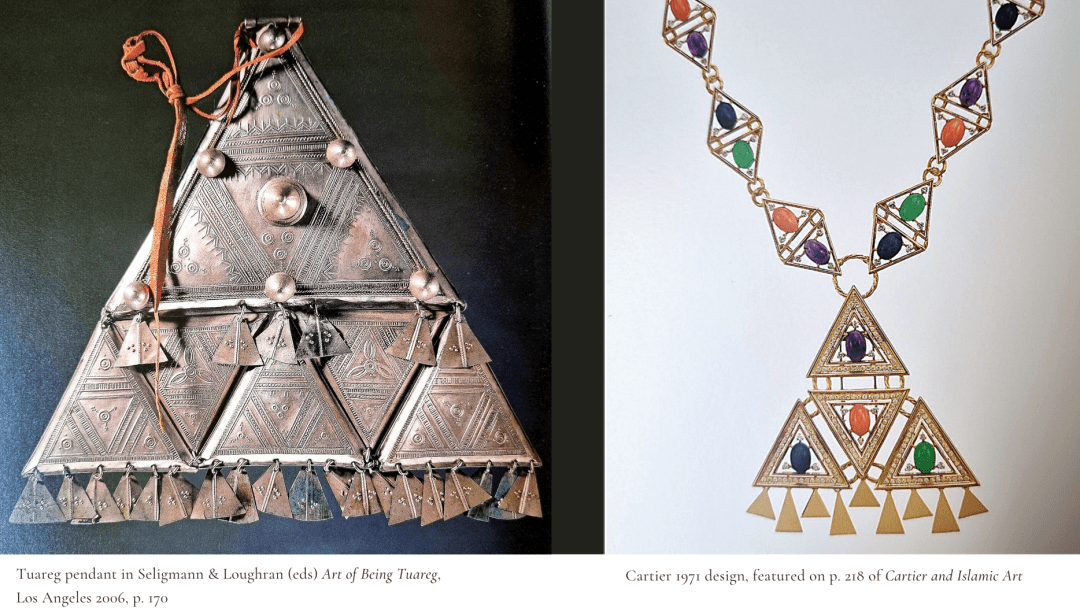
As the timeframe in which the ‘Lexicon of Forms’ came into existence, with all its imprecise denominators as I pointed out above, was at the apex of colonialism, it will not come as a surprise that the origin of some designs is not always clearly identified. An example is the necklace featured on p. 218, designed in 1971. It is described as inspired by Berber (which we now would indicate as Amazigh, following the people’s wish to be named in their own language) fibulae from Kabylia in Algeria (p. 187). While that may certainly hold true for the necklace itself, the pendant seems to me to be based in Tuareg tereout tan idmarden pendants as worn in the Hoggar mountains of Algeria. I was pleasantly surprised to see jewellery of ordinary people (instead of the possessions of shahs and Mughal elite) serve as inspiration for these high-end creations as well, and wonder if other contemporary jewellery examples that form part of North Africa’s and Southwest Asia’s heritage might still go unidentified.

The design and photography of this book are simply fabulous. Both original pieces and Cartier creations are photographed in crisp clarity. The large format allows for endless comparing and admiring, and what I particularly loved are the blow-ups of tiny details at the beginning of each chapter and even the cover: the cover image is a detail of a cigarette case, only 8,7 cm in height! Short intermezzo’s, like a brief essay on the pen boxes of the shah, Mughal jewellery from India or book bindings, provide informative examples on how details traveled to other designs. Each chapter is well referenced: don’t skip the endnotes, they feature many more details and discussions!

Cartier and Islamic Art is a detailed journey into the creative process of this famed jewellery house, placed in the context of its time. From inspirational exhibitions, visits and experiences, via drawings and designs to the breathtaking jewellery creations, this book places western designs and its teachers from the Islamic world side by side. For me, this book was an eye-opener in how deeply rooted abstract jewellery of the early 20th century is in Islamic art: a development in the field of jewellery that has been explored in depth for the first time in this publication. It is a visual feast of stunning, elegant Cartier designs and a wealth of superb original artworks from Southwest Asia, North Africa and India, accompanied by in-depth essays: I am sure you will thoroughly enjoy both!

Cartier and Islamic Art. In Search of Modernity. by Heather Ecker et. al. (eds). Thames & Hudson, 2021

315 pages, full-colour, in English. Available with the publisher, in bookstores and online.

The book was received as review copy by the publisher.

More book reviews on jewellery & art? Browse dozens of books here!

Or join the Jewellery List and receive new book discussions automatically in your inbox!

Sigrid van Roode

Sigrid van Roode is an archeologist, ethnographer and jewellery historian. She considers jewellery heritage and a historic source. She has authored several books on jewellery from North Africa and Southwest Asia, and on archaeological jewellery. Sigrid has lectured for the Society of Jewellery Historians, the National Museum of Antiquities in Leiden and the Sultan Qaboos Cultural Center, among many others. She curates exhibitions and teaches online courses on jewellery from North Africa & Southwest Asia.