Tuareg silver&carnelian ring

Tuareg silver&carnelian ring

Treasures of the Sahara

Tuareg silver rings with carnelian

Published Dec 13, 2023

You have probably seen them often: those beautiful silver Tuareg rings with a big, glowing, pointy carnelian. They make formidable jewels, but what are they called? Who wore these rings? And are they actual finger rings? I mean, doesn’t that carnelian break…?

Tuareg silver rings with a pointy carnelian: where are they from?

Like any other culture, the Tuareg are not a single group. They consist of many tribes, who inhabit a vast area across the Sahara: from North African countries such as Algeria, Tunisia and Libya to sub-Saharan countries as Mali, Niger and Burkina Faso. [1]

The silver rings with a carnelian likely find their origin in Mali, according to Burner. [2] Over time, their use spread to other regions of the Sahara as well. The rings in the photo above (click on it to enlarge it) were all sourced in Mali.

Tuareg rings with carnelian: what are they called?

Names of things are notoriously varied in living cultures who are spread over a wide region. These rings, too, go by different names.

First, they are called simply what they are: a ring, or tassandert in Tamasheq. That name is the basic name for the category they belong to. In the north, notably in the Hoggar in Algeria, but in adjacent northern Mali as well, the basic name for ring is tiseq (sometimes also spelled tisek). [3] Another word for ring is shisandar.

This ring with the pointy carnelian in particular resembles another form of jewellery called tanfuk. Because of this similarity, these rings also go by the name of tanfuk – even though they are a different thing. [4]

And finally, another name for these particular rings hints at how they are worn: tassandert ‘n zakat means ‘ring-pendant’. And I know you probably have been wondering how to wear a ring with a huge spikey carnelian and still go about your daily business…so let’s get into that next!

Are those Tuareg rings worn on the finger?

Yes – and no! (by now, you did not really expect a straightforward answer, did you…?) These ornaments can be worn in a variety of ways, and that makes them so interesting.

They are worn on the fingers by both women and men. There is no strict placement on the fingers, although the ring finger is preferred, but they can be worn on any other finger.

Apart from finger rings, you will also find these strung on a leather cord and worn around the neck. That is more often the case in women’s dress. Usually, this will be in combination with other pendants: they can flank amulet cases (tcherot), appear strung together with beads, tanfuk or zinder pendants as well as with the famous variety of ‘crosses’. You’ll see photos of these in the gallery below: click on the photos to enlarge them.

And they appear braided into the hair as well! [5] As with all living heritage, the decision how to wear it is up to the wearers themselves. There are no strict ‘rules’ when it comes to these Tuareg rings: their use is varied by design. These are very versatile ornaments!

" Rings are versatile: they can be worn in many ways"

How to tell the difference between finger rings and pendants?

You might be thinking ‘So how do I know if a ring is meant to be worn on the finger, or as a pendant?‘ Burner gives us a first clue: when the ring itself is either super tiny, or super large, this indicates it is not meant to be worn on the finger. [6]

Usually, the rings with a smaller carnelian are suitable to be worn on the fingers. Examples of these are shown in the photographs above – click on the images to enlarge them. In these rings, you will see the silver setting has worn smooth, as has the pointy tip of the carnelian itself. In everyday life, the ring has rubbed against clothing, bags, tents, hair….and it has gained a smooth wear as a result. But take note: expecially these smaller ones are very suitable to wear braided into the hair, too.

The huge carnelians with serrated sides and sharp points, as shown in the first image with this post (click on the photo to enlarge it) are more likely to be worn as a pendant. Here, you will notice more wear on the inner band, where the continuous movement on a string has left its mark. The carnelian itself feels sharp to the touch (look for the edges in particular).

Carnelian: its meaning for the Tuareg

The use of carnelian, as well as other agates, is also meaningful. It has a strong protective aspect. As in many other cultures, carnelian is associated with blood and life through its colour. [7]

Many of these rings are set with red glass instead of carnelian. That does not make them any less valuable or real: red glass is often used as a substitute, that has become an equally valid material. See more about how that works, and how we look at jewellery, here.

And from glass, it is a small step to green glass imitating green agates. The colour of greenery and growth carries deep meaning in a desert environment.

Tuareg silver and carnelian rings: living heritage

So, as you see, the names as well as the uses of this particular type of Tuareg ring vary over time, and geographically. For Tuareg craftsmen and wearers of today, they may carry different meaning depending on who you ask. And that is a very important thing to bear in mind.

Because as Seligman has shown, the meaning attributed to symbols and shapes among Tuareg craftsmen changed significantly over the course of two generations. [8] That is because jewellery is never static. These rings represent a living, breathing, changing culture in their many shapes, forms and names: a sparkling testimony of the beauty and resilience of Tuareg culture!

Explore the world of jewellery in more detail in the e-courses!

More posts on jewellery pieces in detail? Browse them all here!

Join the Jewellery List and receive new articles, jewellery news and more in your inbox!

References

[1] See the work of Michel Vallet for a great overview, with maps.

[2] Burner, J. 2011. Bijoux Touaregs. Editions du Fournel, p. 271.

[3] Burner, J. 2011. Bijoux Touaregs. Editions du Fournel, p. 260.

[4] Burner, J. 2011. Bijoux Touaregs. Editions du Fournel, p. 271.

[5] Vaudour, C. 2019. Les Tenues des Touaregs. Fonds documentaire de Michel Vallet, p. 260-261.

[6] Burner, J. 2011. Bijoux Touaregs. Editions du Fournel, p. 271.

[7] See Seligman, T. & K. Loughran (eds) 2006. Art of Being Tuareg. Sahara Nomads in a Modern World, p. 184 for Tuareg jewellery in particular, and my own book Desert Silver for an overview of amulets and colour symbolism.

[8] Seligman, T. & K. Loughran (eds) 2006. Art of Being Tuareg. Sahara Nomads in a Modern World, p. 222-223.


Would you like to quote this article? Please do! Here’s how:

S. van Roode, [write the title as you see it above this post], published on the Bedouin Silver website [paste the exact link to this article], accessed on [the date you are reading this article and decided it was useful for you].

Sigrid van Roode

Sigrid van Roode is an archeologist, ethnographer and jewellery historian. Her main field of expertise is jewellery from North Africa and Southwest Asia, as well as archaeological and archaeological revival jewellery. She has authored several books on jewellery. Sigrid has lectured for the National Museum of Antiquities in Leiden, Turquoise Mountain Jordan, and many others. She provides consultancy and research on jewellery collections for both museums and private collections, teaches courses and curates exhibitions. She is not involved in the business of buying and selling jewellery, and focuses on research, knowledge production, and education only.

Perfume jewels: meskia

Perfume jewels: meskia

Ottoman splendour

Perfume jewels: the meskia pendant

Updated Feb 19, 2024

In the Maghreb, notably in Algeria and Tunisia, spectacular containers called meskia are worn. What are these, what is their history and why are they important? In this post, I’m exploring these delicate and sumptuous jewels.

What is a meskia?

A meskia is a small, delicate pendant with an open worked lid, which contained fragrances. It is usually made of precious materials, such as gold, and decorated with gemstones and pearls. Its name, meskia, is derived from its content: it would hold musk, but was also used for other scented substances. [1]

These containers are relatively small and very opulent in their decoration. That tells us more about the importance attached to these jewels. So, what is that importance?

Meskia: fragrance and faith

Like its name suggests, the contents of boxes like these would have been musk. Musk is an important and popular scent, as it was said to be the favourite fragrance of the Prophet. In that respect, it carries a religious association.

Musk was a scent that was imported into the Mediterranean in Late Antiquity: the Persians had access to the trade with Central Asia. [2] This is where the musk deer lived, from whose glands the scent was first extracted.

Through the association with the Prophet, musk became extremely popular and was imported on a massive scale. That popularity continues until today. Musk is now largely synthetically produced, and you will find it in many shapes and forms throughout the Islamic world.

Style and execution: Ottoman luxury

The opulence of the meskia reflects its origin in the Ottoman period. The Ottoman Empire stretched across the Mediterranean, and included large parts of what is now Algeria and Tunisia. The splendour of the Ottoman court in current-day Istanbul traveled with Ottoman dignitaries, merchants and craftspeople to all corners of the empire. Here, it continued to inspire both the local elite and craftsmen who catered to a wealthy clientele.

" The meskia is a sign of status: both the container and its contents are precious and expensive"

Differences in meskia styles

Not all meskia-pendants are the same: their shape is similar, but there are differences in their execution that are particular to the regions where they have been made and worn. [3]

The Algerian meskia shown above (click to enlarge it) is made of ajour-cut sheet gold. The box itself is decorated with a rim of pearls. Its lid has been set with a border of rubies around a large central emerald. The floral design of the lid shows accents of small rubies and emeralds, and a few diamonds set in the silver leaves.

The Tunisian meskia (click to enlarge it) is made in a different technique: its lid is executed in fine filigree. The dangles of pearls and irregularly shaped precious stones serve to convey that same luxurious status.

Meskia: an urban jewel

Wearing a meskia has long been an urban tradition. [4] This is where the wealthier people lived: rich merchants, affluent families and of course the administrative and military Ottoman elite. They had access to the best craftsmen, as well as to precious stones used to decorated these perfume containers. The content of these containers was expensive as well. Wearing a meskia was a sign of wealth: not only because of the container, but because of the expensive perfume in it, too.

Outside of the main urban centres, fragrance was worn as well, but it took other forms such as the scented paste beads and silver perfume containers.

See more about those scented paste beads from North Africa in this article!

The meskia today: an important wedding jewel

The meskia is still part and parcel of wedding attire. Algerian and Tunisian brides wear elaborate necklaces made of scented paste beads, rows of pearls and a meskia container. As these jewels are quite costly, they can be rented for the day from the wedding planner. Through their combination of heritage, identity and faith, they add an important level of festivity to the wedding. It’s a small, but highly significant piece of jewellery!

Collage of a smiling woman from Egypt, wearing gold earrings, with dewy rose petals, jasmine and lilies. A bright yellow text box reads 'Scents of the Middle East'

Explore the world of fragrance in the course Scents of the Middle East!

More posts on jewellery pieces in detail? Browse them all here!

Join the Jewellery List and receive new articles, jewellery news and more in your inbox!

References

[1] Eudel, Dictionnaire des Bijoux de l‘Afrique du Nord, under ‘meskia’, notes that ‘mesk’ is also a word used to indicate a leather pouch in which jewellery was stored. This shares the significance of a container designed to hold precious content.

[2] King, A.H. 2007. The musk trade and the Near East in the Early Medieval Period. PhD-thesis Indiana University, p. 239.

[3] As already noted by Eudel in his Dictionnaire des Bijoux de l‘Afrique du Nord, under ‘meskia’.

[4] Akam, F & A. Hanafi, 2003. La mode Ottomane dans les bijoux citadins, in: Bijoux & parures de’Algèrie, Somogy Editions d’Art, p. 37-41.

Would you like to quote this article? Please do! Here’s how:

S. van Roode, [write the title as you see it above this post], published on the Bedouin Silver website [paste the exact link to this article], accessed on [the date you are reading this article and decided it was useful for you].

Sigrid van Roode

Sigrid van Roode is an archeologist, ethnographer and jewellery historian. Her main field of expertise is jewellery from North Africa and Southwest Asia, as well as archaeological and archaeological revival jewellery. She has authored several books on jewellery. Sigrid has lectured for the National Museum of Antiquities in Leiden, Turquoise Mountain Jordan, and many others. She provides consultancy and research on jewellery collections for both museums and private collections, teaches courses and curates exhibitions. She is not involved in the business of buying and selling jewellery, and focuses on research, knowledge production, and education only.

The evil eye in jewellery

The evil eye in jewellery

power of the eye symbol

The evil eye in jewellery

Updated August 08, 2024

What is the point of evil eye jewellery? Beads in the shape of an eye are a familiar sight all over the world, and it is a shape that goes back at least 3,500 years. What does it represent, and which other forms may eye jewellery take? In this article, I’ll explore how the symbol of the eye appears in jewellery, and what it means.

Let’s start by addressing what the evil eye is…

In essence, the evil eye is nothing else than jealousy or envy. I suppose we can all relate to what that feels like: that moment when you realize someone is jealous of you, or something you have achieved, or something you own, that moment makes the hairs on your arms stand up and your spine tingle. You awkwardly try to divert their attention to something else by changing the topic of your conversation, but the harm has been done.

And the thing is, you have seen it in their eyes as well as in their behaviour. That glance, that look, that split second? That was the evil eye being cast at you.

Jealousy may leave us feeling anxious, threatened, insecure or even betrayed – jealousy affects our basic need of feeling safe and valued, so no wonder this feeling has been believed to bring visible and material harm as well.

A telling example comes from the Aures Mountains, Algeria. Here, it was reported that with every glance cast a jinn traveled along with it, and that jinn would harm the person or the thing that the glance was directed at. [1]

Evil eye symbolism draws on that looking and staring.

The eye is called ‘ayn al -hasad (‘eye of envy’) or nazar (‘glance, look)’ The concept of envy has been visualized in a symbol that captures it all: the eye. Envy and jealously arise from something you’ve seen, and it is transmitted through glares and glances. The eye represents both aspects: becoming jealous, and showing it.

Incidentally, you may have experienced that openly staring at something or someone for too long is considered inappropriate in many cultures: that is that same act of looking that may make a person feel uneasy. Even if it is not because of jealousy, but out of admiration!

Staring too long in either case is inappropriate, and being too vocal about your admiration of someone or something may alert jinn, who are known to turn jealous easily…and we’re back to square one.

The eye is a universal symbol that has been in use since the early civilizations, so it is not unique to Islam only, and it is not unique to one particular country either. The history of the eye in jewellery can be traced back to the distant past: in Egypt and Mesopotamia, the concept of the evil eye was already known. [2] Eye beads have been found in archaeological excavations across the Mediterranean and throughout Europe.

How and why is the evil eye used in jewellery?

And that brings me to the question how the evil eye is integrated into jewellery, and what its purpose is. Here, I will focus on jewellery in the shape of an eye only.

The eye symbol is not just a symbol, putting a shape to that complex, uneasy feeling, but is sometimes also thought of as an entity of its own.

And jewellery counteracts that concept of the evil eye through a huge variety of forms, shapes and guises: this blog series highlights many of those amuletic capacities of jewellery. One of those is jewellery in the shape of an actual eye, so let’s look at that next.

What is evil eye jewellery?

Basically, jewellery in the shape of an eye is the first line of defense against such malicious glances. The idea is not that the wearer is casting the evil eye herself, but it works more along the lines of mirroring and deflecting. The moment ‘that’ look is shot in your direction, it will be met with a counter-gaze. That is where jewellery in the form of an actual eye gets its power from.

Usually, these will be glass beads in the shape of an eye, but there are a few other forms as well that take the form of an eye. Banded agate for example can be fashioned into eye-beads, and has been used as such for at least two millennia.

Cowrie shells may be used as a ‘stand-in’ for an eye too, as they resemble the shape of a half-closed eye. [3]

Are evil eye beads bad, then?

That’s a question I hear a lot. The term ‘evil eye jewellery’ or ‘evil eye beads’ has become so commonplace that we would almost forget that this is a contraption of two different things: the evil eye itself (a bad thing), and the eye symbol that is believed to work against it (a good thing).

The eye beads on charm bracelets and necklaces are not evil themselves – they deflect evil.

Whether you feel comfortable wearing them is a matter of your own values, but historically, eye beads and eye jewellery are not designed as evil. They serve to counteract evil.

And what about the blue in evil eye jewellery?

Historically, these evil eye beads appear as blue eyes. That is of course related to the cultural importance of the colour blue, to the relative rarity of people with blue eyes around the Mediterranean (‘relative’, mind you – they did and do exist), but also to the limits of technical possibilities in the past.

Nowadays, you’ll find eye beads in all colours including yellow, pink, orange or green. These are marketed with nifty sales pitches, promoting various amuletic capacities for every colour: I found pink eye beads plugged as serving ‘love’, but also to ‘neutralize disorder’ or ‘protecting friendships’.

Here, it would seem the millennia old eye symbol is now being merged with modern-day interpretations of colours and their perceived powers. This is more of a marketing concept than embpodying actual beliefs that are rooted in history – these forms of the evil eye are often mass-produced in China and serve no other purpose than profit.

The evil eye is perhaps oldest amulet symbol in the world. It is still being used and acquiring new meanings today, developing along with the changing needs, spiritual convictions and economic savy of today’s world – but in doing so, it is at risk of becoming a commodity only.

Very specific forms of eye beads

There are several specific forms of eye beads throughout North Africa and Southwest Asia: in many regions, unique traditions have developed that take their own spin on evil eye beads. Some examples are here on the blog:

The ‘Seven Eyes’ blue bead that you’ll find throughout Southwest Asia…but what is it, and what are those seven eyes?

Khalili glass eye beads from Hebron were popular from Southwest Asia to Italy: how were they worn? This article explores.


Where can I learn more about evil eye beads and jewellery?

Find out more about the histories behind amulets in the e-course on Amulets and Magic in Jewellery!

Or start by downloading the free e-book on amulets and jewellery here.

More posts on jewellery and amulets? Browse them all here!

Join the Jewellery List and receive new articles, jewellery news and more in your inbox!

References

[1] Hilton-Simpson, 1915. Some Algerian superstitions noted among the Shawia Berbers of the Aures Mountains and their nomad neighbours, in: Folklore Vol. 26 No. 3, p. 228.

[2] S. Gunther & D. Pielow (eds) 2018. Geheimnisse der Oberen und Unteren Welt. Magie im Islam zwischen Glaube und Wissenschaft, p. 29.

[3] Hilton-Simpson, 1915. Some Algerian superstitions noted among the Shawia Berbers of the Aures Mountains and their nomad neighbours, in: Folklore Vol. 26 No. 3, p. 229.

Would you like to quote this article? Please do! Here’s how:

S. van Roode, [write the title as you see it above this post], published on the Bedouin Silver website [paste the exact link to this article], accessed on [the date you are reading this article and decided it was useful for you].

Sigrid van Roode

Sigrid van Roode is an archeologist, ethnographer and jewellery historian. Her main field of expertise is jewellery from North Africa and Southwest Asia, as well as archaeological and archaeological revival jewellery. She has authored several books on jewellery, and obtained her PhD at Leiden University on the jewellery of the Egyptian zar-ritual. Sigrid has lectured for the National Museum of Antiquities in Leiden, Turquoise Mountain Jordan, and many others. She provides consultancy and research on jewellery collections for both museums and private collections, teaches courses and curates exhibitions. She is not involved in the business of buying and selling jewellery, and focuses on research, knowledge production, and education only.

Binding magic in jewellery

Binding magic in jewellery

keeping it together

Binding magic in jewellery: pins

Updated Jan 28, 2024

The most mundane, everyday things can be transformed into magical objects simply by analogy, and that is what makes this form of magical activities so relatable. Fastening something is one of those acts that can carry a deeper meaning, and the object that goes with it becomes important, too. And clothing pins, also known as fibulas, are perfect for that goal!

Pinning a fibula: the magic behind it

This is basically a specific form of binding magic, where pins to keep clothing together gain a different meaning.

I talked about the magic of tying and girding in another blog post, and pinning your clothing together works along the same lines. The clothing pins that are used to keep fabric together, can be transformed into very powerful magical objects when they are used in ritual.

The analogy is of course very clear: a clothing pin holds two separate pieces of dress together, and so it would also be very useful in rituals to keep persons together.

When you fasten a fibula (see how to do that here), you actually have to carry out a number of steps: it does not close automatically by itself. And that is where the magic is, in those acts of deliberately fastening…clothing pins are the perfect object for love-magic!

Fibula magic in ancient times

The Romans already used their pins or fibulas (the Latin word is still in use to indicate these pins) as such. Some 2,000 years ago, you could buy an inscribed fibula to present to a lady: it would say something like ‘Hello, gorgeous!’, or, if you were bolder, ‘mix yourself with me’ – I’ll leave it up to you to figure out what they meant by that!

The point is that the fibula would work as a magical tool. [1] Once the lady in question would pin her clothes with it, it was hoped your relationship with her would immediately grow stronger.

Some 1,000 years earlier, three imported bronze fibulas were left behind in a shallow pit on the edge of a moor in The Netherlands. They were a gift to the gods, or whatever beings were believed to inhabit that place, and they were a precious gift, too.

Those fibulas were imported from Scandinavia and did not form part of traditional dress in what later would become The Netherlands: a treasure worthy of the gods. [2] You’ll see it in the collage below.

Gloomy photo of a swamp with a Bronze Age jewellery hoard

Fibula magic in North Africa

In a different world and a different time, fibulas have a very similar protective power. In Morocco, clothing pins are considered powerful because their sturdy pin has the power to harm the evil eye, a meaning also found widely in the rest of the Maghreb. [3]

Many shapes on fibulas are designed to attract good fortune and to keep evil at a distance, while their triangular form alludes to the powers of the number 3 (see more about the magic of numbers in this blog post). Fibulas are also the perfect piece of jewellery to attach amulet boxes to, which would be suspended from either the fibula itself or from the chain between them.

But here as well, their importance as something that holds to halves together, shines through.

The fibulas are part of the dowry, given to the bride by her husband and his family, and here the magic of pinning reinforces the bond between both the husband and wife and their respective families.

Adorning the bride with her jewellery, including fastening her fibula set, was part of the transformative magic in Libya, which would accompany the bride during her transition from unmarried girl to married woman. [4]

Belt buckle magic in Europe

And that power of fastening is found as a theme in other parts of the world, too.

Belt buckles function in much the same way: they, too, hold something together. As such, it became very popular as a form in European rings from the 17th century onwards. The belt buckle symbolized eternal love and loyalty – even beyond death, which is why you will also find it in mourning rings. Together with the shape of the ring itself as an endless cycle, the belt buckle firmly connects two halves for all eternity.

Pinning, fastening, closing: magic in adornment

So whether it is clothing pins or belt buckles: by fastening something, humans have tried to influence the natural course of events for millennia!


Find out more about the histories behind amulets in the e-course on Amulets and Magic in Jewellery!

Or start by downloading the free e-book on amulets and jewellery here.

More posts on jewellery and amulets? Browse them all here!

Join the Jewellery List and receive new articles, jewellery news and more in your inbox!

References

[1] Peter Wells notes that fibulas in Europe’s prehistory, when they are depicted, are always shown ‘open’, and wonders if that has something to do with magic: nothing is definitive yet, nothing is sealed, the future is open. Wells 2012, How Ancient Europeans Saw the World, p.111.

[2] I wrote about these in Bos, J. & S. van Roode 2019. Landschap vol Leven. BLKVLD Uitgevers Publishers.

[3] Cynthia Becker, Amazigh Textiles and Dress in Morocco. Metaphors of Motherhood, in: African Arts vol 39 no. 6 (2006), p. 44

[4] Elena Schenone Alberini, Las mujeres Libias en la litteratura oral. Ritos de paso y roles de genero, in: Orafrica no 6, 2010.

Would you like to quote this article? Please do! Here’s how:

S. van Roode, [write the title as you see it above this post], published on the Bedouin Silver website [paste the exact link to this article], accessed on [the date you are reading this article and decided it was useful for you].

Sigrid van Roode

Sigrid van Roode is an archeologist, ethnographer and jewellery historian. Her main field of expertise is jewellery from North Africa and Southwest Asia, as well as archaeological and archaeological revival jewellery. She has authored several books on jewellery. Sigrid has lectured for the National Museum of Antiquities in Leiden, Turquoise Mountain Jordan, and many others. She provides consultancy and research on jewellery collections for both museums and private collections, teaches courses and curates exhibitions. She is not involved in the business of buying and selling jewellery, and focuses on research, knowledge production, and education only.

Keys as amulets

Keys as amulets

magic of keys

Keys as amulets

Among the forms that are not immediately associated with amulets, is that of a key. Yet they appear as amulet in several ways throughout the Middle East and North Africa, from actual keys to images of keys. You will see them dangling from necklaces, included as miniature charm on charm necklaces, and alluded to in embroidery for example. What is the symbolic meaning of a key? In this article, I will introduce three ways keys hold significance as amulets in the Middle East.

Detail of a silver somt necklace, leather amulet pouches, bright beaded necklaces and keys worn by a Bedouin woman from Oman.

Power of keys: materials and amulets

First off, the material that keys were traditionally made of, is powerful in itself. Jinn are known to be afraid of iron, (see here why that is) and so anything made from iron would keep them at a distance. Keys, which for a long time were made of iron, fit that criterium perfectly. The image of the necklaces worn by a Bedouin woman from Oman shows her wearing a set of keys amidst leather amulet pouches: most likely, the keys also serve an apotropaic function.

A more recent version of a key as amulet is the silver key from Oman, shown below, which is shaped after a modern key. In North Africa, tiny keys sewn on to children’s clothing help prevent an early death. [1] (see here which spirits were feared for harming children). In 1915, a baby boy in Algeria was seen adorned with a series of amulets, including two iron keys, and the author observing that practice also noticed that keys were worn commonly as a charm. [2]

Silver Omani amulets, including a silver key

Key symbolism: locking and unlocking

There is more to keys than just the material they are made of, and is where their function comes into view. Keys, of course, lock and unlock things. The concept of locking and unlocking is closely related to a woman’s fertility: not so much in terms of chastity, but in the context of spirits blocking her from getting pregnant or causing a miscarriage. In that respect, keys function in a similar fashion to knots and knotting (see more about that here).

Here, keys are often combined with locks: amulets in the shape of locks were believed to prevent miscarriage in Egypt, as these ‘lock’ the womb until the time of birth has come. [3] When a birth is difficult, the reverse principle is used, and the key to a saint’s tomb is placed on the lower back of the mother to ease the birth. [4]

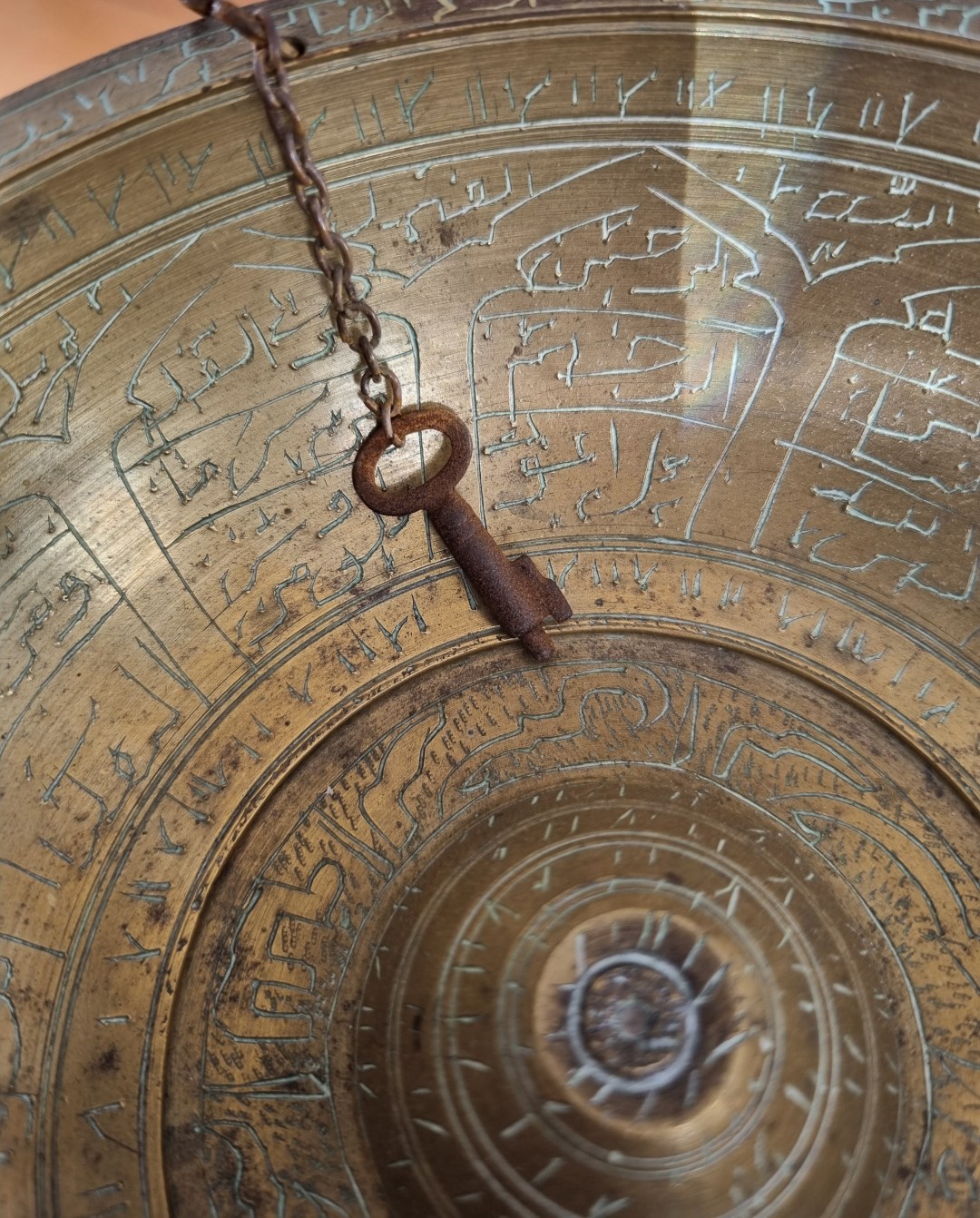
An Islamic magic bowl with a tiny iron key attached

Keys in ritual: protection and knowledge

Keys are also symbolic of accessing protection and knowledge. An example of that are the magical bowls of the Yezidi, where tiny amulet plaquettes are attached to its rim. These are called kilit, which literally means ‘key’ in Kurdic. [5] These amulet plaquettes can also take the form of an actual key, such as shown above.

The general idea is that the key amulet would enhance the efficacy of the bowl by submerging it into the water of the bowl. [6] Bowls like these were used in informal ritual aimed, again, at securing healthy pregnancy and safe births, as well as protection from evil forces. [7]

Keys as amulets: the magic in everyday objects

A seemingly simple household item may hold deep significance on a supernatural level: this example of keys shows how ‘magic’ is not something alien or mysterious, but something that is expressed in forms and shapes most familiar to us.


What kinds of amulets exist in North Africa and the Middle East?

Curious as to what other everyday objects may be used as amulets, and what their meaning is? Find out more about the histories behind amulets in the e-course on Amulets and Magic in Jewellery!

Or start by downloading the free e-book on amulets and jewellery here.

More posts on jewellery and amulets? Browse them all here!

Join the Jewellery List and receive new articles, jewellery news and more in your inbox!

References

[1] Hansmann, L. and L. Kriss-Rettenbeck 1977. Amulet und Talismann. Erscheinungsform und Geschichte. Verlag Georg D.W. Callwey, Munchen, p. 240.

[2] Hilton-Simpson, M.W. 1915. Some Algerian Superstitions Noted among the Shawia Berbers of the Aures Mountains and their Nomad Neighbours, in: Folklore Vol. 26, no. 3, p. 233 and p. 240.

[3] Hansen, N. 2006. Motherhood in the Mother of the World, PhD-thesis, University of Chicago, p. 116.

[4] Idem

[5] Biesterfeld, H. & D. Pielow (eds) 2019. Die Geheimnisse der Oberen und Unteren Welt. Magie im Islam zwischen Glaube und Wissenschaft, Brill, Leiden. p. 469-470 for a description of these bowls.

[6] Idem, p. 469

[7] Idem, p. 472-473


Sigrid van Roode

Sigrid van Roode is an archeologist, ethnographer and jewellery historian. Her main field of expertise is jewellery from North Africa and Southwest Asia, as well as archaeological and archaeological revival jewellery. She has authored several books on jewellery. Sigrid has lectured for the National Museum of Antiquities in Leiden, Turquoise Mountain Jordan, and many others. She provides consultancy and research on jewellery collections for both museums and private collections, teaches courses and curates exhibitions. She is not involved in the business of buying and selling jewellery, and focuses on research, knowledge production, and education only.