Silberschmuck aus Nubien

Silberschmuck aus Nubien

Collection of Wolfgang and Sibylle Mayer

Silberschmuck aus Nubien

Silver jewellery from Nubia is a category of jewellery that has not received all that much attention throughout the years, and so a new book on this beautiful heritage is very welcome! Silberschmuck aus Nubien is devoted to the private collection of Sibylle and Wolfgang Mayer.

This collection was built up over decades by Wolfgang and Sibylle Mayer, a German couple living and working on the island of Elephantine in the south of Egypt, opposite the town of Aswan, and elsewhere in Egypt. The book opens with the ‘how’ of collecting: I’m always interested in what triggered collectors to fall in love with a certain type of jewellery, and here it is living in, and falling in love with, a culture. Having been in Aswan myself many times, both for work and for holiday sojourns, reading this book brought back so many memories.

I very much appreciated that it looks beyond jewellery itself to its people: the first chapters introduce life in Nubia briefly, and describe the fundamental changes in both the countryside itself and their impact on its inhabitants as a result of the Aswan Dam. Much of Nubia was flooded permanently and people were forced to relocate, which had an impact on lifestyle and thus on jewellery. Understanding that background is important to appreciating jewellery that belongs in it. Speaking of cultural background, I loved how the book also shows the decoration on not just jewellery, but on houses and utensils, too: jewellery is as much part of material culture as anything else.

The book itself is beautifully designed. Each chapter opens with a large black and white photograph of jewellery being worn, and then goes on to show a variety of silver jewellery that you will not find easily anywhere else. Bracelets, pendants, coin jewellery, anklets, earrings, nose rings, finger rings….in many forms and designs, as well as beautifully designed silver kohl needles. There are some truly remarkable pieces to be admired in this book: the imitation coin jewellery is very rare, as are several of the amulets shown.

Much of the collection was purchased in Aswan and in Cairo. That explains why there is a large body of jewellery in the book that is Egyptian, but not necessarily Nubian: zār jewellery. [1] The author explicitly states that he believes the majority of his collection may actually be from Middle and Lower Egypt (notably Cairo) [p. 75], and looking at the photos I agree that that is probably the case. The photographs of a zār included in this section are the same as featured in the book on zār by dr. el-Hadidi, or here on this website – which makes sense, as this is a most private event that is rarely photographed. The many examples of zār jewellery in this book are sometimes misidentified, but that does not diminish the value of the photographs: these pages will give you a great overview of the variety in zār pendants with spirit images!

The chapter on zār jewellery links more to Middle and Lower Egypt than to Nubia, but also within the earlier chapters there is a regional variety within Nubia itself that is not addressed. Nubia encompasses quite a large area, and the rings shown on pages 66-67 for example reflect that: there are rings present as worn by the coastal Rashayda tribes, but also from the Nile Valley villages. These regional varieties in jewellery remain unaddressed throughout the book. The bibliography does not mention the work of Griselda Tayib [2] (but frankly, that is really hard to obtain) or Imogen Thurbon [3]: both focus on Sudan, which also includes parts of Nubia. But, as the author writes, collecting with a scholarly goal was never the plan [p. 106] – this is a collection built from the heart, and that passion shines through in every page.

The collection also shows the cultural influences that you’d expect in a trade city as well connected as Aswan: for centuries, trade routes converged here. The schematic drawing of the rosette, which is a staple of Nubian jewellery, as shown on page 27 is actually drawn after a pendant from Oman – but one that ended up in Nubia and fit right in. One of the bracelets on page 45 is from Yemen, and several rings shown are worn on either side of the Red Sea: there is so much that ended up in the souks of Aswan (and also Cairo, of course) that bears testimony to this long history of trade and connection!

And what I found the most wonderful thing to read are the future plans for this collection! When you have been following this blog for a while, you know my greatest concern is not what is happening to jewellery today, but what will become of it in the future. (and if you’re new to this blog: there is more about that here). What will happen to collected jewellery when its collectors are no longer there? How will it continue to speak for the people who created it? For this collection, there is a clear plan in place: the couple have promised large parts of their collection to a yet to be realized museum on the history of Nubia in Wadi Halfa. Seeing this heritage return home eventually, where it will be integrated in the many stories of living and working in this part of the world, is simply inspiring.

Silberschmuck aus Nubien is a great visual reference book for anyone interested in jewellery from southern Egypt and northern Sudan! The beautiful photography allows you to zoom in on details, and the collection is just stunning. This book does much to spark the enthousiasm for Nubian silver jewellery and to keep it visible and admired: particularly with a relatively unknown category of traditional jewellery, that is no small feat. And if you do not read German, I know you will love it for its photographs and the wide variety of jewellery alone!

Silberschmuck aus Nubien. Ein fast verlorenes Kulturgut. By Wolfgang Mayer, 2021.

Full colour, 111 pages, in German. Published by Edition esefeld & traub, Stuttgart.

Available with the publisher and via Amazon.

The book was purchased in the museum shop of the Schmuckmuseum in Pforzheim.

Never miss out on a new book review? Join the Jewellery List and have them sent to your inbox!

Looking for background information on your jewellery? Have a look at the courses – there’s so much available on the world of the jewellery you love!

More tips on collection management? Check this free resource or download the e-book!

References

[1] Full disclaimer: I’m close to finishing my PhD-research into zār jewellery and as such have seen more of them and read more about these than can be reasonably expected of anyone else who wants to keep their sanity. When it’s published, hopefully in the near future, this link will refer to it: the collection shown in Silberschmuck aus Nubien is absolutely wonderful and informative regardless!

[2] Griselda Tayib, Regional Costumes of Sudan: see more here

[3] Imogen Thurbon runs the informative website Women’s Literacy Sudan: see this post for example on hair braiding in Sudan

Sigrid van Roode

Sigrid van Roode is an archeologist, ethnographer and jewellery historian. Her main field of expertise is jewellery from North Africa and Southwest Asia, as well as archaeological and archaeological revival jewellery. She has authored several books on jewellery. Sigrid has lectured for the National Museum of Antiquities in Leiden, Turquoise Mountain Jordan, and many others. She provides consultancy and research on jewellery collections for both museums and private collections, teaches courses and curates exhibitions. She is not involved in the business of buying and selling jewellery, and focuses on research, knowledge production, and education only.

Keys as amulets

Keys as amulets

magic of keys

Keys as amulets

Among the forms that are not immediately associated with amulets, is that of a key. Yet they appear as amulet in several ways throughout the Middle East and North Africa, from actual keys to images of keys. You will see them dangling from necklaces, included as miniature charm on charm necklaces, and alluded to in embroidery for example. What is the symbolic meaning of a key? In this article, I will introduce three ways keys hold significance as amulets in the Middle East.

Detail of a silver somt necklace, leather amulet pouches, bright beaded necklaces and keys worn by a Bedouin woman from Oman.

Power of keys: materials and amulets

First off, the material that keys were traditionally made of, is powerful in itself. Jinn are known to be afraid of iron, (see here why that is) and so anything made from iron would keep them at a distance. Keys, which for a long time were made of iron, fit that criterium perfectly. The image of the necklaces worn by a Bedouin woman from Oman shows her wearing a set of keys amidst leather amulet pouches: most likely, the keys also serve an apotropaic function.

A more recent version of a key as amulet is the silver key from Oman, shown below, which is shaped after a modern key. In North Africa, tiny keys sewn on to children’s clothing help prevent an early death. [1] (see here which spirits were feared for harming children). In 1915, a baby boy in Algeria was seen adorned with a series of amulets, including two iron keys, and the author observing that practice also noticed that keys were worn commonly as a charm. [2]

Silver Omani amulets, including a silver key

Key symbolism: locking and unlocking

There is more to keys than just the material they are made of, and is where their function comes into view. Keys, of course, lock and unlock things. The concept of locking and unlocking is closely related to a woman’s fertility: not so much in terms of chastity, but in the context of spirits blocking her from getting pregnant or causing a miscarriage. In that respect, keys function in a similar fashion to knots and knotting (see more about that here).

Here, keys are often combined with locks: amulets in the shape of locks were believed to prevent miscarriage in Egypt, as these ‘lock’ the womb until the time of birth has come. [3] When a birth is difficult, the reverse principle is used, and the key to a saint’s tomb is placed on the lower back of the mother to ease the birth. [4]

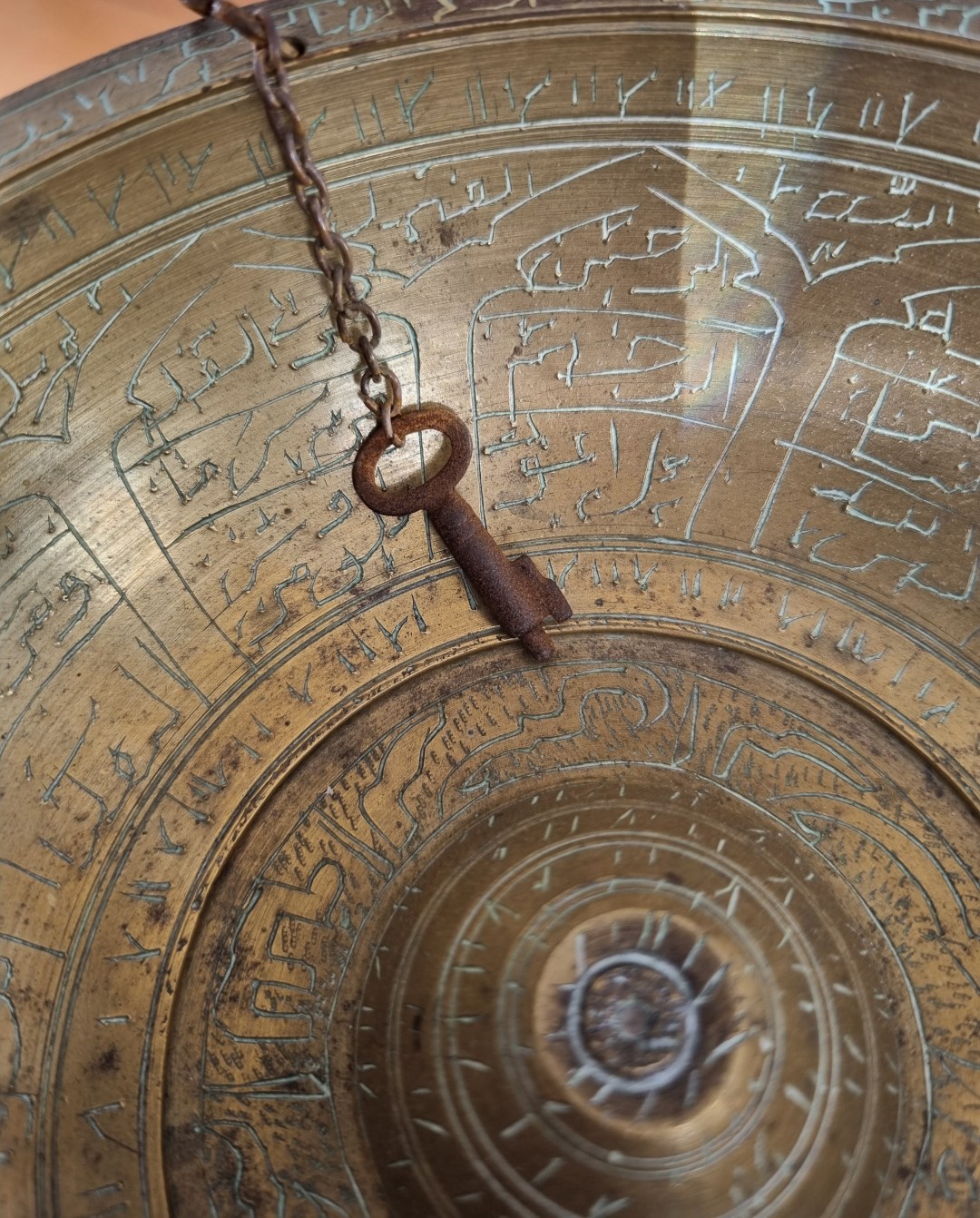
An Islamic magic bowl with a tiny iron key attached

Keys in ritual: protection and knowledge

Keys are also symbolic of accessing protection and knowledge. An example of that are the magical bowls of the Yezidi, where tiny amulet plaquettes are attached to its rim. These are called kilit, which literally means ‘key’ in Kurdic. [5] These amulet plaquettes can also take the form of an actual key, such as shown above.

The general idea is that the key amulet would enhance the efficacy of the bowl by submerging it into the water of the bowl. [6] Bowls like these were used in informal ritual aimed, again, at securing healthy pregnancy and safe births, as well as protection from evil forces. [7]

Keys as amulets: the magic in everyday objects

A seemingly simple household item may hold deep significance on a supernatural level: this example of keys shows how ‘magic’ is not something alien or mysterious, but something that is expressed in forms and shapes most familiar to us.


What kinds of amulets exist in North Africa and the Middle East?

Curious as to what other everyday objects may be used as amulets, and what their meaning is? Find out more about the histories behind amulets in the e-course on Amulets and Magic in Jewellery!

Or start by downloading the free e-book on amulets and jewellery here.

More posts on jewellery and amulets? Browse them all here!

Join the Jewellery List and receive new articles, jewellery news and more in your inbox!

References

[1] Hansmann, L. and L. Kriss-Rettenbeck 1977. Amulet und Talismann. Erscheinungsform und Geschichte. Verlag Georg D.W. Callwey, Munchen, p. 240.

[2] Hilton-Simpson, M.W. 1915. Some Algerian Superstitions Noted among the Shawia Berbers of the Aures Mountains and their Nomad Neighbours, in: Folklore Vol. 26, no. 3, p. 233 and p. 240.

[3] Hansen, N. 2006. Motherhood in the Mother of the World, PhD-thesis, University of Chicago, p. 116.

[4] Idem

[5] Biesterfeld, H. & D. Pielow (eds) 2019. Die Geheimnisse der Oberen und Unteren Welt. Magie im Islam zwischen Glaube und Wissenschaft, Brill, Leiden. p. 469-470 for a description of these bowls.

[6] Idem, p. 469

[7] Idem, p. 472-473


Sigrid van Roode

Sigrid van Roode is an archeologist, ethnographer and jewellery historian. Her main field of expertise is jewellery from North Africa and Southwest Asia, as well as archaeological and archaeological revival jewellery. She has authored several books on jewellery. Sigrid has lectured for the National Museum of Antiquities in Leiden, Turquoise Mountain Jordan, and many others. She provides consultancy and research on jewellery collections for both museums and private collections, teaches courses and curates exhibitions. She is not involved in the business of buying and selling jewellery, and focuses on research, knowledge production, and education only.

Magic of plastic

Magic of plastic

surprising materials

The magic of plastic

Updated Jan 8, 2024

Jewellery made with materials that we consider less valuable, are often not taken seriously. Plastic has that effect in particular, and you may hear comments like: ‘this piece has plastic, so it’s not real’ or even ‘this is a fake because it should have coral instead of plastic.’ But who says that it should…?⁠ Plastic plays a role in ethnic jewellery quite often, and its use extends into the realm of amulets. Here are a few examples.

Plastics in ethnic jewellery: Bakelite

Bakelite, a type of plastic invented in the early 1900s, was widely used in jewellery production in the early 20th century. Its popularity was due to its durability, versatility, and affordability. It could be shaped, carved, and molded into various forms, making it an ideal material for creating intricate and colorful designs.

So instead of thinking about this material as ‘fake’, I feel the use of bakelite in traditional jewellery highlights the intersection of technology and culture and tells us about the changing social and economic circumstances of that time. It shows how people adapted to new materials and incorporated them into their jewellery.

The bright red of the bakelite in the Kabyle brooch shown above (click to enlarge it) shows both the fascination for this new material, and works miracles for the wearer!

Plastics in ethnic jewellery: Imitation amber

One thing these plastics were used for, is to imitate the costly amber. Amber was valued for a number of reasons, including magical ones: a little more about that is here.

An example is the woman from el-Arish, shown in the photo above (click to enlarge it). Around her neck, visible behind the string of Maria Theresia Thalers her child is playing with, she is wearing a necklace made of dark beads: most likely these are the imitation amber beads in a dark cherry hue as shown in the image.

They also exist as proper amber imitations in an opaque amber colour, and are now rare themselves as they are no longer made. ⁠[1]

Plastics in ethnic jewellery: Colour over material

Plastic is also the material chosen for the Bedouin ring, shown above (click to enlarge it) where a piece of battered and damaged plastic has been carefully set in silver. Judging by the wear, it has kept its wearer safe from harm for a lifetime.

That is by virtue of its colour: these bluegreen shades are considered particularly effective against the evil eye, just like turquoise. This piece of plastic serves that purpose perfectly: it is the colour that matters here, not the material.

A plastic bicycle reflector against evil

A wonderful example of jewellery with apotropaic properties is the silver necklace from Oman shown above. It combines several well-known principles of magical protection, and adds to those a reinforcement of its own.

The colour red is the dominant colour when it comes to averting evil, and is present here in three splashes of vibrant red.

Three is a number that is regarded as beneficial, as it represents the trinities of life: man, woman and child, along with birth, life and death.

The dangles confuse evil with their unpredictable swaying and the sound of their jingling, while the tiny crescent moons bring prosperity and growth. ⁠

But it is the center piece that steals the show: a plastic bicycle reflector. Its reflecting capacity averts evil even more on top of all of the above: imagine how these would shine when they catch a ray of sunlight! ⁠I especially like this necklace as it shows that purpose beats material in some cases: there is nothing precious about a plastic reflector, and yet it may save your life from both evil forces and approaching traffic.⁠

Plastic in ethnic jewellery: a wonderful amulet

So you see how plastic may function as amulet in a range of ways. It can be a substitute for something else (such as imitation amber or coral), it can function as fully equal to other materials because of its colour, and it can even be the material of choice precisely because of its own capacities. In all cases, it would have been as real to the wearer as other materials: it is the desired effect that counts!

More on amulets, charms and magic in jewellery? Download your free e-book here, read other posts, or enroll in the e-course on Magic of Jewellery!

Never miss a new article? Join the Jewellery List and have them delivered to your inbox!

References

[1] See the chapter on imitation amber in King, R. 2022 Amber. From Antiquity to Eternity.

Would you like to quote this article? Please do! Here’s how:

S. van Roode, [write the title as you see it above this post], published on the Bedouin Silver website [paste the exact link to this article], accessed on [the date you are reading this article and decided it was useful for you].

Sigrid van Roode

Sigrid van Roode is an archeologist, ethnographer and jewellery historian. Her main field of expertise is jewellery from North Africa and Southwest Asia, as well as archaeological and archaeological revival jewellery. She has authored several books on jewellery. Sigrid has lectured for the National Museum of Antiquities in Leiden, Turquoise Mountain Jordan, and many others. She provides consultancy and research on jewellery collections for both museums and private collections, teaches courses and curates exhibitions. She is not involved in the business of buying and selling jewellery, and focuses on research, knowledge production, and education only.

Food ceremonies & amulets

Food ceremonies & amulets

magic of food

Food ceremonies, rituals and amulets

Updated Jan 1, 2024

Not turning this jewellery blog into a foodie feed…but did you know there is a strong relation between food, ritual and personal adornment in North Africa and Southwest Asia? I have rounded up several examples of jewellery and adornment to show you how food and personal adornment are interrelated.

Food and magic: a connection on many levels

Food is something we depend on. We can’t live without it, and so it is hardly surprising to find the importance of growing, raising and preparing of food resonating in the realm of magic and amulets. This is often related to growth, wealth, health and having children.

The opposite is also true: poisonous foods or animals feature in magic, too, with the aim of fighting evil influences.

Another link between food and magic is medicine: many ingredients used for food preparations are also found in medicine, a field originally closely linked to magic.

There are countless rituals involving beans, sprouts and such aimed at becoming pregnant or keeping spirits away from the house.

And everyday acts from the culinary domain take on new meaning in ritual, such as the pounding of coffee beans [1] referring to sexual relations. Yes, you read that right….do check the reference with this, the story is amazing!

Back to jewellery: that close relation between food and magic can take material form in personal adornment in several ways. First, there are actual edible things that may be worn on the body, but you could also think of imitations of those, both lifelike and in abstract shapes, the names given to jewellery elements and even more indirect connections such as through colours. So how does that work?

Food & amulets: actual ingredients

Starting with actual ingredients, to protect children in Egypt, a small pouch filled with bread and salt would be worn as an amulet to keep spirits away, a practice recorded up until the last century. [2]

A naming ceremony for a baby among the Bisharin, living in Sudan, had visiting guests write down a name suggestion and put that in a dish containing milk, bread and sugar. [3]

The fragrance of cloves was believed to be an aphrodisiac throughout North Africa and Southwest Asia, and so adornment made of cloves was regarded as a powerful means to attract the love of a husband.

Throughout Southwest and Central Asia, red chili peppers are dried and strung on cord to protect houses from evil spirits; tiny peppers in plastic are strung in between evil eye beads (see more about those here) as a powerful amulet. Here, the general idea is that just like peppers irritate your eyes (ever rubbed your eyes after chopping a pepper? You’ll know what I mean…!), they will irritate the evil eye as well.

Food & amulets: imitations of food

Those plastic mini peppers are an example of imitations of food. Another example are silver amulets from the area of Tetuan, Morocco, in the shape of peas in a pod. It’s the first image in the photo gallery with this article: click on the image to enlarge it, they are something special!

This amulet is called arhaz, and it was believed to be bring good luck and fertility to the wearer. [4] The amulets are very recognizable as pea pods, with a slight curve and bulging peas inside. What makes them stand out as an amulet is visible on the example on the right: the zigzag-border is characteristic of amulets and talismans.

Each pod is shown with 5 peas. Renderings of the number 5 in jewellery are known to bring good luck in general, as 5 is the most powerful number. (click here to read more on numerology in jewellery) That number is repeated again on each pea of the pendant on the left, where each pea is further decorated by 4 intersecting lines and a square in the centre. That is also a rendering of the number 5. This repetition of the number 5 and the imagery of the pea pod bursting with fat peas is what would bring good luck and abundance to the wearer.

The peas in the pod also serve as fertility amulet. That is a rather obvious metaphor of course, and one that is used in many cultures.

Food & amulets: names and shapes

In other cases, the relation is more subtle. Oak leaf lettuce (ifrawen ukerush) is rendered in the shape of Kabyle pendants from Algeria, and other pendants from the same region are named after melon seeds (iyes afeqqus). [5]

These are regular pendants on necklaces. They have not separately created as amulet, but still work their magic: melon seeds, as there are so many of them, are often associated with fertility beliefs as well.

Sometimes it is the visual similarity between food and jewellery that is reflected in the name: the habbiyat (chickpea) bracelets derive their name from the many granules on them. One example is shown above: click on the image to enlarge it.

Click here to read more on a special amulet that is actually named after food, which no one seems to remember…!

Food & amulets: embroidery, motifs and colours

Food finds its way into personal adornment in other forms as well.

In Siwa Oasis, Egypt, the colours chosen for embroidery on dresses, pants, shawls and scarves all reflect the colour palette of the dates that Siwa is famous for. The life cycle of date productions directs the rhythm of everyday life in the oasis, and so the embroidery on personal adornment brings that cycle of growth and abundance to the wearer. Palm branches themselves form part of the pattern repertoire.

The Palestinian tatreez elements of wheat stalks, coffee beans, pomegranates and more all form part of the connection with the land [6].

In some cases, it’s impossible to tell whether a magic connotation of an element is related to food, or that that is entirely by coincidence. Doves and fish for example are featured often in jewellery, and are related to blessings, happiness and abundance, but they appear equally often in delicious regional dishes.

The power of everyday life

That close connection does show one thing, though: forms and shapes chosen in personal adornment are rooted in everyday life to a level where distinguishing ‘magic’ as something different from regular existence is impossible.

Incorporating food themes in jewellery shows how its wearers aligned themselves with the rhythm of nature, with the endless cycles of sowing and harvesting, the same cycle that is at the basis of many amulets.

It is in motifs like these that we not only catch a glimpse of the most fervent wishes of women, but also of how they thought of themselves: connected with their world.

More on amulets, charms and magic in jewellery? Download your free e-book here, read other posts, or enroll in the e-course on Magic of Jewellery!

Never miss a new article? Join the Jewellery List and have them delivered to your inbox!

References

[1] See a fascinating article about female Bedouin poetry here, including the reference to pounding coffee beans.

[2] Hansen, N. 2006, Motherhood in the Mother of the World, pp. 222.

[3] Hansen 2006, p. 241.

[4] These three silver amulets are in the collection of the Museu Etnològic I de Cultures del Món in Barcelona, where I photographed them on their Montjuïc location.

[5] Camps Fabrer, H. 1990. Bijoux berbères d’Algérie, Edisud, pp. 44-45.

[6] Ghnaim, W. 2018. Tatreez and Tea.

Sigrid van Roode

Sigrid van Roode is an archeologist, ethnographer and jewellery historian. Her main field of expertise is jewellery from North Africa and Southwest Asia, as well as archaeological and archaeological revival jewellery. She has authored several books on jewellery. Sigrid has lectured for the National Museum of Antiquities in Leiden, Turquoise Mountain Jordan, and many others. She provides consultancy and research on jewellery collections for both museums and private collections, teaches courses and curates exhibitions. She is not involved in the business of buying and selling jewellery, and focuses on research, knowledge production, and education only.

Improve your search results

Improve your search results

how to improve your search results

Jewellery search terms

Updated Jan 18, 2024

There is a world of information available on jewellery from North Africa and Southwest Asia, as well as an abundance of photographs and pictures. But how to find these? Here are my two main tips, and a resource to help you get started!

Tip 1: expand your search beyond English

To get better search results, a first must is expanding your search terms beyond English. Let me explain (and of course I’ve got you covered!)

What are jewellery items actually called in Arabic or Tamazight, for example? Additionally, there is an entire world of German, French, Italian and Spanish museums and collectors, who have online databases available or share their items on platforms such as Pinterest. Getting a handle on these helps you expand your search results.

And there is a certain logic behind it, too.

Understanding the world behind search terms

Ethnic jewellery items have ended up in a variety of countries, and it’s here that expanding your search terms beyond English comes into view.

Not just because jewellery items were sold to Western people, but also because Western languages remained in use in occupied countries.

Egyptian antiquaries, their country for a long time having been controlled by the British, offer their wares mainly in English, while French is the predominant Western language in the Maghreb. So you see how even something as seemingly innocent as jewellery search terms reflects colonial structures, something to be actively aware of.

Knowing all this means you can start to use search terms strategically to gain an overview beyond language barriers that have since divided the information available on this jewellery. The pieces themselves have been scattered around several continents and their stories are told in different languages: adopting an integral approach in your research is essential.

Tip 2: spelling variations

The other trick is to take spelling variations into account. Say what?  I promise it makes total sense!

The original names of things are in another language entirely: Arabic, Tamazight, Hebrew…These languages have their own script and their own particular sounds. When they are rendered phonetically in a Western language, that invariably results in a gazillion ways to spell a word.

Take the Arabic word for ‘market’, for example. You’ll find it as souk, souq, suq, suk, soek, and so on. The well-known hand amulet is known as hamsa, khamsa, chamsa, khoumsa, khmissa….you get the idea.

Try fiddling around with spelling variations: you might be surprised at the difference in results!

And like I said… I’ve got you covered!

Search terms in 7 languages? Yes please!

To help you get started with exploring the world of jewellery in other languages, I have compiled a free resource of basic jewellery terms in 7 languages. With an introduction and pointers as to spelling variations, and a series of sheets to create your own cheat sheet. These will get you on your way to see search results that searching in one language would never present: find it here!

More tips for collectors? Browse them all here!

Regular updates and jewellery news delivered straight into your inbox? Join the Jewellery List and never miss out!

Would you like to quote this article? Please do! Here’s how:

S. van Roode, [write the title as you see it above this post], published on the Bedouin Silver website [paste the exact link to this article], accessed on [the date you are reading this article and decided it was useful for you].

Sigrid van Roode

Sigrid van Roode is an archeologist, ethnographer and jewellery historian. Her main field of expertise is jewellery from North Africa and Southwest Asia, as well as archaeological and archaeological revival jewellery. She has authored several books on jewellery. Sigrid has lectured for the National Museum of Antiquities in Leiden, Turquoise Mountain Jordan, and many others. She provides consultancy and research on jewellery collections for both museums and private collections, teaches courses and curates exhibitions. She is not involved in the business of buying and selling jewellery, and focuses on research, knowledge production, and education only.