Magic of Amber

Magic of Amber

Magic of amber

amber throughout history

Amber Amulets

Updated Jan 17, 2024

One of the most used components in jewellery from North Africa and Southwest Asia is amber. This fossilized resin has been popular as adornment since prehistoric times, and has been attributed with a variety of magical capacities throughout millennia. What is the significance of amber? Let’s explore how amber has been the go-to substance in a surprisingly large field of problems!

The power of amber: the Roman period

Amber was already highly valued by the Romans, who attributed a great deal of capacities to this material. It was thought to help against throat diseases, to alleviate fever, solve ear aches and problems with sight, and cure stomach pains and problems in the urinary trajectory. [1]

Notably, amber was believed to be specifically effective for women and children; when a woman dreamt of amber ringer rings, this was considered a beneficial omen. [2]

Its scent may also have played a role in its magical powers: rubbing an amber object firmly produces a resinous fragrance. Evidence of amber dice that have been rubbed vigorously in the past may show that gamers sought to influence their throw by activating the magical powers of amber [3], although, as we shall see, I think its static capacity may also have helped to attract winners’ luck.

The fragrance of amber may also be the reason why it was sometimes burned in ritual settings: archaeology only recovers the remains, but it may have been its smell that was the key behind this practice.

Amber in medieval amulets

Amber continued to be much appreciated in the Middle Ages. What people in Europe thought of its powers only becomes clear in the 13th century, when it is listed in a book on the healing capacities of stones as excellent remedy against stomach ache. [4]

A piece of amber was to be put in wine, beer or water and left to sit there for some time, after which you would take it out and drink the fluid – this method of transferring the magical capacity of a substance to a fluid that can be consumed has existed for millennia.

The use of amber against urinary problems was also still very much alive in the Middle Ages: imbuing milk with amber as described above would lighten your load. Here again, the magic works following the lines of analogy, this time because of its yellow hues.

Amber in amulets from the Middle East

In Arabic, amber is called kahramān. Here another magical use reveals itself: the name is related to kahrabah, meaning electricity. When real amber is rubbed, it becomes slightly static. This makes it an excellent substance to attract the love of a husband, as the Bedouin in Palestine believed. [5]

And who knows, maybe the amber carving of Amor, the god of love, from the Roman period served the same purpose…?

Amber also is very powerful against the evil eye in general. The combination of its fragrance (as was already the case with the Romans) and its quality to keep evil at a distance makes it a highly valued prayer bead: these are also held, rubbed and passed through the fingers many times. [6]

Amber in amulets from North Africa

Like in many other parts of the world, amber is used to dispel teething pains. [7] In a way of analogous magic similar to that of earlier periods and cultures, it is considered a warming and invigorating substance. This is why the Amazigh also consider it very useful against rheuma and respiratory inflictions, as well as against skin diseases.

Additionally, to the Amazigh amber represents the warmth of the sun, and as such forms a natural pair with silver elements that invoke the power of the moon. As amber was so highly valued for its beneficial properties as well as visual expression of wealth, amber beads were often strung with small felt pieces in between to keep the beads from damaging. [8]

The long history of amber as an amulet

So what you see, is that the qualities of amber occur in more or less similar forms time and again. It was believed to be useful against ear aches in both ancient Rome and modern Egypt, it works its magic against stomach aches and respiratory problems from the Maghreb to the Levant, and has helped babies through their teething pains since the Middle Ages. Amber has captivated the human imagination since forever!

—

What other materials were used in amulets?

Want to see more? Check out the video page, where I’m showing a stunning necklace from Morocco with absolutely gorgeous amber beads!

Find out more about the magic of materials in the e-course on Amulets and Magic in Jewellery!

There is a free e-book on amulets in jewellery ready for you here…discover how they work!

Articles like these in your inbox? Join the Jewellery List today and stay in the loop on all things jewellery.

—

References

[1] Koster, A. 2013. The Cemetery of Noviomagus, p. 174

[2] Davis, G. 2018. Rubbing and Rolling, Burning and Burying: The Magical Use of Amber in Roman London, in: Parker, A. & S. McKie 2018. Material Approaches to Roman Magic. Occult Objects and Supernatural Substances. Oxbow Books, Oxford, p. 71

[3] Idem, p. 75

[4] Hildegard von Bingen, Heilsame Schöpfung, übersetzt und eingeleitet von Ortrun Riha, Beuroner Kunstverlag 2016, p. 278

[5] Biasio, E. 1998. Beduinen im Negev, Zürich, p. 221

[6] Idem, p. 221-222

[7] Draguet, M. 2021. Berber Memories, p. 350

[8] Berber Women of Morocco, Fondation Pierre Bergé/Yves Saint Laurent 2014, p. 73

Would you like to quote this article? Please do! Here’s how:

S. van Roode, [write the title as you see it above this post], published on the Bedouin Silver website [paste the exact link to this article], accessed on [the date you are reading this article and decided it was useful for you].

Sigrid van Roode

Sigrid van Roode is an archeologist, ethnographer and jewellery historian. Her main field of expertise is jewellery from North Africa and Southwest Asia, as well as archaeological and archaeological revival jewellery. She has authored several books on jewellery. Sigrid has lectured for the National Museum of Antiquities in Leiden, Turquoise Mountain Jordan, and many others. She provides consultancy and research on jewellery collections for both museums and private collections, teaches courses and curates exhibitions. She is not involved in the business of buying and selling jewellery, and focuses on research, knowledge production, and education only.

Bahariya discs: Coptic magic

Bahariya discs: Coptic magic

Bahariya discs

connecting cultures

The Bahariya discs: Coptic magic in jewellery

Updated July 28, 2024

The decoration on a piece of jewellery sometimes is puzzling. An example is the round disc worn by women in the Bahariya oasis in Egypt’s Western Desert until the 1960’s. Because the origin of this jewellery item has long been subject of discussion, it is a very illustrative case to discuss in more detail.

What do the disc pendants from Bahariya Oasis look like?

The image below shows a pendant from Bahariya Oasis. Like all its siblings, it is made of blank metal instead of silver. They are quite rare: in the last 25 years, I have come across an original Bahariya ornament only once. [1]

This probably is due to the fact that they were a ‘limited production’: they are known to have been made by two Coptic silversmiths, who lived in the oasis until one of them died. At that point, the other one decided to move out of the oasis and settled in Cairo. They were the only ones that created these discs: with their demise and relocation, no other discs were made.

From that moment onwards, the people of the oasis had to buy their jewellery from elsewhere; the two Copts were the last silversmiths in Bahariya. But what do the engravings on these discs represent?

Decoding the symbolism on the Bahariya discs

These discs have been interpreted as derivates of Egyptian zār-amulets, or as Nubian imitation coins, and their possible relation to the Siwa adrim has been investigated as well. But none of these are right. They are not zār, they are not coins, they are not related to the adrim.

So where does the unique decoration on the amulets finds its source…?

It has been suggested that the two silversmiths may not have been as well versed in both technique and decoration, since they were Copts and had little rapport with Islam. [2] So basically, the silversmiths just didn’t get it? That can’t be it.

Because it is not uncommon for silversmiths to be of another social group or faith than the group the smith is catering to. Most of the silversmiths in the Middle East were Jews up until 1948, and they made jewellery for Muslim, Jewish and Christian clients.

But the silversmiths may still be the cental clue here….

Coptic magic: papyri and images

Let’s have a closer look at the image on this disc shown above. In the middle, a standing figure is visible, hands raised, flanked by two amorph blobs. The head of the figure is detailed with wide open eyes, a broad nose, and curious horizontal strikes through the head.

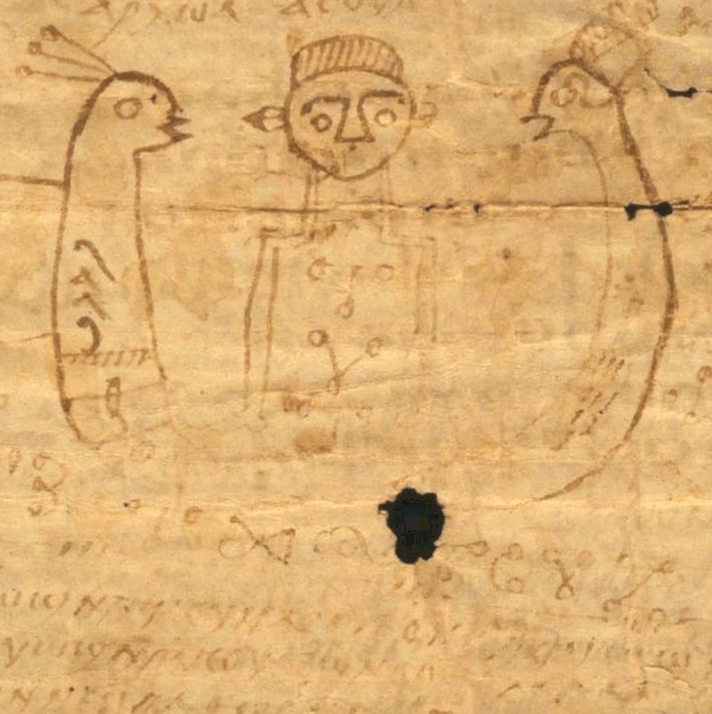
On top of the head, a few vertical lines are visible. Imagine my surprise when I saw a page of a Coptic magical book, featuring a very similar setup, notably in the detailing of the head! [3]

The two ‘blobs’ in the magical book appear to be creatures with the head of birds, while the arrow through the head and the headgear itself are also recognizable in their watered-down rendering on the pendant.

Papyrus RMO inv. F 1964/4.14, 11th century

Another form often found on the Bahariya discs is that of a square with a human neck and head, flanked by two vegetal motifs. This representation as well features in Coptic magical papyri, such as visible in Pap. Heidelberg Kopt. 685. [4] Might the iconography of the Bahariya amulets be based on Coptic charms?

Coptic smiths, Coptic charms in traditional jewellery?

I feel that one fact has been overlooked in determining what the depiction on the Bahariya pendant could mean. It is the simple fact that the smiths were Copts that may prove to be the explanation for the iconography on the amulets.

Not because they were less skilled than Muslim smiths, nor because they had no interest in creating amulets for rituals outside their faith, but because they based their designs on the iconography that was well-known and used in their religion.

With this possible origin however, we still don’t know what these pendants meant to their wearers, who were largely Muslim. As both silversmiths have passed away, they can no longer share their story.

Did they use a magical papyrus as their sourcebook? Was there any other reason to decide for this type of decoration? In this particular case, it is too late to find out for sure.

What this example does illustrate however is the importance of regarding jewellery in its wider sociocultural context instead of only as adornment.

—

Where can I find more on the historical background of amulets in the Middle East?

Find out more about the social meaning of amulets in the e-course on Amulets and Magic in Jewellery!

Or start by downloading the free e-book explaining 6 ways amulets work here.

More articles on jewellery & amulets? Browse them all here!

Always the first to get new articles? Join the Jewellery List and bling up your inbox!

This post is based on the chapter ‘The Evil Eye and Other Problems’ on magic and jewellery in my book Desert Silver.

—

References

[1] Weissenberger, M., 1998. Les bijoux des oasis égyptiennes, in: Bliss, F. 1998. Artisanat et artisanat d’art dans les oasis du desert occidental egyptien, Rüdiger Köppe Verlag, Köln p. 319, also mentions that these amulets have completely disappeared from the markets.

[2] Weissenberger 1998, p. 319

[3] Raven, M. 2012. Egyptian Magic. AUC Press, Cairo, p. 172

[4] Heidelberg Inv. Kopt. 685 (Meyer) Lage 5 Seite 12 and 9, digitally available on the website of the Papyrological Institute of Heidelberg university here

The Bedouin Silver blog gives credit where credit is due! Transparent referencing and citing sources helps us all grow. Would you like to do the same and quote this article? Here’s how:

S. van Roode, [write the title as you see it above this post], published on the Bedouin Silver website [paste the exact link to this article], accessed on [the date you are reading this article and decided it was useful for you].

Sigrid van Roode

Sigrid van Roode is an archeologist, ethnographer and jewellery historian. Her main field of expertise is jewellery from North Africa and Southwest Asia, as well as archaeological and archaeological revival jewellery. She has authored several books on jewellery, and obtained her PhD at Leiden University on the jewellery of the Egyptian zar-ritual. Sigrid has lectured for the National Museum of Antiquities in Leiden, Turquoise Mountain Jordan, and many others. She provides consultancy and research on jewellery collections for both museums and private collections, teaches courses and curates exhibitions. She is not involved in the business of buying and selling jewellery, and focuses on research, knowledge production, and education only.
A shackled jinn from Oman

A shackled jinn from Oman

jewellery as protection

A shackled jinn from Oman

Updated June 25, 2025

Jewellery regularly doubles as protection, as it is worn so close to the body. Often this form of protection is of general nature, but every now and then it makes uses of specific elements to ward off a particular evil. This pendant from Oman hides such an element on its reverse side: a tiny figure of a shackled human form. What does this mean, and what does it tell us about the women who wore this necklace?

The image of a jinn on the Omani kirsh kitab

The disc-shaped pendant is known by several names. The most often used name is somt, which is also used for other round pendants of the same size. [1] In one publication it is called kirsh kitab. [2] A similarly shaped pendant with a comparable reverse side is called kokh, again in one publication: this pendant is decorated with gold leaf on its front side rather than an inscription. [3]

The pendant carries an inscription on its front side. This is the Throne Verse, one of the most powerful verses of the Quran and often used for protection. You will find it often on amulets throughout the Middle East and North Africa.

On the reverse side, in many cases you will find a stylized depiction of a human-shaped figure. This is an image only known to the woman wearing it. You would not be able to see it from the outside. Mostly, this figure is explained as a jinn, held captive by the power of the Throne Verse.

As such, these pendants offer protection from evil spirits in general. The figure however is in some cases said to carry a name. This jinn is not any jinn, but a very particular one. So which jinn is this, and why is it engraved on the back side of an Omani pendant?

The jinn on an Omani pendant: the Bahla Witch?

Forster explains the figure as a representation of the Bahla Witch.[4] Bahla, a fortress town in Oman, has a reputation for the presence of both jinn and witches. [5] The pendant would protect the wearer from witchcraft and jinn alike. As this pendant was worn in a much larger area than just Bahla however, this interpretation may well be true for the inhabitants of the town itself, but there is another possibility that would make sense to many women.

The jinn on an Omani pendant: Umm as-Subyān

This other explanation is that of the human figure as Umm as-Subyān, ‘Mother of Children’. [6] This female jinn is well known beyond Oman and appears also further on the Arab Peninsula. But who is Umm as-Subyān?

In the most benign version, she is said to cause nightmares in children and uncomfortable wet dreams for boys in particular. But, there is more to her than just a night filled with bad dreams. She may be really dangerous.

Anne Regourd has researched how this jinn features in Yemeni oral traditions. [7] These tales share a more gruesome side to Umm as-Subyāns character: she lures young children away from their mothers and eats them, and she also takes newborns. Another tale records how she is capable of possessing young men and women, who then can’t seem to marry, no matter how much they try.

Regourd concludes that Umm as-Subyān is intent on preventing the arrival of children. She tries to prevent marriage altogether, and if a union does succeed, she takes and kills the offspring.

In short, Umm as-Subyān embodies what every woman feared: the inability to have children. [8]

Having children: fertility amulets in the Middle East

Why is not having children something to be afraid of? Fertility was one of the most fundamental aspects of a woman’s life. Having children was important: they assisted from a young age in the daily running of household and work, and would take care of their parents when these grew old. Remember, this is a past in which no retirement funds or care-homes existed!

Not having children could even be reason for divorce. Add to that a high infant mortality rate, and the pressure women were undeer becomes apparent. All over the Arab world, jealous jinn were thought to obstruct attempts at getting pregnant and bearing healthy children.

In this respect, Umm as-Subyān is comparable to for example the Qarina in Egypt [9] and La Taba in Morocco [10]. All three target newborns and young children, and cause infertility or miscarriages in young women.

Many women took precautions to make sure these jinn were rendered harmless, and these precautions often took the form of personal adornment. Jewellery is worn close to the body, and so forms a barrier between you, and the outer world full of dangers.

An Omani pendant with a hidden message

In the case of Umm as-Subyān, two ways of averting her are in both the name humans use when talking about her, and the way she is depicted on the pendant. The name ‘Mother of Children’ uses reverse magic. She is called by the exact opposite of her actions, a form often seen in informal magical practices around the world.

In the image on the pendant, the stylized figure is shackled around her ankles and wrists. Immobilized, she is not able to come for the wearers’ children or prevent her from getting married.

Jewellery reveals a woman’s world of worry

As with anything jinn-related, there is not one definitive identification or final explanation. With the presence of the Throne Verse, the pendant protects against evil influences in general.

The tiny shackled figure, in the story of Umm as-Subyān, reveals a world of worry for women, and so the pendant protects them from what well may have been one of their worst fears.

—

Where can I find more on women and amulets in the Middle East?

Find out more about the historic value of amulets in the e-course on Amulets and Magic in Jewellery!

Or start by downloading the free e-book on amulets and jewellery here.

More posts on jewellery and amulets? Browse them all here!

Join the Jewellery List and receive new articles, jewellery news and more in your inbox!

—

References

See the book chapter on these amulets by James Redman, which discusses the texts and context of precisely this pendant type in much more depth. This chapter was published in Nov 2020, after the writing of this blog post. Highly recommended reading!

 [1] A. Forster 2000. Disappearing Treasures of Oman. Archway Books, Somerset, p. 38-39

[2] P. Shelton, R. Richmond & M. Morris, Oman Adorned.

[3] J.S. Rajab 1998, Silver Jewellery of Oman. Tareq Rajab Museum, Kuwait, p. 63

[4] Forster 2000, p. 40

[5] See L.J. Borger 2011, By the Pricking of My Thumbs, Something Wicked This Way Comes: Omani Perceptions of the Supernatural. Independent Study Project (ISP) Collection. 1039., for a discussion of the supernatural in Omani society.

[6] P. Shelton, R. Richmond & M. Morris, Oman Adorned, p. 102; L. Mols, Kunst uit Zilver. Traditionele sieraden van Oman, in: L. Mols & B. Boelens (red) Oman, p. 137

[7] A. Regourd 2012, Représentations d’Umm Sibyan dans les contes yéménites : de la dévoreuse d’enfant à la djinniyya possédant les humains, in: A. Caiozzo & N. Ernoult (eds), Femmes médiatrices et ambivalentes. Mythes et imaginaires, Paris, Colin, pp. 63 – 72

[8] Regourd 2012, p. 72

[9] See my article in RAWI Magazine for the qarina

[10] J. Bois, La Sorcellerie au Maroc, nouvelle édition 2014, Dar al-Amane, Rabat p. 198.

The Bedouin Silver blog gives credit where credit is due! Transparent referencing and citing sources helps us all grow. Would you like to do the same and quote this article? Here’s how:

S. van Roode, [write the title as you see it above this post], published on the Bedouin Silver website [paste the exact link to this article], accessed on [the date you are reading this article and decided it was useful for you].

The Bedouin Silver Jewellery Blog: Sigrid van Roode

Sigrid van Roode is an archeologist, ethnographer and jewellery historian. Her main field of expertise is jewellery from North Africa and Southwest Asia, as well as archaeological and archaeological revival jewellery. She has authored several books on jewellery, and obtained her PhD at Leiden University on jewellery, informal ritual and collections. Sigrid has lectured for the National Museum of Antiquities in Leiden, Turquoise Mountain Jordan, and many others. She provides consultancy and research on jewellery collections for both museums and private collections, teaches courses and curates exhibitions. She is not involved in the business of buying and selling jewellery, and focuses on research, knowledge production, and education only. Sigrid strongly believes in accessibility of knowledge, and aims to provide reliable and trustworthy content: that’s why the Bedouin Silver blog provides references and citations.

Knot magic in adornment

Knot magic in adornment

the magic of tying

Knot magic in adornment

Updated Jun 25, 2025

In many forms of adornment from the Middle East and North Africa, you’ll find a form of intricacy. Interwoven patterns, knots and complex shapes are added to jewellery and adornment for a reason: there is power in intricacy. That power goes back to the cultural significance of knotting, tying and binding.  In this article, we’ll have a look at the magical meanings behind that simple act we all carry out on a daily basis, and that is tying a knot in something.

The history of knot spells

Knots are an ambivalent symbol; they are believed to have curative properties, but they are also said to restrain, bind and strangle.

Even in everyday language, the mention of knotting and untying is often used as a reference to having or solving problems: in Cairo for example, the question ‘Did you get untied?’ actually means ‘Did you solve your problems?’ [1] This power attached to knots dates back deep in in history. One way of undoing magic spells cast on you is untying the knots with which these have been bound together: untying knots is undoing magic.

Babylonian cuneiform texts from as far back as the eighth century BC reveal spells using knots [2], and in ancient Egypt, the hieroglyph denoting protection depicts a series of knots in a rope. In ancient Rome, the Hercules knot was regarded as a powerful talismanic symbol.

Knot magic in the Middle East: what do knots mean?

Knots have many meanings in magic: they can bind, but also strangle. In contemporary Egypt, a wool cord with seven knots, called an ‘uqad,is used to combat fever. The knots are tied by a ritual practitioner who subsequently blows on them, a practice also mentioned in sura 113 of the Qur’an.

The symbolism of knots in the Middle East is powerful. In Syria, both bride and groom take care not to have anything knotted in or on their wedding costume in order to ensure fertility and health. A Palestine lullaby sings ‘Oh our moon, oh sleepy one, loosen your girth and go to sleep’: the loosening of the girdle brings about a state of relaxedness and comfort. [3]

The importance of knots in transition stages is illustrated by a death ritual of the Mandeans in Iraq and Iran. When a sick person is dying, he is washed and clothed in new clothes, but the knot of his girdle is left unfinished. Upon the moment of actual passing, the knot is completed, and after death the last, final knot is tied and the girdle arranged properly. [4]

Knot magic as protection

Intricate knots are often present in amulets: their goal is to utterly confuse the evil eye in order to distract its attention from the wearer or inhabitant of the house. Knot patterns on engraved seals serve the same purpose, besides their wonderful ornamental value, and mark the end of Quranic verses on written amulets. [5]

Written spells are sometimes seen encircled by a border of knots or braids [6], another example of the way these intricate motifs helped to keep evil out and thus enhance the power of the spell.

Tying a knot in your hair was also considered an effective way against spirit possession in Sudan: if you had been previously possessed and were to attend a possession ritual for someone else, tying a knot into your hair would ensure you would not be bothered by a spirit. [7]

What do knots of fabric in trees mean?

Related to tying knots is the use of textile scraps in places that carry significance. Trees near shrines, graves, tombs and (surprisingly often) ancient ruins sometimes carry worn and bleached pieces of textile in their branches. These are tied there on behalf of sick people, hoping the saint, deceased or spirit of the place will heal the owner.

That this practice is still very much alive is for example seen in the visitor regulations of the Shah-i-Zinda mausoleum complex in Samarkand: the rules clearly state that tying a knot is forbidden.

Tying knots: a small ritual of the everyday

You see how a seemingly mundane object, the knot, may represent so much more than just a utilitarian aspect of life. Because beyond the directly utilitarian, the act of tying a knot is often highly meaningful, but after a while all we are left with is the material component of ritual: a simple knot.

Although these materials remnants of magic are inconspicuous and often do not survive in the archaeological record [8], they are among the most used forms of everyday magic and can be seen everywhere if you realize where to look!

—

Where can I find more on everyday practices in magic and jewellery?

Find out more about the magic of acts and gestures in the e-course on Amulets and Magic in Jewellery,

…explore more articles on magic in jewellery from the Middle East here…

or download the free e-book on amulets and talismans!

This post is partly based on the chapter ‘The Evil Eye and Other Problems’ on magic and jewellery in my book Desert Silver.

—

References

[1] Early, E. 1993. Baladi women of Cairo: playing with an egg and a stone. American University in Cairo Press, Cairo, p. 127

[2] Day, C. 1950. Knots and Knot Lore, in: Western Folklore, Vol 9, no. 3

[3] Masterman. E.W.G. 1901. Dress and Personal Adornment in Modern Palestine, in: The Biblical World, Vol. 18 No. 3

[4] Drower, E.S. 1937, The Mandaeans of Iraq and Iran, p. 260

[5] An example is seen in V. Porter, 2017. Arabic and Persian Seals and Amulets in the British Museum, p. 179

[6] Nünlist, T, 2019. Enzauberte Amulettrollen, in: Günther, S. and D. Pielow (eds), Die Geheimnisse der Oberen und Unteren Welt: Magie im Islam zwischen Glaube und Wissenschaft, Brill, Leiden, p. 252

[7] Zvenkovsky, S. 1950. Zar and Tambura as practiced by the women of Omdurman, in: Sudan Notes and Records Vol. 31, no. 1, p. 81

[8] Like noted for example by Cameron Moffett, 2019, in The Amulets of Roman Wroxeter: Evidence for Everyday magic, in: Transactions of the Shropshire Archaeological and Historical Society 94, p. 46

The Bedouin Silver blog gives credit where credit is due! Transparent referencing and citing sources helps us all grow. Would you like to do the same and quote this article? Here’s how:

S. van Roode, [write the title as you see it above this post], published on the Bedouin Silver website [paste the exact link to this article], accessed on [the date you are reading this article and decided it was useful for you].

The Bedouin Silver Jewellery Blog: Sigrid van Roode

Sigrid van Roode is an archeologist, ethnographer and jewellery historian. Her main field of expertise is jewellery from North Africa and Southwest Asia, as well as archaeological and archaeological revival jewellery. She has authored several books on jewellery, and obtained her PhD at Leiden University on jewellery, informal ritual and collections. Sigrid has lectured for the National Museum of Antiquities in Leiden, Turquoise Mountain Jordan, and many others. She provides consultancy and research on jewellery collections for both museums and private collections, teaches courses and curates exhibitions. She is not involved in the business of buying and selling jewellery, and focuses on research, knowledge production, and education only. Sigrid strongly believes in accessibility of knowledge, and aims to provide reliable and trustworthy content: that’s why the Bedouin Silver blog provides references and citations.

Magic Squares

Magic Squares

the power of mathematics

Magic Squares

Updated Jan 17, 2024

What is a magic square? A magic square is a well-known variety of amulets based in numerology: a numerical arrangement that has magical meaning. Numbers are as meaningful as words in the symbolism of the Middle East, and so a magic square is considered a powerful amulet. They exist in many forms, and they also take the form of jewellery. Where do they come from, and how do they work?

The buduh-square: the most widely used magic square

The most widely used square is the ‘buduh’-square: an arrangement of the numbers 1 through 9 with 5 in the middle, that reads 15 in all directions.  One example of this square is visible in the silver amulet featured in the gallery below: click to enlarge and see its details.

This square gets its name from the four letters on the corners of the square when noted down in the Abjad letter-numerals: b-d-w-h. Its powers were believed to be so strong that the name ‘buduh’ itself was enough to invoke that power. [1]

The number five in the centre of the basic magic square is significant: five is a number that carries a special meaning throughout the Middle East. See how this number is worked into jewellery in this article on numerology in jewellery.

The placement of the number five in the centre is also an indication of the universe, in symbolizing humankind in the middle of the four cardinal points.

Elaborating on this idea, the central number in any magic square is often considered to represent God in the centre of His creation. Some amulets leave this middle field blank out of respect for God, or simply write Allah or one of the 99 Names of God.

The magic square in this way becomes a symbol of God, holding the universe in order and controlling creation.

What is the history of magic squares?

The magic square has a very long history. The buduh-square is first encountered in a 9th or 10th century copy of the writings of Jabir ibn Hayyan, and is said to ease childbirth. [2] Its origins probably are much older and to be found in China, from where it traveled along the Silk Road to the Arab world. [3]

After the buduh-square, many other magical squares have been developed and worked into silver amulets. Their use is not limited to the Islamic world. A Christian version of a magical square can be found on the Sagrada Familia in Barcelona, where the numbers read 33 in all directions. In this square however some numbers are repeatedly used, while it is preferred to use the same number only once in a magical square.

The composition of magic squares is also not limited to 3 x 3 rows, but can be expanded as well. The example in the gallery above (click to enlarge for details) shows a magic square of 4 x 4 rows.

Magic squares as talisman and amulet

Magical squares are often used in jewellery, as amulet or talisman.

Pseudo-magic squares are also in use in jewellery. These are an imitation of a magic square, but then with symbols and numbers arranged without any specific order. The use of pseudo-magic squares is illustrative for the decline in meaning of a ‘true’ magic square: instead of the order of the universe, only the shape of the square is regarded as beneficial.

Elaborate, purpose-made magic squares are very personal and created for a specific goal, and often worn hidden from view. They are painted on garments, or worn on a necklace.

The magic square has been, and still is, in use throughout the Middle East in Islamic, Christian and Jewish tradition.

—

Where to find more on amulets and magic in jewellery?

Check out the e-course on Amulets and Magic in Jewellery – there’s an entire section devoted to numerology and jewellery!

Explore more articles on amulets, charms and jewelry from the Middle East here…

…or download the free e-book on amulets from North Africa & the Middle East!

This post is based on the chapter ‘The Evil Eye and Other Problems’ in my book Desert Silver

—

References

[1] Savage-Smith, E. 1997. Amulets and related talismanic objects, in: Raby, J. (ed) 1997. The Nasser D. Khalili Collection of Islamic Art. Vol. XII. The Nour Foundation, New York p. 106

[2] Kriss, R. & H. Kriss-Heinrich, 1962. Volksglaube im Bereich des Islam. Band II. Amulette, Zauberformeln und Beschwörungen. Otto Harrassowitz, Wiesbaden, p. 84 relate that the square should be drawn on two linen bandages, that have to be shown to the pregnant woman after which they are placed underneath her feet.

[3] See Schuyler Cammann, Islamic and Indian Magic Squares Part I, in History of Religions Vol 8 No 3 (1969) pp 181-209 for more information about the Chinese origins of this square.

The Bedouin Silver blog gives credit where credit is due! Transparent referencing and citing sources helps us all grow. Would you like to do the same and quote this article? Here’s how:

S. van Roode, [write the title as you see it above this post], published on the Bedouin Silver website [paste the exact link to this article], accessed on [the date you are reading this article and decided it was useful for you].

The Bedouin Silver Jewellery Blog: Sigrid van Roode

Sigrid van Roode is an archeologist, ethnographer and jewellery historian. Her main field of expertise is jewellery from North Africa and Southwest Asia, as well as archaeological and archaeological revival jewellery. She has authored several books on jewellery, and obtained her PhD at Leiden University on jewellery, informal ritual and collections. Sigrid has lectured for the National Museum of Antiquities in Leiden, Turquoise Mountain Jordan, and many others. She provides consultancy and research on jewellery collections for both museums and private collections, teaches courses and curates exhibitions. She is not involved in the business of buying and selling jewellery, and focuses on research, knowledge production, and education only. Sigrid strongly believes in accessibility of knowledge, and aims to provide reliable and trustworthy content: that’s why the Bedouin Silver blog provides references and citations.