Bahariya discs: Coptic magic

Bahariya discs: Coptic magic

Bahariya discs

connecting cultures

The Bahariya discs: Coptic magic in jewellery

Updated July 28, 2024

The decoration on a piece of jewellery sometimes is puzzling. An example is the round disc worn by women in the Bahariya oasis in Egypt’s Western Desert until the 1960’s. Because the origin of this jewellery item has long been subject of discussion, it is a very illustrative case to discuss in more detail.

What do the disc pendants from Bahariya Oasis look like?

The image below shows a pendant from Bahariya Oasis. Like all its siblings, it is made of blank metal instead of silver. They are quite rare: in the last 25 years, I have come across an original Bahariya ornament only once. [1]

This probably is due to the fact that they were a ‘limited production’: they are known to have been made by two Coptic silversmiths, who lived in the oasis until one of them died. At that point, the other one decided to move out of the oasis and settled in Cairo. They were the only ones that created these discs: with their demise and relocation, no other discs were made.

From that moment onwards, the people of the oasis had to buy their jewellery from elsewhere; the two Copts were the last silversmiths in Bahariya. But what do the engravings on these discs represent?

Decoding the symbolism on the Bahariya discs

These discs have been interpreted as derivates of Egyptian zār-amulets, or as Nubian imitation coins, and their possible relation to the Siwa adrim has been investigated as well. But none of these are right. They are not zār, they are not coins, they are not related to the adrim.

So where does the unique decoration on the amulets finds its source…?

It has been suggested that the two silversmiths may not have been as well versed in both technique and decoration, since they were Copts and had little rapport with Islam. [2] So basically, the silversmiths just didn’t get it? That can’t be it.

Because it is not uncommon for silversmiths to be of another social group or faith than the group the smith is catering to. Most of the silversmiths in the Middle East were Jews up until 1948, and they made jewellery for Muslim, Jewish and Christian clients.

But the silversmiths may still be the cental clue here….

Coptic magic: papyri and images

Let’s have a closer look at the image on this disc shown above. In the middle, a standing figure is visible, hands raised, flanked by two amorph blobs. The head of the figure is detailed with wide open eyes, a broad nose, and curious horizontal strikes through the head.

On top of the head, a few vertical lines are visible. Imagine my surprise when I saw a page of a Coptic magical book, featuring a very similar setup, notably in the detailing of the head! [3]

The two ‘blobs’ in the magical book appear to be creatures with the head of birds, while the arrow through the head and the headgear itself are also recognizable in their watered-down rendering on the pendant.
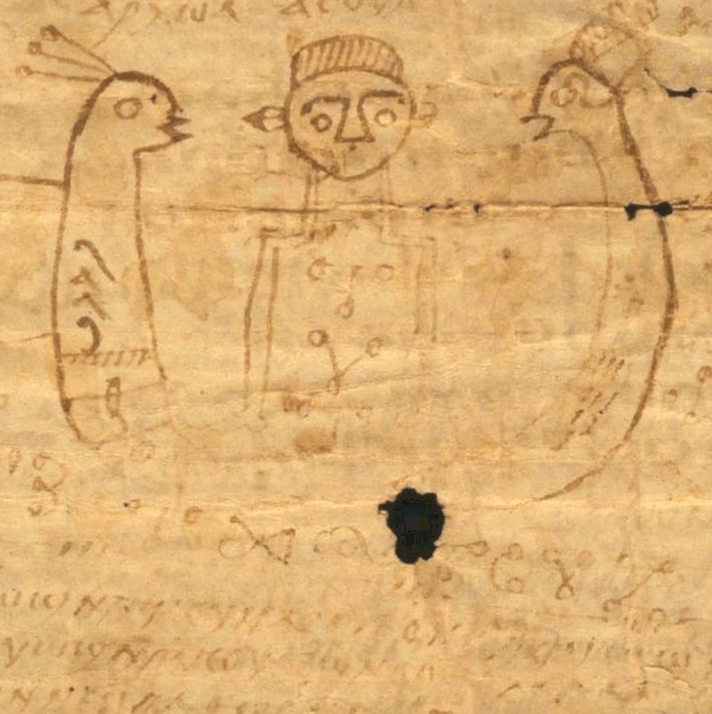
Papyrus RMO inv. F 1964/4.14, 11th century

Another form often found on the Bahariya discs is that of a square with a human neck and head, flanked by two vegetal motifs. This representation as well features in Coptic magical papyri, such as visible in Pap. Heidelberg Kopt. 685. [4] Might the iconography of the Bahariya amulets be based on Coptic charms?

Coptic smiths, Coptic charms in traditional jewellery?

I feel that one fact has been overlooked in determining what the depiction on the Bahariya pendant could mean. It is the simple fact that the smiths were Copts that may prove to be the explanation for the iconography on the amulets.

Not because they were less skilled than Muslim smiths, nor because they had no interest in creating amulets for rituals outside their faith, but because they based their designs on the iconography that was well-known and used in their religion.

With this possible origin however, we still don’t know what these pendants meant to their wearers, who were largely Muslim. As both silversmiths have passed away, they can no longer share their story.

Did they use a magical papyrus as their sourcebook? Was there any other reason to decide for this type of decoration? In this particular case, it is too late to find out for sure.

What this example does illustrate however is the importance of regarding jewellery in its wider sociocultural context instead of only as adornment.

Where can I find more on the historical background of amulets in the Middle East?

Find out more about the social meaning of amulets in the e-course on Amulets and Magic in Jewellery!

Or start by downloading the free e-book explaining 6 ways amulets work here.

More articles on jewellery & amulets? Browse them all here!

Always the first to get new articles? Join the Jewellery List and bling up your inbox!

This post is based on the chapter ‘The Evil Eye and Other Problems’ on magic and jewellery in my book Desert Silver.

References

[1] Weissenberger, M., 1998. Les bijoux des oasis égyptiennes, in: Bliss, F. 1998. Artisanat et artisanat d’art dans les oasis du desert occidental egyptien, Rüdiger Köppe Verlag, Köln p. 319, also mentions that these amulets have completely disappeared from the markets.

[2] Weissenberger 1998, p. 319

[3] Raven, M. 2012. Egyptian Magic. AUC Press, Cairo, p. 172

[4] Heidelberg Inv. Kopt. 685 (Meyer) Lage 5 Seite 12 and 9, digitally available on the website of the Papyrological Institute of Heidelberg university here

The Bedouin Silver blog gives credit where credit is due! Transparent referencing and citing sources helps us all grow. Would you like to do the same and quote this article? Here’s how:

S. van Roode, [write the title as you see it above this post], published on the Bedouin Silver website [paste the exact link to this article], accessed on [the date you are reading this article and decided it was useful for you].

Sigrid van Roode

Sigrid van Roode is an archeologist, ethnographer and jewellery historian. Her main field of expertise is jewellery from North Africa and Southwest Asia, as well as archaeological and archaeological revival jewellery. She has authored several books on jewellery, and obtained her PhD at Leiden University on the jewellery of the Egyptian zar-ritual. Sigrid has lectured for the National Museum of Antiquities in Leiden, Turquoise Mountain Jordan, and many others. She provides consultancy and research on jewellery collections for both museums and private collections, teaches courses and curates exhibitions. She is not involved in the business of buying and selling jewellery, and focuses on research, knowledge production, and education only.

Jewels of the Nile

Jewels of the Nile

Jewels of the Nile

The Marrs Collection
ancient egypt

Jewels of the Nile

Ancient Egyptian jewellery never ceases to fascinate. Be it original ancient pieces or Egyptian revival-style of the last century, the allure of Egypt continues to capture the imagination and serve as inspiration. The splendid collection of the Worcester Art Museum encompasses pieces from pharaonic Egypt up to the early 20th century. These have now been published in the book Jewels of the Nile: a book that not only presents the jewellery itself, but offers a wide range of contextual information on ancient Egypt, the history of collecting and the opportunities that jewellery research has to offer, to name but a few. This scope makes Jewels of the Nile into an exceptional book.

The jewellery collection presented in the book has been assembled by Laura Marrs (1845-1926). She and her husband met with Howard Carter in the early 20th century, and the latter advised the couple for many years on which pieces to buy. Howard Carter of course would later be remembered as the discoverer of the tomb of Tutankhamun –the centennial of the discovery approaching is one of the reasons for this book to be published.

To provide a historic background for the jewellery, the book starts out with a brief overview of Egyptian history. Next is an important chapter on the collector of the jewels, Laura Marrs, which is as much about Howard Carter as it is about Mrs. Marrs. Snippets of letters exchanged show the great talent of Carter as an artist – the Marrs couple also commissioned several water colour drawings which are included in the book. The letters and other documentation preserved in the personal archive of Mrs. Marrs shed light on how their collection was built: not only on the advice of Carter, but of Mohamed Mohassib as well, an antiquities dealer in Luxor. This chapter provides a glimpse of the world of antiquities trade a century ago, a thread that is picked up and returned to in the chapters that follow.

The chapter on jewellery itself covers a wide variety of jewellery-related aspects. In the introduction, emphasis is placed on the value jewellery holds as source of information about the past and the circumstances in which this value speaks the loudest, in carefully documented archaeological research. This goes not only for burials, like the chapter mentions, but also for production places, discard heaps and stray jewellery like beads found in settlements, although the richest jewellery assemblies of course have been found in burial contexts and as such have much to offer in terms of research. An absolutely stunning testimony to the skill of the ancient Egyptian craftsmen is the silver scarab of a person named Wah: a small but perfectly shaped scarab with even smaller inlaid hieroglyphs. (I also love the way the photographer is reflected in its shining surface, a problem I run into myself often when photographing silver jewellery….it’s simply inevitable!) Colour symbolism along with three sections on various materials and techniques deepen our understanding of Egyptian jewellery. A section on Egyptian revival jewellery illustrates how both original pieces and Egyptian inspired jewellery came to be all the rage from the 1870’s onwards.

It is difficult to pick a favourite chapter in this book, but if I had to, it would be the chapter on conservation, technique and research. Here, the value of jewellery research is shown in several exciting discoveries. The restringing of beaded jewellery for example: in the timeframe these beads were collected, stringing them into interesting-looking compositions was standard and carried out by either the seller, or later, the buyer. This was not exceptional: in many parts of the world, restringing beads uncovered during archaeological excavation was executed with little or no regard for their original composition or stringing technique. This chapter discusses and illustrates the choices made in researching and reassembling beads, with results that might surprise you – a jumble of strings becoming an elegant and well-balanced piece. That is just one example of this fascinating chapter: cleaning, restoration and amulet production are combined with bits and pieces about the organization of ancient Egyptian craftmanship. Jewellery research is not limited to this chapter, as hidden away at the end of the book is another detailed analysis of an ancient Egyptian plaquette mounted in a modern brooch, which illuminates what research can and cannot (yet) determine: possibilities for future research angles!

The catalogue of jewellery items finally is simply a treasure. This is not only due to the high quality of the jewellery items in the collection, but certainly also because of the fabulous photography and design of the book: large images, in vibrant colours, with plenty of space for detailed shots. Every single piece is allowed to shine and the combinations are equally vivid. A bibliography along with additional information for each catalogue entry completes the volume. An absolutely stunning, highly informative book that you will want to both read and admire!

Jewels of the Nile. Ancient Egyptian Treasures from the Worcester Art Museum, by Peter Lacovara and Yvonne J. Markowitz. 216 pp, full colour, in English

Available through the publisher D Giles Limited

The book was gifted as advance reading copy by the publisher.

Ancient Egyptian Jewelry

Ancient Egyptian Jewelry

Ancient Egyptian Jewelry

50 masterpieces
ancient masterpieces

Ancient Egyptian Jewelry

A new book on jewellery from ancient Egypt, featuring 50 well-known masterpieces: at first I wondered why I would want to read this, as many of the pieces have been published before. Let me tell you, here and now, that I’m really glad I did! It’s definitely a wonderful addition to my library, and here is why you will love it, too.

What immediately caught my eye and initially persuaded me to buy the book, is the photography. Each jewellery item has been photographed so beautifully that just browsing through the book is such a delight. The photography is crisp, clear, modern and very attractive: it makes you observe the jewellery in another way and it certainly made me gasp at the intricate designs and high level of artistry these ancient jewelers achieved.

Each piece of jewellery is given its own spread (2 pages). One entire page is used for the image, and the other for the accompanying text. What I found very useful is the concise overview of all the details for each piece: materials, dimensions, date, owner, inventory numbers, and if at all known, excavation date and campaign. The main body of the text describes the piece in detail and explains the background and meaning of materials and motifs used. The result is that the book provides, seemingly in passing, an enormous amount of information about religion, economy, trade, history and craftsmanship.

Besides jewellery, the book also presents a few other forms of ornament, like a beautiful mirror, a stunning dagger that once belonged to a princess, and the daggers of Tutankhamun. From the early Dynastic period to the Roman period, the jewellery items in the book illustrate Egypt’s history, show its consistency in certain beliefs and traditions, and its innovative adaptations of new techniques, shapes and forms. All in all, this is a concise yet value-packed, and visually very pleasing book that you can’t go wrong with.

Ancient Egyptian Jewelry. 50 Masterpieces of Art and Design. By Nigel Fletcher-Jones. AUC Press, Cairo. 112 pages, full colour

Read more on the website of AUC Press.

The book was purchased through Amazon.

Paint It, Black

Paint It, Black

Paint it, Black

A biography of kohl containers
eye make-up

Paint it, Black

With a title so rock and roll, a book can only be fabulous, and is certainly what Paint it, Black by Jolanda Bos is. In this study, she zooms in on one of the most well-known objects from the Arab world and beyond: kohl containers. Kohl, kajal or surma is widely used to decorate eyes and eyelids. This practice dates back millennia; some of the oldest kohl containers come from ancient Egypt. Surprisingly enough however, no study into these items exited until now.

Kohl containers vary in size, shape and materials used throughout the regio under study in this book. By comparing their decoration and execution to that of other elements of costume and dress, it becomes possible to see where in the personal sphere these items belonged. In some countries, they are clearly at home in the realm of adornment and jewellery, while in other countries their place is more among dress and clothing. Associations like these tell us more about the values attached to these objects.

These values in turn are manifold. Throughout the book, their social and ritual values are presented and illustrated, but also their economical and technological values. In some countries, the containers are used in wedding rituals and as such imply a deeper meaning than just a container for make-up. This deeper level of meaning is also apparent in the many archaeological objects shown in the book, where protection and status were values closely connected to seemingly everyday utensils.

Beautifully illustrated and with a catalogue of over 30 objects, this book presents a unique overview of the history and use of kohl containers. I especially liked the intermittent ‘kohl stories’, in which an aspect of kohl (ancient and modern) is highlighted. This hardcover book will embellish your ethnographical library!

Here is a review of the book and photos of its UK launch in London, and here is a 13 minute podcast with the author about this topic.

Paint It, Black. A Biography of kohl containers, by Jolanda Bos (2019) Blikveld UItgevers Publishers

356 pp, full colour, in English. The book can be ordered directly with the publishers, via Oxbow books or via Casemate.

The book was a gift from the author and publisher.