Brand New Vintage

Brand New Vintage

Brand New Vintage

is it real or not?
pieces in the twilight zone

Brand New Vintage

For many collectors, a key aspect is whether a piece of jewellery has been used. Signs of wear are welcomed (to a certain extent, though; damage is often a bridge too far), and jewellery pieces that do not display any wear are sometimes dismissed as ‘too new’. With the presence of wear and age, it seems, comes the notion of authenticity. There is a category in between however, that is both brand new and old: pieces that have been purchased when they were new, but that have never been used. Is wear a reliable factor in determining authenticity?

Two examples

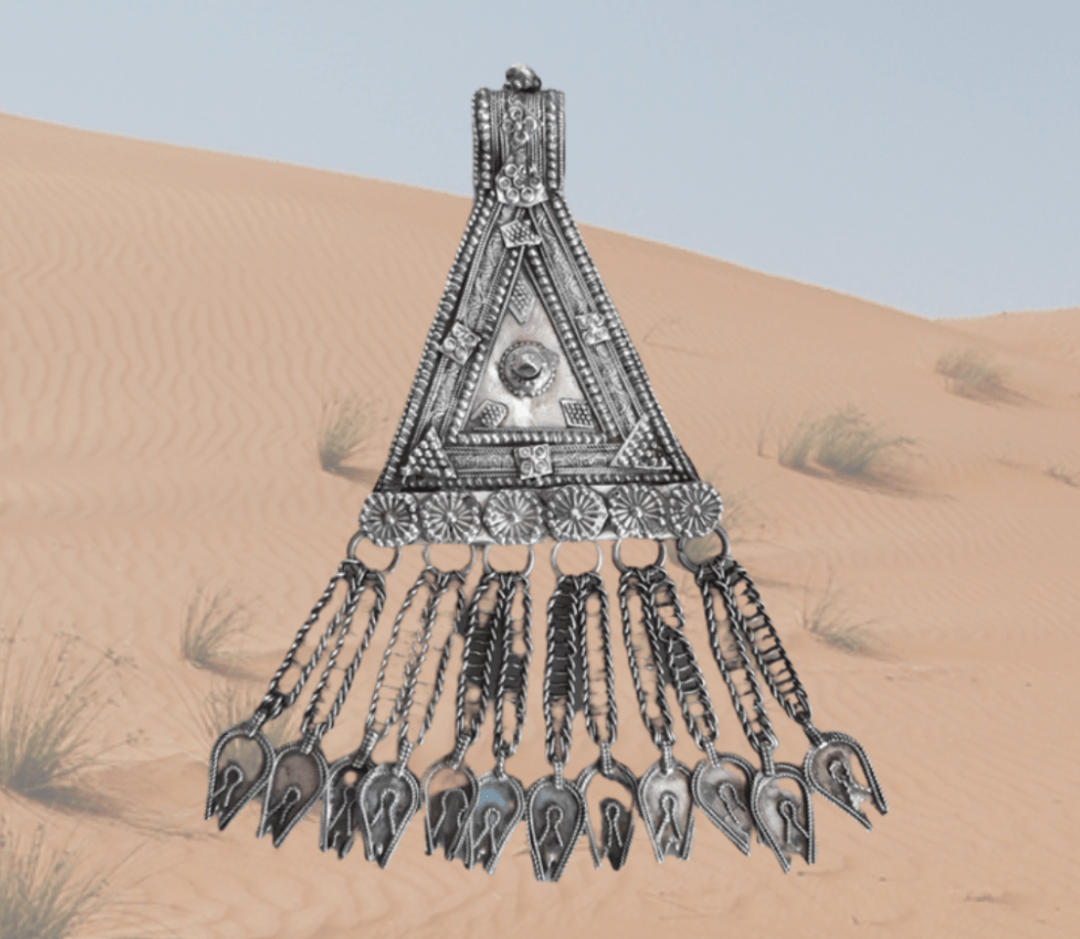
Featured below is a silver pendant from Oman, that would have been one of a pair. Both were worn on either side of the head, suspended from a leather or silver strap. This particular style of head jewellery was worn in the region of Sur. Now this pendant here has never been used. It feels sharp to the touch: the dangles are as edgy as the day they were made, and each raised decoration on the body of the ornament is still pristine. Yet, this item was purchased roughly 30 years ago.
The same is true for these five silver braid ornaments, also from Oman. Ornaments like these were worn in the region of Dhofar, but these five have never been worn as such. They come from the personal possessions of Shirley Temple-Black, and were most likely acquired during her years of service as a diplomat during the 1970’s and the 1980’s.

So are these real?

Yes, they are. An important thing to keep in mind is that by collecting vintage jewellery, you train your eyes to look specifically for signs of age. After all, collectors do not want to be duped into buying newly made copies that are passed off as vintage. That means that the absence of these signs of age (rounded edges, worn decoration, soft patina, to name but a few) casts doubt over the authenticity of a piece. Yet, there is a category of pieces that is new, but not produced recently.

The time of collecting

This category stems from the early days of collecting. Most traditional silver jewellery from the Arab world started to be collected in large numbers from the 1960’s onwards. The first wave was during the hippie-age, when many people flocked to the Middle East, a trend which then continued during the oil boom. That timeframe saw massive changes in clothing and adornment nearly everywhere in the world: traditional jewellery slowly ceased to be worn, but was still produced, old silver was traded in for gold, and jewellery items ended up for sale. This was before large scale tourism, before the Internet, and before the spike in interest for disappearing material culture: jewellery was still being created, but not especially for tourists, as a souvenir. Jewellery items newly bought in those years are now 60 years old.

The murky field of authenticity

Authenticity is one of the most debated topics within the field of material culture. A first observation is who determines what is, and what is not ‘authentic’ – I will talk about that in a future post. For jewellery, older objects are quicker to be accepted as authentic (‘this is at least 120 years old, it must be authentic’), but also in the past, things were passed off as traditional or specifically created to cater to the demand by others. Authenticity is not solely dependent on temporal aspects (age), but rather the intended interaction between the object and people is a vital aspect. Both jewellery examples shown above have been produced locally, to be part of a local attire that was still worn regularly, but were purchased by a non-local when they were still brand new. They are for all intents and purposes authentic parts of Omani culture: they just have never been used.

But how to discern between old-new and new-new…?

This category of newly made items that have been collected half a century ago depends mainly on sound documentation to attest its provenance. It’s a catch-22: without signs of age, it’s near impossible to tell whether it has been made yesterday or decades ago. Stylistic analysis may help: certain techniques are not mastered as well these days as half a century ago, the size of an object can be an indicator, or the materials used. But more than anything, this category depends on its documentation to connect it to its proper timeframe. So, if you own such a piece and you do remember more or less when and where you bought it, make a note of it. Very helpful are additions like an old photograph of the piece hanging on a wall in your house, for example, or a picture of you yourself wearing it. Both serve to confirm a timeframe when this piece was created, and help preventing misinterpretations when you are no longer there to share its story. This is especially important as this category has an unexpected added value.

A hidden value

Jewellery items like these might prove to possess an additional value: they are among the few surviving old pieces that are new. All jewellery once was new, of course, but after having been worn a lifetime, the surviving majority nowadays shows signs of wear. From a perspective of material studies, it is interesting to be able to compare a new item and a worn item that are of the same age. Having the original, newly made piece to compare to a similar piece that has been worn a lifetime provides another layer of information about the everyday life of the person who once wore this jewellery. Because after all, the story of jewellery is a story of people!

References

‘Authentic’: of undisputed origin; genuine

For more on Omani silver jewellery, see www.omanisilver.com

Jones, S. & T Yarrow 2013, Crafting authenticity: An ethnography of conservation practice, in: Journal of Material Culture, March 2013, Vol.18(1), pp.3-26

Broekhoven & A. Geurds 2013. Creating authenticity : authentication processes in ethnographic museums. Sidestone Press (read online for free)

Sigrid van Roode

Sigrid van Roode is an archeologist, ethnographer and jewellery historian. She considers jewellery heritage and a historic source. She has authored several books on jewellery from North Africa and Southwest Asia, and on archaeological jewellery. Sigrid has lectured for the Society of Jewellery Historians, the National Museum of Antiquities in Leiden and the Sultan Qaboos Cultural Center, among many others. She curates exhibitions and teaches online courses on jewellery from North Africa & Southwest Asia.

Silk Roads

Silk Roads

Silk Roads

Peoples, Cultures, Landscapes
cultural connections

Silk Roads

The Silk Roads…one of my favourite topics. The importance of Central Asia as a corridor for languages, inventions, sciences, and religions has been fundamental for the world we know today. As I traveled more and more through Central Asia, I gradually learned that for several centuries, this was the centre of the universe. I visited abandoned universities of the Middle Ages, marveled at astrolabia in museums (still can’t reproduce how they actually work, though) and explored both Greek and Buddhist complexes on the Uzbek-Afghan border on the same day. I followed the Oxus river all the way to its sources in the Tajik Pamir and (after I had recovered from a bout of altitude sickness) wondered how it could be that I still found myself within the reach of a 4th century Roman road map. Here, religions, technologies and people connected. On an unparalleled scale, writings from various cultures were translated into one and the same language, shared and improved upon. It is in this vast region that the foundations for many scientific methods and processes were laid, book printing enabled the spread of literature and scientific works even further, and art styles mingled and fused. In the last decade many excellent studies have appeared into this finely mazed, interconnected system of exchange. In 2019, Thames & Hudson added the heavy volume Silk Roads: Peoples, Cultures, Landscapes, edited by Susan Whitfield. And what a volume it is!

The approach chosen follows the various landscapes over and through which the networks existed. The main framework of the book are the sections Steppe, Mountains and Highlands, Deserts and Oases, Rivers and Plains, and Seas and Skies. I like how the landscape is the binding agent in this book, instead of the ubiquitous chronology. But what I really, really like is the how the editor has unlocked the rich variety in this book by cross-referencing material culture with categories in the table of contents. The material culture is divided over the categories cities/buildings/archaeological sites, ceramics and glass, coins and money, metalware and semi-precious stones, manuscripts, books and other writings, sculptures and paintings, textiles and ‘other’. Each of these is cross-referenced with the categories religion, military, clothing and accoutrement, and science. This allows you to search and find almost anything that meets your fancy, and I feel it perfectly illustrates the interconnectivity of the Silk Roads-system itself.

On to the lay-out: you will want to keep exploring these pages, as there is so much room for illustrations. The entire book is for the most part full-colour and shows sweeping views of the various landscapes, (details of) objects and maps. Every page is another invitation to read and see, to explore and learn.  Especially in this online day and age (because let’s face it, I’m writing this on a website and you’re here reading it) when investing in visuals in a book is not as self-evident as it used to be, this is a very welcome visual feast. I particularly enjoy the maps: I can look at them for hours, tracing how it all fits together. 

And besides photographs, what does this book offer? I would say it creates a larger context for an important part of history and puts individual finds in perspective. Over 75 contributors, each experts in their fields, have provided longer and shorter entries within the landscape framework. Each of the landscape chapters mixes a total of circa 20 angles in longer texts and box texts, in which specific objects or locations are the focus of attention. These are in turn tied in with the larger framework through references to other entries. One example is a well-known helmet found in the southern part of The Netherlands, highlighted in The Steppe and the Roman World. For The Netherlands, it is a unique find, but it is placed here in the larger context of cultural contacts between the Romans and the Sassanians. A Viking tapestry, found in Oseberg, shows a Buddhist ‘endless knot’, indicating contacts with Central Asia. That these existed is illustrated by means of the Samanid coin hoards, from current-day Uzbekistan and Tajikistan, found in Scandinavia as well as a bronze Buddha statuette found in Helgo, Sweden. The book links back and forth internally and externally to finds, ideas, technologies, religions and people connecting through time. What I particularly like is that every single entry ends with a few suggestions for further reading. It has definitely been a major piece of work for the editors to ensure that all of these bits and pieces of information are tied together instead of forming a loose bundle of trivia.  

The only thing that I found interesting but could do without, is the short introduction in the beginning about early photography in Central Asia. As much as I like old photographs and the pioneering days of this once new documentation art, this introduction did not do much for me in the overall view on the Silk Roads network – but it does make for beautiful illustrations.

All in all, this is a book to explore. Due to its encyclopedic approach with a multitude of entries, it will not be a book that you will read in one go from cover to cover. Rather, I found myself cherrypicking topics that I wanted to read about from that wonderfully cross-referenced table of contents, and then wandering from there throughout the book. An Islamic glass dish found in China led me to Buddhist relic keeping, and from Parthian textiles on the steppe I found myself back in Palmyra.  Silk Roads allows you to explore many narratives from many disciplines. For me, this way of weaving topics, places, people and cultures reflects the multi-layered capacity of history: there is not one linear story, not one fixed set of events. A book to treasure on many rainy afternoons!

Silk Roads: Peoples, Cultures, Landscapes. Edited by Susan Whitfield. 480 pages, 450 colour images and 200 b/w images.

See more images and views inside the book on the publishers’ website here.

The book is a gift from one of the contributors to the volume.

Tatreez and Tea

Tatreez and Tea

Tatreez and Tea

Embroidery as storytelling in the Palestinian diaspora
embroidery as storytelling

Tatreez and Tea

Updated Jan 20, 2024

When I was little, my mother and grandmother attempted to teach me cross-stitch embroidery. I remember very well the endless counting and recounting of the pattern, the frustration when I had miscounted and need to undo most of my stitches due to a mistake in the beginning, the art of using as little thread as possible (so no easy long-hauls at the back of the cloth…) and my happiness at the final result. It has been ages since I last picked up needle and thread, but I came across a wonderful book that really makes me want to start again!

Tatreez: more than just handicraft

The art of Palestinian cross-stitch embroidery is called tatreez, and it is infinitely more than just handicraft. Tatreez is both storytelling and affirming identity. Because it always has been a form of storytelling for hundreds of years, embroidery is the ultimate medium to keep telling and sharing the history of a people and of a nation.

In her book Tatreez and Tea, author Wafa Ghnaim combines all of these aspects in a very personal way.

Embroidery as teaching

Embroidered dresses document history, tradition and a way of life. By teaching her daughter to embroider, a mother would also transfer all of her knowledge to the next generation.

This could be practical knowledge, like how to deal with scorpions and snakes. The Snakes design holds no fewer than 5 lessons to be learned, and the Scorpions design teaches the same aspects that I learned during archaeological fieldwork in Egypt.

By means of nature, other concepts such as love and faith are illustrated as well. Ways of life are for example communicated through a beautiful design called Wheat Harvest, reflecting the importance of wheat, bread and hospitality.

Embroidery as historical record

This book however is far more than just an illustration of embroidery. Mixed in with every description of a pattern or a dress is the authors’ own family history. This makes this book all the more personal to read and places dress and adornment squarely where it belongs, at the heart of a people and a nation.

Embroidery is not just decorative or an art on the sidelines of life: embroidering keeps Palestinian culture alive and communicates its longterm and recent history. From the Cleopatra design to the Intifada and Missile designs, embroidery serves to affirm identity.

Tatreez and Tea: a must-read

I thoroughly recommend this book for anyone who would like to learn more about tatreez, its place in the Palestinian diaspora and the agency of dress and adornment. With over 400 pages, dozens of design patterns, terminology and techniques, tea, coffee and quince preserve recipes and personal history over several generations, this is a cultural treasure trove.

Update: Wafa Ghnaim’s second book THOBNA. Reclaiming Palestinian dresses in the diaspora is a powerful study of resistance embroidery that you will not want to miss.

—

Tatreez and Tea. Embroidery and Storytelling in the Palestinian Diaspora. By Wafa Ghaim. 428 pages.

Read more about the book, classes, lectures etc on the website of Tatreez and Tea.

Follow Wafa on Instagram for updates and embroidery!

I purchased the book directly from Wafa.

—

More book reviews? Browse them all here!

Never miss out on a new book or article? Join the Jewellery List and receive updates straight into your inbox!

The Bedouin Silver blog gives credit where credit is due! Transparent referencing and citing sources helps us all grow. Would you like to do the same and quote this article? Here’s how:

S. van Roode, [write the title as you see it above this post], published on the Bedouin Silver website [paste the exact link to this article], accessed on [the date you are reading this article and decided it was useful for you].

The Bedouin Silver Jewellery Blog: Sigrid van Roode

Sigrid van Roode is an archeologist, ethnographer and jewellery historian. Her main field of expertise is jewellery from North Africa and Southwest Asia, as well as archaeological and archaeological revival jewellery. She has authored several books on jewellery, and obtained her PhD at Leiden University on jewellery, informal ritual and collections. Sigrid has lectured for the National Museum of Antiquities in Leiden, Turquoise Mountain Jordan, and many others. She provides consultancy and research on jewellery collections for both museums and private collections, teaches courses and curates exhibitions. She is not involved in the business of buying and selling jewellery, and focuses on research, knowledge production, and education only. Sigrid strongly believes in accessibility of knowledge, and aims to provide reliable and trustworthy content: that’s why the Bedouin Silver blog provides references and citations.

Paint It, Black

Paint It, Black

Paint it, Black

A biography of kohl containers
eye make-up

Paint it, Black

With a title so rock and roll, a book can only be fabulous, and is certainly what Paint it, Black by Jolanda Bos is. In this study, she zooms in on one of the most well-known objects from the Arab world and beyond: kohl containers. Kohl, kajal or surma is widely used to decorate eyes and eyelids. This practice dates back millennia; some of the oldest kohl containers come from ancient Egypt. Surprisingly enough however, no study into these items exited until now.

Kohl containers vary in size, shape and materials used throughout the regio under study in this book. By comparing their decoration and execution to that of other elements of costume and dress, it becomes possible to see where in the personal sphere these items belonged. In some countries, they are clearly at home in the realm of adornment and jewellery, while in other countries their place is more among dress and clothing. Associations like these tell us more about the values attached to these objects.

These values in turn are manifold. Throughout the book, their social and ritual values are presented and illustrated, but also their economical and technological values. In some countries, the containers are used in wedding rituals and as such imply a deeper meaning than just a container for make-up. This deeper level of meaning is also apparent in the many archaeological objects shown in the book, where protection and status were values closely connected to seemingly everyday utensils.

Beautifully illustrated and with a catalogue of over 30 objects, this book presents a unique overview of the history and use of kohl containers. I especially liked the intermittent ‘kohl stories’, in which an aspect of kohl (ancient and modern) is highlighted. This hardcover book will embellish your ethnographical library!

Here is a review of the book and photos of its UK launch in London, and here is a 13 minute podcast with the author about this topic.

Paint It, Black. A Biography of kohl containers, by Jolanda Bos (2019) Blikveld UItgevers Publishers

356 pp, full colour, in English. The book can be ordered directly with the publishers, via Oxbow books or via Casemate.

The book was a gift from the author and publisher.