Losing sight

Losing sight

the decline in knowledge

Losing sight

Traditional jewellery is disappearing at a fast rate. It is no longer made in the quantities past generations would need, and it is being sold both in the countries of origin as well as in the regions of the world where collectors live. These days, that is not just ‘the West’, but also for example China: amber and coral are bought in bulk by Chinese collectors. But besides the jewellery itself, another valuable asset is disappearing at an even more alarming speed. That is knowledge about what this jewellery actually is – and what it represents.

That loss of insight is for example visible in the flawed identification of pieces of adornment. Sometimes these can be way off the mark, such as the Bedouin face veil shown in the gallery below. It was offered up for auction as a body ornament/necklace from Turkmenistan (1). The dorsal ornament from Turkmenistan, pictured below as well, was offered as a Saudi jewel. We might have a good laugh about such a mismatch (and I usually do), but the rate in which these appear is indicative of a much more serious matter.

Now you might think ‘Of course these are misidentified, they are being handled by cultural outsiders’ and that would certainly hold true in a number of cases. But incorrect attributions also, and increasingly, occur within the countries of origin themselves. The photograph in the gallery below shows several splendid Yemeni necklaces – I photographed these in the exhibition Splendour and Shine in the Flow of Time. When I posted this photograph on my Instagram-account, I received dozens of messages from Algerian followers insisting this was Algerian. The Turkmen jewellery, which I photographed on the Amsterdam Tribal Jewelry and Textiles Fair, received a lot of attention as well, with many people writing me these pieces were from Kabylia. These are just a few examples: I receive messages every single day of people who genuinely believe a piece of adornment stems from their culture, even if it hails from another continent, another culture, another language family entirely.

The loss of accurate knowledge also manifests in constructed images presenting as reality. Lebanese singer Myriam Fares launched a new music video early in 2022, in which she claimed to dress and perform in Amazigh tradition: the jewels and dress she used in an online dress-up challenge however were random and had very little to do with actual Amazigh adornment. (2)  The comments on this particular post range from appreciation to anger: misrepresenting Amazigh culture on a global stage by an Arab performer is adding insult to injury in an already strained dynamic. Being respectful about adornment has much wider implications than just ‘looking the part’: it includes understanding what jewellery actually means. The photograph of the young woman included in the image gallery (click ‘next’ on the right side of the gallery) is another example of a non-existent, exotic-looking ensemble. Constructed reality in older photographs is a well-known phenomenon, as I addressed in another blog post. It is however still very much alive today, where photos are made specifically to share one narrative or to convey one particular message. There is no such thing as neutral photographs, yet we often accept them as reliable sources of information. When we no longer recognize that a dress is worn the wrong way, or mismatched with ornaments that would not belong with it, the power of misinformation that is shaping our world view will only grow stronger.

You might also think ‘So what? A wrongly attributed piece, what’s the big deal?’. Incorrectly identifying pieces of adornment is not my point here. That happens all the time, and many of those glitches can be avoided with a little more research. My point is that ascribing pieces of heritage to another culture has consequences. In the continuous struggle for identity and acknowledgement that many cultures face, it is imperative to be aware that spreading misinformation is not helping, to say the least. It can even be outright damaging, if the misattribution occurs willfully and intentionally – rebranding heritage to fit a new narrative is one of the most vicious ways of erasing the past.

Piece by piece, accurate insights in dress and adornment are diluted further with chunks of misinformation that are repeated over and over again – the Internet is as fast as it is patient. Images are easily copied and shared, with the accompanying background information disappearing and being replaced by brief, and often wrong, captions. With the watering down of conducting proper research to simply ‘Googling’, these nuggets of misinformation continue to be repeated and shared. The meticulous work of Wafa Ghnaim of Tatreez and Tea is just one example of the time and effort it takes to bring back the detailed meaning of Palestinian tatreez from the brink of oblivion, and there are many more researchers that work tirelessly to ensure not only material culture survives, but its cultural, social, economic and historic meaning as well. One of the most important factors in this ongoing effort is that the results are shared widely, so they are accessible to people worldwide: the databases of both the Textile Research Centre and the Zay Initiative are just two examples of accessible information.

And we need those efforts more than ever. Because we have now arrived at that point where the transfer of knowledge to the next generation is crucial. If we lose sight of both the details of and the wider world behind adornment, if we let the stories of both wearers and collectors slip through the cracks of time, the remaining jewellery pieces will have lost their voice as a historic source forever.

—-

Do you own a collection? Please do try and document it as much as possible. Every little note helps! A free guide on how to get started with that is here.

Are you wondering what to do with your collection? Please consider the work of the Qilada Foundation – my non-profit initiative aimed at repatriating collections and everything they represent to their countries of origin.

References

1) Catawiki lot 59513855, auctioned on June 17th 2022

2) The choreography did, however: this was copied straight from a choreography by Kif-Kif Bledi, a group of performers who are known for their deep study of dance and identity. The contemporary twists they add to traditional dance made the choreography easily identifiable as a creation of Kif-Kif Bledi as shown in this video– the intellectual property dispute is still ongoing.

Sigrid van Roode

Sigrid van Roode is an archeologist, ethnographer and jewellery historian. She considers jewellery heritage and a historic source. She has authored several books on jewellery from North Africa and Southwest Asia, and on archaeological jewellery. Sigrid has lectured for the Society of Jewellery Historians, the National Museum of Antiquities in Leiden and the Sultan Qaboos Cultural Center, among many others. She curates exhibitions and teaches online courses on jewellery from North Africa & Southwest Asia.

Hair: untold stories

Hair: untold stories

the many meanings of hair

Hair: untold stories

Hair has been our most personal, natural form of adornment for millennia. We either hide it or show it, and it is so personal that it is regarded as an extension of the person itself. But hair is much more than that. The excellent exhibition Hair: untold stories in the Horniman Museum and Gardens is entirely devoted to the many meanings of hair.

Hair explores our relationship to human hair by looking at it from various perspectives. Researchers, artists, film makers, hair dressers, poets and photographers all weigh in to paint a vivid and sometimes unexpected picture of this material. The exhibition starts out with a section on hair as material: maybe not the first use to come to mind, but to me a refreshing way of looking at hair as something other than a part of our body or our appearance. Hair is a marvelous fibre: lightweight yet incredibly strong, flexible and absorbing. Hair was used to attach shark’s teeth to palm rib swords on the Kiribati islands in Oceania, but of course also in products related to hairstyling like wigs and fillers.

A large map illustrating the hair trade is very illuminating. I was aware that in many cultures, hair is shaven off for religious reasons, but never thought much about what that hair was used for: apparently, there is a thriving market for it, and not all of it goes to wig making. ‘Waste’ hair, collected when brushing, is sorted and sold as well. I learned that many early Afro wigs were made of yak hair coming from Central Asia and China, that nowadays synthetic wigs can also be made of fibres derived from banana skins, and much more.

What looks like a hair shop, is an art installation by Korantema Anyimadu, exploring the experiences of black and non-binary people with hair in the UK. Listening to their favourite songs, reading memories and looking around in the hair shop I learned a great deal about memories associated with the smell, feel, timing and handling of hair and the challenges of feeling ‘at home’ in a country where your basic hair care cannot be achieved so easily.

The section on Entanglements presents and discusses the balance between the personal aspects of hair and the social norms expected of the wearer: the eternal balance between individuality and the common. Bridal hair is associated with fertility and beauty, Victorian women were expected to wear their hair up when married, and keeping the first hairlocks of a child as memento is a worldwide phenomenon. Hair and death are shown in European mourning jewellery created with hair of the passed persons, and a topic I could personally relate to is how to deal with the loss of hair due to illness or chemotherapy.

A series of combs ends the exhibition: these are not just presented as hair maintenance tools, but as meaningful, powerful objects that can convey many messages. I really enjoyed this exhibition, as it managed to address many unexpected angles on hair in a comprehensible, enjoyable and thought provoking way.

Accompanying the main exhibition are several smaller photographic exhibitions: Cult Hair (on the lower gallery) and Intimate Archives (on the gallery above the World Gallery). The latter combines hair care rituals with spells and traditions, showing how acts of social care connect scattered and displaced people. A powerful expression of the meaning of body aesthetic, both as performative act and as carrier of identity!

Hair: untold stories in Horniman Museum and Gardens: find out more on the museum website

More on personal adornment in exhibitions and museums? Read about other collections here! Want to be kept in the know on new and forthcoming exhibitions and museum installations? Join the Jewellery List and have news delivered to your inbox!

Sigrid van Roode

Sigrid van Roode is an archeologist, ethnographer and jewellery historian. She considers jewellery heritage and a historic source. She has authored several books on jewellery from North Africa and Southwest Asia, and on archaeological jewellery. Sigrid has lectured for the Society of Jewellery Historians, the National Museum of Antiquities in Leiden and the Sultan Qaboos Cultural Center, among many others. She curates exhibitions and teaches online courses on jewellery from North Africa & Southwest Asia.

Horniman Museum

Horniman Museum

anthropological collection

Horniman Museum and Gardens

The Horniman Museum and Gardens in London (UK) houses a wonderful anthropology collection. Over 3,000 objects are on display, offering a wide view into how people all over the world experience their life and seek to understand their surroundings. I had the pleasure of visiting the museum and browse its gallery!

The museum was founded by Frederick Horniman, a tea trader who made a fortune with the company his father started. The museum is very clear about the colonial past of the museum and its collections: the collection of ethnographic objects to educate and inform people in Britain about other cultures was only possible in a colonial setting and with a fortune earned by the exploitation of others. The museum actively works with community researchers, artists and creatives on a continuous basis, and it will be interesting to see how this translates into choices and decisions, for example in regard to the Benin bronzes on display.

The central part of the museum, and the part I came to visit in particular, is the World Gallery. Here, showcases form cubicles that each address a continent. Africa, the Americas, Oceania, Asia and Europe are represented by a selection of objects that highlight varying themes. You will find many beautiful examples of ethnographic art, ranging from clothing and adornment to utensils and tools. What I particularly liked is that these are not only aimed at seeing, but at hearing, smelling and touching as well. With the display of Tuareg craftmanship you will find worked leather and a veil weight which are meant to be touched: feeling the patterns below your fingers makes an object come more to life than just by looking at it. The Asian section offers the possibility to smell the medicine of a Bhutan doctor, and throughout the exhibition sounds of song and music are present. These latter can cause somewhat of a drawback though: as they are audible throughout the Gallery, they create permanent more or less noisy surroundings.

The section on Perspectives shows how people aim to understand, control and categorize their world. Lots of amulets and other meaningful objects illustrate the problems and challenges people faced and how they sought to deal with those. I loved the showcase with all sorts of amulets from Great Britain: holed flint as a charm against nosebleeds, ‘hag stones’ to avert witches and pigeon’s feet against cramp are just a few of those. That did bring me to another drawback (well, at least, to me): the museum shop has many lovely and sustainable gift ideas, but nothing relating to the anthropological collection. There are no museum or exhibition catalogues to offer a deeper level of understanding to visitors wanting to learn more. While the museum works hard to engage visitors during their stay, by offering several moments to reflect on one’s own beliefs, values and thoughts in the exhibition, this ends at the door.

The museum website does offer more information, though. It has a great and searchable overview of the collections: providing the collections with a more detailed description is a work in progress and will provide a great resource for research. On the website, you will also find information on ongoing collaborations, projects under way and an extensive blog with a wide variety of background stories (found more on those ‘hag-stones’ here!), inviting to keep on reading and exploring.

The museum is surrounded by beautiful gardens, and boasts a really good museum café where I enjoyed a lovely outdoor lunch with a view on the conservatory. It also houses a Butterfly House, an Aquarium and a Natural History Gallery: I did not have a chance to visit those, but I will definitely be back to explore more of this beautiful, colourful and lively museum!

Horniman Museum and Gardens: find out more on the museum website

More on exhibitions and museums in the field of personal adornment, archaeology, ethnography and Islamic art? Find more here, or join the Jewellery List to receive new interesting tips in your inbox!

Sigrid van Roode

Sigrid van Roode is an archeologist, ethnographer and jewellery historian. She considers jewellery heritage and a historic source. She has authored several books on jewellery from North Africa and Southwest Asia, and on archaeological jewellery. Sigrid has lectured for the Society of Jewellery Historians, the National Museum of Antiquities in Leiden and the Sultan Qaboos Cultural Center, among many others. She curates exhibitions and teaches online courses on jewellery from North Africa & Southwest Asia.

Beautiful Bodies

Beautiful Bodies

gender and corporeal aesthetic in the past

Beautiful Bodies

Body aesthetic is increasingly understood as much more than just ornamentation. How we treat our bodies, dress our hair, inscribe our skin, apply make-up and fragrance as well as how we clothe and adorn ourselves is highly informative about how we see ourselves and how we would like others to see us. But how to approach this sense of self for past societies? Beautiful Bodies explores how archaeological studies may shed light on both beauty and gender, two highly discussed topics.

Beautiful Bodies is a series of articles resulting from a conference session on the same topic. As such, this is an academic read, that will bring you up to speed with current theory and thought about the relation of gender and body aesthetic, explored through archaeological material. Archaeology uses things and how they were found to attempt to explore the past, and this is also very applicable to grasping past notions of concepts like beauty and gender. Because, as the editor Uros Matic explains in the introduction, ‘beauty’ is achieved by doing something: putting your hair up in a certain way, applying make-up, wearing a certain outfit. For doing, you will need materials and tools, and those are what archaeologists ultimately find. The introductory chapter, like the last chapter, serves to provide context for the case studies in this book, and as such covers a few basics. It goes over how the social construct of ‘beauty’ is inevitably indicative of a class society, how it may be achieved in gendered spaces or through gendered acts, and how it can lead to racism and excluding: whoever does not conform to socially accepted beauty standards is often an outsider, and that sadly still holds true today.

The nine chapters that follow are in chronological order, starting out with an examination of aesthetic leadership by Queen Puabi in ancient Mesopotamia. Its author Helga Vogel considers not only the materials and colours of her jewellery and dress, but also their weight, as presented by Kim Benzel in her PhD-thesis. That weight (imagine up to 4 kg of jewellery) might have had ‘a significant impact on the physical embodiment of queenhood and her self-perception of being queen’. (p. 38) There is much to ponder about Puabi’s physical appearance and the significance attributed to her dress and adornment, which reminded me of the essay by Josephine Verduci in the Routledge Handbook of the Senses of the Ancient Near East: she points out how ‘multiple modes of experience can be working in unison’ (p. 137), and I imagine the sensory overload of Queen Puabi’s presence to do just that.

Pharaonic Egypt is presented in two chapters. Uros Matic considers how grooming activities for men were carried out in public places, for all to see, while women seem to have preferred their body-care to be carried out in private. While that points to a gender system behind beauty treatments (p. 62) and the use of gendered spaces, it got me thinking about what else this gender-defined time was used for: grooming, obviously, but how did that activity set the scene for others? What did women talk about in private, what was the point of men grooming in public? Could a point be made that female grooming acts might not just be beautification, but constituted a transformation, a rite de passage of sorts in themselves? His observation that Egyptology tends to create an image of ancient Egypt, populated by beautiful people (p. 58) is particularly noteworthy, as this adds another layer to our view of gender and beauty in the past: our own filters. The next chapter by Kira Zumkley focuses on a mystery grooming tool found in burials of both men and women, in elaborate and simpler contexts. She proposes this to be a tool for wig maintenance, and that is fascinating to me in relation to recent research on hair in ancient Egypt: excavations in Amarna have revealed the dressing of the hair of the dead by means of extensions and with head cones. Could bringing such a tool along with you have a particular agency in the context of an afterlife?

Hairstyles also are discussed in the chapter on the Aegean, where Filip Frankovic demonstrates that during the Bronze Age, social affiliation was based on age, before it shifted to gender: changes in hairstyle reveal a changing self-perception. Another layer of identification is explored for ancient Athens by Isabelle Algrain, which I found to be intriguing. Besides heteronormativity, she argues, politonormativity was a determining factor: status associated with male or female values mattered first and foremost in the context of citizenship (p. 173). Here, society defines who we are, before gender does.

Wanting to belong to a different social group is reflected in the use of mirrors, found in burials in the Roman province of Moesia Superior. Vladimir Mihajlovic argues that mirrors have been found with both male and female individuals, who were not necessarily Roman citizens. In self-fashioning themselves as such though, they attempted to perform their desired status into being: an ancient equivalent of ‘fake it ‘till you make it’. Exactly the opposite seems to have been the case in Viking-age Scandinavia. Bo Jensen makes the interesting point that ‘beauty’ was not something to achieve or generate: beauty was something everyone apparently possessed as long as there were no flaws, such as scars or marks. The last chapter deals with beauty ideals in Qajar Iran, where Maryam Dezkhamkooy takes us through the varying beauty ideals from genderless beauty to notably gender-differentiated preferences: an enriching read.

Beautiful Bodies is an exploration in both objects and ideas in the context of past gender norms. Not all chapters include all elements, but this entire book provides plenty of food for thought on how we might approach the past by carefully going over some of the most personal objects that have survived: those with which we create who we are and that in turn shape our world. It will get you thinking about how fashioning the self is related to the gendered structures of any given society, sometimes even shaping those, to manifesting our wishes and aspirations, and even to creating a particular afterlife – definitely a recommended read!

Beautiful Bodies. Gender and Corporeal Aesthetics in the Past. by Uros Matic (ed). Oxbow Books, 2022

305 pages, with B/W illustrations, in English. Available with the publisher and online.

The book was received as review copy by the publisher.

More books on personal adornment, jewellery & archaeology? See my picks for you here, or join the Jewellery List to get new book tips in your inbox. You could also dive right in and take the e-course on 5,000 years of jewellery: bringing the past to life on your screen!

Sigrid van Roode

Sigrid van Roode is an archeologist, ethnographer and jewellery historian. She considers jewellery heritage and a historic source. She has authored several books on jewellery from North Africa and Southwest Asia, and on archaeological jewellery. Sigrid has lectured for the Society of Jewellery Historians, the National Museum of Antiquities in Leiden and the Sultan Qaboos Cultural Center, among many others. She curates exhibitions and teaches online courses on jewellery from North Africa & Southwest Asia.

Cartier and Islamic Art

Cartier and Islamic Art

in search of modernity

Cartier and Islamic Art

Jewellery exchange between the Islamic world and the Christian world has existed for millennia. Byzantine jewellery is at times indistinguishable from early Islamic jewellery, and cross-cultural influences still exist in the traditional jewellery worn around the Mediterranean. These are all evidence of a long, shared history. But what happens when a high-end European jeweller feels ‘stuck’ in his repertoire, and actively seeks inspiration in another culture? The book Cartier and Islamic Art is a lavish publication exploring how eastern designs formed a source of inspiration for the work of one of the most famous jewellery houses of the West.

This book accompanies the exhibition of the same name, that was held in Paris and will be on view in in the Dallas Museum of Art from May 14, 2022 to September 18, 2022. A point to note in advance is that this is a book about aesthetics and forms, not about cultural meaning or significance: it is an art historian exploration of the creations of Cartier. The terminology used reflects a Western point of view entirely, such as the definition of what ‘Islamic arts’ actually are. You will find not just pieces created by Islamic cultures, but also jewellery from the Hindu world, and the ‘arts’ themselves exclude for example calligraphy. Let me elaborate on that a little. As for example Charlotte Huygens explains in her essay ‘On the History of Art in the Islamic World’ in the 2018 publication Splendour & Bliss, the term Islamic Art was coined in the colonial era, when the Islamic world was viewed as a monolithic entity, the counterpart of the West – the era in which Cartier started out to look for inspiration. That world view shines through, amongst other things, in the imprecise way the Cartier archives label both their creations and its inspiration: ‘Persian’, ‘Arab’, ‘Oriental’ are regularly used interchangeably. Nowadays, the denominator ‘Islamic Art’ is still used, but with the connotation of its cultural pluriformity, and it is to be understood as such in this book as well. The many essays in this book however do much more than simply illustrate how Cartier jewellery was inspired by Islamic art. They show us how to what extent abstract Western arts, notably Art Déco, are indebted to the Islamic world, and that is a great deal.

The essay on ‘Islamic Art “revealed”: a path toward modern design’ is one of the most powerful contributions in this publication. I am usually wary of wording like ‘revealing’ in the context of the Islamic world, but the use of quotation marks here reflects the sentiment of the essay itself. Its authors unpick how the Islamic arts were introduced to a European audience: through wars, displacement and colonial greed (p. 40). The success of world exhibitions and the subsequent adaptations of Islamic art forms lead to new experiments in the design field, moving away from Orientalist interpretations (p. 46) to the first attempts at abstract expression. This historical context is pivotal for understanding the jewellery created. The private collection of Louis Cartier is central in the next essay, where stunning manuscripts and inlaid works were not just collected to satisfy a personal curiosity, but also to be shared and loaned to exhibitions that in turn furthered European interest in the Islamic arts.

The arts from the Islamic world and beyond did not just form design inspiration, but brought new techniques to Europe as well. The essays on India explore how wealthy clientele from India brought their jewellery and gemstones to Cartier in order to have them updated or set in new jewels. These latter however had to conform to Indian tastes, and so the technique of stone setting known as kundan found its way to the Cartier ateliers, along with other ways of looking at forms and types of jewellery. The essay on Cartier’s Lexicon of Forms, although it uses terms like ‘Arab’ and ‘Persian’ loosely, showcases how forms derived from Islamic art and architecture were translated into design elements: not as mere copies though, but adapted and transformed into a new visual language. Even the graphic arts of Cartier were transformed based on the structures and patterns learned: the influence of Islamic art is profound and stretches well beyond jewellery design.

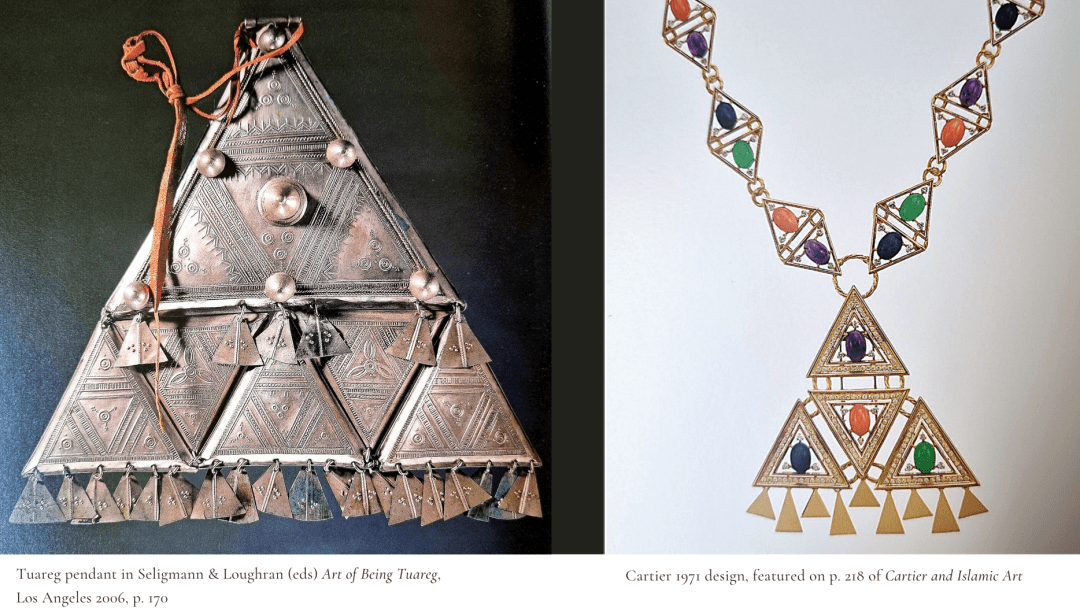
As the timeframe in which the ‘Lexicon of Forms’ came into existence, with all its imprecise denominators as I pointed out above, was at the apex of colonialism, it will not come as a surprise that the origin of some designs is not always clearly identified. An example is the necklace featured on p. 218, designed in 1971. It is described as inspired by Berber (which we now would indicate as Amazigh, following the people’s wish to be named in their own language) fibulae from Kabylia in Algeria (p. 187). While that may certainly hold true for the necklace itself, the pendant seems to me to be based in Tuareg tereout tan idmarden pendants as worn in the Hoggar mountains of Algeria. I was pleasantly surprised to see jewellery of ordinary people (instead of the possessions of shahs and Mughal elite) serve as inspiration for these high-end creations as well, and wonder if other contemporary jewellery examples that form part of North Africa’s and Southwest Asia’s heritage might still go unidentified.

The design and photography of this book are simply fabulous. Both original pieces and Cartier creations are photographed in crisp clarity. The large format allows for endless comparing and admiring, and what I particularly loved are the blow-ups of tiny details at the beginning of each chapter and even the cover: the cover image is a detail of a cigarette case, only 8,7 cm in height! Short intermezzo’s, like a brief essay on the pen boxes of the shah, Mughal jewellery from India or book bindings, provide informative examples on how details traveled to other designs. Each chapter is well referenced: don’t skip the endnotes, they feature many more details and discussions!

Cartier and Islamic Art is a detailed journey into the creative process of this famed jewellery house, placed in the context of its time. From inspirational exhibitions, visits and experiences, via drawings and designs to the breathtaking jewellery creations, this book places western designs and its teachers from the Islamic world side by side. For me, this book was an eye-opener in how deeply rooted abstract jewellery of the early 20th century is in Islamic art: a development in the field of jewellery that has been explored in depth for the first time in this publication. It is a visual feast of stunning, elegant Cartier designs and a wealth of superb original artworks from Southwest Asia, North Africa and India, accompanied by in-depth essays: I am sure you will thoroughly enjoy both!

Cartier and Islamic Art. In Search of Modernity. by Heather Ecker et. al. (eds). Thames & Hudson, 2021

315 pages, full-colour, in English. Available with the publisher, in bookstores and online.

The book was received as review copy by the publisher.

More book reviews on jewellery & art? Browse dozens of books here!

Or join the Jewellery List and receive new book discussions automatically in your inbox!

Sigrid van Roode

Sigrid van Roode is an archeologist, ethnographer and jewellery historian. She considers jewellery heritage and a historic source. She has authored several books on jewellery from North Africa and Southwest Asia, and on archaeological jewellery. Sigrid has lectured for the Society of Jewellery Historians, the National Museum of Antiquities in Leiden and the Sultan Qaboos Cultural Center, among many others. She curates exhibitions and teaches online courses on jewellery from North Africa & Southwest Asia.