Amber

Amber

From Antiquity to Eternity

Amber

I love books that deepen our understanding of one particular material, and so when I met dr. Rachel King briefly early in 2022 and she told me she was finishing a book on amber, I was excited! And rightly so: Amber. From Antiquity to Eternity is a most engaging and important discussion of all things amber.


What stands out from the first lines is how very well this book is written. It is accessible, relatable, easy to follow, but by no means simple. The volume explores the world of amber in great detail and with obvious knowledge. Given the amount of information and the complexity of the topics presented, clarity of writing is of great importance: you will enjoy the lucid and engaging style of Dr. King!

Amber discusses amber from a great many angles. In eight chapters, the past, present and future of this material that has enticed humans for millennia are presented. The first of these deals with definitions: what is amber, where is it found, what different types exist? In this chapter, the wide reach of this book becomes apparent. Themes like ecosystems, the science behind investigating amber and research angles yet to be pursued all are discussed. The next chapter picks up on this theme of research in presenting what earlier scholars believed amber to be. This results in a delightful overview of legends and myths, some of which may reflect actual archaeological finds – and with that, the next chapter on the use of amber artefacts by humans begins.

This focuses mainly on Europe and China, and contains a great overview of amber finds from prehistory and the early Middle Ages. The following chapter picks up the narrative in later periods and highlights the amber trade in all its aspects. How and where to find amber is followed up upon by the economic, political and social aspects of the amber industry. An excursion to the Dominican Republic shows the harsh reality of amber mining, and as such makes us reflect on not just past monopolies on the mining and selling of amber, but also of the present and future of the amber industry. The amber industry is fraught with illegal and unsafe extraction and trade: just one example is how in 2015, 90% of the amber from Ukraine has been extracted without permission (p. 94). This book certainly gets you thinking on the darker sides of those pretty amber jewellery items that are offered for sale far and wide.

It will come as no surprise that this material, that has played such an important part in trade networks and political power plays, has been imitated as well. I am obviously aware that amber is widely faked, but I did not know how far back this went – did you know a recipe to imitate amber existed in China some 1,800 years ago, and that imitations of amber have been found in Spain that date back 4,000 years? And there is so much more involved in imitations: from smell to inclusions, from weight to colour – and increasingly innovative and scientific ways to expose forgeries.

The chapter on jewellery is a varied introduction in the many forms amber is worn as adornment. That is not just as personal adornment, but also as precious objects to show wealth and status, such as handles, mouthpieces or inlays. In this chapter the colonial use of amber as commodity is addressed, and its fragrant capacities and its meaning in ritual are touched upon as well. This is a dazzling and kaleidoscopic portrait of the use of amber, which is continued in the next chapter on artworks in amber. The final chapters deals with lost amber in again a variety of angles: not just actual lost pieces, but also the loss of status and knowledge. In this chapter, the role of private and public collections in preserving amber surfaces. As many pieces with spectacular inclusions find their way into private collections, scientists may not always have access to study these (p. 217) – and studying amber and its eternal world within from a scientific perspective is relevant for not just our past, but our future as well. (so if you do have a collection: please give some thought on how to pass your collection on to the future)

The focus of this beautifully illustrated book is mainly on Europe and Asia. The use and meaning of amber in other parts of the world are only touched upon in a few instances, but that does not diminish the relevance of this book. What makes Amber so important is its wide scope. It places amber not just in an art historian or historical context, but also in a social, environmental and humanitarian context. Throughout the book, attention is called to the ethical and sustainability challenges with amber, the knowledge that can be gained from it about our climate and planet, and the inevitable choices that present themselves. The attractive way in which the author presents an accessible overview of the history and uses of amber as well as serious food for thought in one fluid narrative is rare, and I enjoyed every page of this book. Possibly the most powerful line I read is the last one, in which past and future of our planet meet: I highly recommend reading this book, as it will not only tell you everything you would want to know about amber itself, but also eminently shows the importance of our choices in studying and treating it for humanity – which stretches so far as our very survival.

Amber. From Antiquity to Eternity, by Rachel King, 2022.

272 pp., full-colour, in English. Published by Reaktion Books

Available online and with the publisher.

I purchased the book in the British Museum.

More on amber in jewellery is in this article. If books like these are of interest to you, join the Jewellery List and have reviews of new books sent to you!

Sigrid van Roode

Sigrid van Roode is an archeologist, ethnographer and jewellery historian. She considers jewellery heritage and a historic source. She has authored several books on jewellery from North Africa and Southwest Asia, and on archaeological jewellery. Sigrid has lectured for the Society of Jewellery Historians, the National Museum of Antiquities in Leiden and the Sultan Qaboos Cultural Center, among many others. She curates exhibitions and teaches online courses on jewellery from North Africa & Southwest Asia.

Hair: untold stories

Hair: untold stories

the many meanings of hair

Hair: untold stories

Hair has been our most personal, natural form of adornment for millennia. We either hide it or show it, and it is so personal that it is regarded as an extension of the person itself. But hair is much more than that. The excellent exhibition Hair: untold stories in the Horniman Museum and Gardens is entirely devoted to the many meanings of hair.

Hair explores our relationship to human hair by looking at it from various perspectives. Researchers, artists, film makers, hair dressers, poets and photographers all weigh in to paint a vivid and sometimes unexpected picture of this material. The exhibition starts out with a section on hair as material: maybe not the first use to come to mind, but to me a refreshing way of looking at hair as something other than a part of our body or our appearance. Hair is a marvelous fibre: lightweight yet incredibly strong, flexible and absorbing. Hair was used to attach shark’s teeth to palm rib swords on the Kiribati islands in Oceania, but of course also in products related to hairstyling like wigs and fillers.

A large map illustrating the hair trade is very illuminating. I was aware that in many cultures, hair is shaven off for religious reasons, but never thought much about what that hair was used for: apparently, there is a thriving market for it, and not all of it goes to wig making. ‘Waste’ hair, collected when brushing, is sorted and sold as well. I learned that many early Afro wigs were made of yak hair coming from Central Asia and China, that nowadays synthetic wigs can also be made of fibres derived from banana skins, and much more.

What looks like a hair shop, is an art installation by Korantema Anyimadu, exploring the experiences of black and non-binary people with hair in the UK. Listening to their favourite songs, reading memories and looking around in the hair shop I learned a great deal about memories associated with the smell, feel, timing and handling of hair and the challenges of feeling ‘at home’ in a country where your basic hair care cannot be achieved so easily.

The section on Entanglements presents and discusses the balance between the personal aspects of hair and the social norms expected of the wearer: the eternal balance between individuality and the common. Bridal hair is associated with fertility and beauty, Victorian women were expected to wear their hair up when married, and keeping the first hairlocks of a child as memento is a worldwide phenomenon. Hair and death are shown in European mourning jewellery created with hair of the passed persons, and a topic I could personally relate to is how to deal with the loss of hair due to illness or chemotherapy.

A series of combs ends the exhibition: these are not just presented as hair maintenance tools, but as meaningful, powerful objects that can convey many messages. I really enjoyed this exhibition, as it managed to address many unexpected angles on hair in a comprehensible, enjoyable and thought provoking way.

Accompanying the main exhibition are several smaller photographic exhibitions: Cult Hair (on the lower gallery) and Intimate Archives (on the gallery above the World Gallery). The latter combines hair care rituals with spells and traditions, showing how acts of social care connect scattered and displaced people. A powerful expression of the meaning of body aesthetic, both as performative act and as carrier of identity!

Hair: untold stories in Horniman Museum and Gardens: find out more on the museum website

More on personal adornment in exhibitions and museums? Read about other collections here! Want to be kept in the know on new and forthcoming exhibitions and museum installations? Join the Jewellery List and have news delivered to your inbox!

Sigrid van Roode

Sigrid van Roode is an archeologist, ethnographer and jewellery historian. She considers jewellery heritage and a historic source. She has authored several books on jewellery from North Africa and Southwest Asia, and on archaeological jewellery. Sigrid has lectured for the Society of Jewellery Historians, the National Museum of Antiquities in Leiden and the Sultan Qaboos Cultural Center, among many others. She curates exhibitions and teaches online courses on jewellery from North Africa & Southwest Asia.

Horniman Museum

Horniman Museum

anthropological collection

Horniman Museum and Gardens

The Horniman Museum and Gardens in London (UK) houses a wonderful anthropology collection. Over 3,000 objects are on display, offering a wide view into how people all over the world experience their life and seek to understand their surroundings. I had the pleasure of visiting the museum and browse its gallery!

The museum was founded by Frederick Horniman, a tea trader who made a fortune with the company his father started. The museum is very clear about the colonial past of the museum and its collections: the collection of ethnographic objects to educate and inform people in Britain about other cultures was only possible in a colonial setting and with a fortune earned by the exploitation of others. The museum actively works with community researchers, artists and creatives on a continuous basis, and it will be interesting to see how this translates into choices and decisions, for example in regard to the Benin bronzes on display.

The central part of the museum, and the part I came to visit in particular, is the World Gallery. Here, showcases form cubicles that each address a continent. Africa, the Americas, Oceania, Asia and Europe are represented by a selection of objects that highlight varying themes. You will find many beautiful examples of ethnographic art, ranging from clothing and adornment to utensils and tools. What I particularly liked is that these are not only aimed at seeing, but at hearing, smelling and touching as well. With the display of Tuareg craftmanship you will find worked leather and a veil weight which are meant to be touched: feeling the patterns below your fingers makes an object come more to life than just by looking at it. The Asian section offers the possibility to smell the medicine of a Bhutan doctor, and throughout the exhibition sounds of song and music are present. These latter can cause somewhat of a drawback though: as they are audible throughout the Gallery, they create permanent more or less noisy surroundings.

The section on Perspectives shows how people aim to understand, control and categorize their world. Lots of amulets and other meaningful objects illustrate the problems and challenges people faced and how they sought to deal with those. I loved the showcase with all sorts of amulets from Great Britain: holed flint as a charm against nosebleeds, ‘hag stones’ to avert witches and pigeon’s feet against cramp are just a few of those. That did bring me to another drawback (well, at least, to me): the museum shop has many lovely and sustainable gift ideas, but nothing relating to the anthropological collection. There are no museum or exhibition catalogues to offer a deeper level of understanding to visitors wanting to learn more. While the museum works hard to engage visitors during their stay, by offering several moments to reflect on one’s own beliefs, values and thoughts in the exhibition, this ends at the door.

The museum website does offer more information, though. It has a great and searchable overview of the collections: providing the collections with a more detailed description is a work in progress and will provide a great resource for research. On the website, you will also find information on ongoing collaborations, projects under way and an extensive blog with a wide variety of background stories (found more on those ‘hag-stones’ here!), inviting to keep on reading and exploring.

The museum is surrounded by beautiful gardens, and boasts a really good museum café where I enjoyed a lovely outdoor lunch with a view on the conservatory. It also houses a Butterfly House, an Aquarium and a Natural History Gallery: I did not have a chance to visit those, but I will definitely be back to explore more of this beautiful, colourful and lively museum!

Horniman Museum and Gardens: find out more on the museum website

More on exhibitions and museums in the field of personal adornment, archaeology, ethnography and Islamic art? Find more here, or join the Jewellery List to receive new interesting tips in your inbox!

Sigrid van Roode

Sigrid van Roode is an archeologist, ethnographer and jewellery historian. She considers jewellery heritage and a historic source. She has authored several books on jewellery from North Africa and Southwest Asia, and on archaeological jewellery. Sigrid has lectured for the Society of Jewellery Historians, the National Museum of Antiquities in Leiden and the Sultan Qaboos Cultural Center, among many others. She curates exhibitions and teaches online courses on jewellery from North Africa & Southwest Asia.

Cartier and Islamic Art

Cartier and Islamic Art

in search of modernity

Cartier and Islamic Art

Jewellery exchange between the Islamic world and the Christian world has existed for millennia. Byzantine jewellery is at times indistinguishable from early Islamic jewellery, and cross-cultural influences still exist in the traditional jewellery worn around the Mediterranean. These are all evidence of a long, shared history. But what happens when a high-end European jeweller feels ‘stuck’ in his repertoire, and actively seeks inspiration in another culture? The book Cartier and Islamic Art is a lavish publication exploring how eastern designs formed a source of inspiration for the work of one of the most famous jewellery houses of the West.

This book accompanies the exhibition of the same name, that was held in Paris and will be on view in in the Dallas Museum of Art from May 14, 2022 to September 18, 2022. A point to note in advance is that this is a book about aesthetics and forms, not about cultural meaning or significance: it is an art historian exploration of the creations of Cartier. The terminology used reflects a Western point of view entirely, such as the definition of what ‘Islamic arts’ actually are. You will find not just pieces created by Islamic cultures, but also jewellery from the Hindu world, and the ‘arts’ themselves exclude for example calligraphy. Let me elaborate on that a little. As for example Charlotte Huygens explains in her essay ‘On the History of Art in the Islamic World’ in the 2018 publication Splendour & Bliss, the term Islamic Art was coined in the colonial era, when the Islamic world was viewed as a monolithic entity, the counterpart of the West – the era in which Cartier started out to look for inspiration. That world view shines through, amongst other things, in the imprecise way the Cartier archives label both their creations and its inspiration: ‘Persian’, ‘Arab’, ‘Oriental’ are regularly used interchangeably. Nowadays, the denominator ‘Islamic Art’ is still used, but with the connotation of its cultural pluriformity, and it is to be understood as such in this book as well. The many essays in this book however do much more than simply illustrate how Cartier jewellery was inspired by Islamic art. They show us how to what extent abstract Western arts, notably Art Déco, are indebted to the Islamic world, and that is a great deal.

The essay on ‘Islamic Art “revealed”: a path toward modern design’ is one of the most powerful contributions in this publication. I am usually wary of wording like ‘revealing’ in the context of the Islamic world, but the use of quotation marks here reflects the sentiment of the essay itself. Its authors unpick how the Islamic arts were introduced to a European audience: through wars, displacement and colonial greed (p. 40). The success of world exhibitions and the subsequent adaptations of Islamic art forms lead to new experiments in the design field, moving away from Orientalist interpretations (p. 46) to the first attempts at abstract expression. This historical context is pivotal for understanding the jewellery created. The private collection of Louis Cartier is central in the next essay, where stunning manuscripts and inlaid works were not just collected to satisfy a personal curiosity, but also to be shared and loaned to exhibitions that in turn furthered European interest in the Islamic arts.

The arts from the Islamic world and beyond did not just form design inspiration, but brought new techniques to Europe as well. The essays on India explore how wealthy clientele from India brought their jewellery and gemstones to Cartier in order to have them updated or set in new jewels. These latter however had to conform to Indian tastes, and so the technique of stone setting known as kundan found its way to the Cartier ateliers, along with other ways of looking at forms and types of jewellery. The essay on Cartier’s Lexicon of Forms, although it uses terms like ‘Arab’ and ‘Persian’ loosely, showcases how forms derived from Islamic art and architecture were translated into design elements: not as mere copies though, but adapted and transformed into a new visual language. Even the graphic arts of Cartier were transformed based on the structures and patterns learned: the influence of Islamic art is profound and stretches well beyond jewellery design.

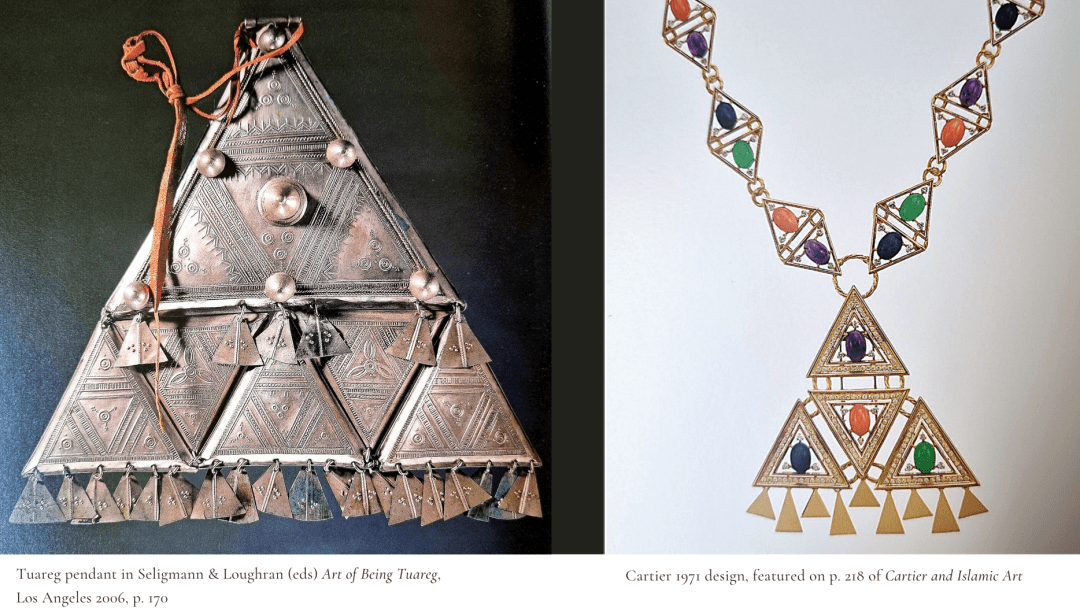
As the timeframe in which the ‘Lexicon of Forms’ came into existence, with all its imprecise denominators as I pointed out above, was at the apex of colonialism, it will not come as a surprise that the origin of some designs is not always clearly identified. An example is the necklace featured on p. 218, designed in 1971. It is described as inspired by Berber (which we now would indicate as Amazigh, following the people’s wish to be named in their own language) fibulae from Kabylia in Algeria (p. 187). While that may certainly hold true for the necklace itself, the pendant seems to me to be based in Tuareg tereout tan idmarden pendants as worn in the Hoggar mountains of Algeria. I was pleasantly surprised to see jewellery of ordinary people (instead of the possessions of shahs and Mughal elite) serve as inspiration for these high-end creations as well, and wonder if other contemporary jewellery examples that form part of North Africa’s and Southwest Asia’s heritage might still go unidentified.

The design and photography of this book are simply fabulous. Both original pieces and Cartier creations are photographed in crisp clarity. The large format allows for endless comparing and admiring, and what I particularly loved are the blow-ups of tiny details at the beginning of each chapter and even the cover: the cover image is a detail of a cigarette case, only 8,7 cm in height! Short intermezzo’s, like a brief essay on the pen boxes of the shah, Mughal jewellery from India or book bindings, provide informative examples on how details traveled to other designs. Each chapter is well referenced: don’t skip the endnotes, they feature many more details and discussions!

Cartier and Islamic Art is a detailed journey into the creative process of this famed jewellery house, placed in the context of its time. From inspirational exhibitions, visits and experiences, via drawings and designs to the breathtaking jewellery creations, this book places western designs and its teachers from the Islamic world side by side. For me, this book was an eye-opener in how deeply rooted abstract jewellery of the early 20th century is in Islamic art: a development in the field of jewellery that has been explored in depth for the first time in this publication. It is a visual feast of stunning, elegant Cartier designs and a wealth of superb original artworks from Southwest Asia, North Africa and India, accompanied by in-depth essays: I am sure you will thoroughly enjoy both!

Cartier and Islamic Art. In Search of Modernity. by Heather Ecker et. al. (eds). Thames & Hudson, 2021

315 pages, full-colour, in English. Available with the publisher, in bookstores and online.

The book was received as review copy by the publisher.

More book reviews on jewellery & art? Browse dozens of books here!

Or join the Jewellery List and receive new book discussions automatically in your inbox!

Sigrid van Roode

Sigrid van Roode is an archeologist, ethnographer and jewellery historian. She considers jewellery heritage and a historic source. She has authored several books on jewellery from North Africa and Southwest Asia, and on archaeological jewellery. Sigrid has lectured for the Society of Jewellery Historians, the National Museum of Antiquities in Leiden and the Sultan Qaboos Cultural Center, among many others. She curates exhibitions and teaches online courses on jewellery from North Africa & Southwest Asia.

DIVA Library

DIVA Library

jewellery research

DIVA Library

Jewellery research is not just looking at beautiful jewellery, but involves a lot of desk study, too: looking for parallels, tracing provenance, finding out more about cultural context and meaning…Which is why I love books about jewellery just as much as jewellery itself, and so I was thrilled to visit the library of DIVA Antwerp: with 23,000 titles on jewellery, this is an incredibly important resource!

Antwerp has been a center of the diamond trade and expertise for centuries, as well as a major hub for silversmithing and jewellery creation. The DIVA museum showcases that history, serves as knowledge center and is a springboard for young designers. A visit to the museum is a treat in itself: each room is carefully designed with its own look & feel and focuses on one aspect of the diamond and jewellery history. From ancient Egyptian objects and their Art Déco counterparts, Moghul splendor from India and religious objects in silver and gold to shining tableware and dazzling parures, each of the six rooms in the museum has its own theme and stories to share.

And behind it all is an even larger treasure: the library. Here, you will find books on everything jewellery related, from archaeological works to modern designers, cultural significance of jewellery, art historian approaches, and related fields in the applied arts. Special care is given to auction house catalogues and even newspaper clippings that will help identify the provenance of jewellery items. Through these becomes possible to trace the journey of a certain piece through repeated auctions and sales. The emphasis of the collection is on Belgian jewellery, notably silver and diamond, but you will find plenty of books on other jewellery fields and geographical areas, too.

The library does not only house books, but other materials as well. Glass negatives, complete archives of designers and traders, model books, sales registers…the antique design drawings I was shown are works of art on their own. A special treat are the antiquarian volumes on jewellery making, which somehow survived the centuries and contain recipes for soldering, technique descriptions and overviews of gem cutting. All of these are carefully stored in custom made boxes, old drawings and prints are carefully restored, so as to survive the next few centuries as well.

The library is more than a static space filled with books, but is a vibrant knowledge hub. Design students come to find inspiration in the collection, regular talks share the many stories in this library with a larger audience, the reading room offers an airy, bright space to sit and enjoy the volumes of your choice. Whether that is to work on your school project or your dissertation, the librarians are happy to help. I definitely will be spending more time here to discover more!

See more about the museum itself here, and more about the library can be found here. The Instagram account of the library @DIVALibrary is a joy to follow, too!

I was shown around the library as a personal gesture by the librarian, with no obligation to write a blog. I am just enthousiastic about this large research library and wanted to share this treasure with you.

More places to go or books to read about jewellery? Explore my suggestions and reviews here!

Or join the Jewellery List to have new updates delivered straight into your inbox: never miss out on a jewellery thing!

Sigrid van Roode

Sigrid van Roode is an archeologist, ethnographer and jewellery historian. She considers jewellery heritage and a historic source. She has authored several books on jewellery from North Africa and Southwest Asia, and on archaeological jewellery. Sigrid has lectured for the Society of Jewellery Historians, the National Museum of Antiquities in Leiden and the Sultan Qaboos Cultural Center, among many others. She curates exhibitions and teaches online courses on jewellery from North Africa & Southwest Asia.