Cartier and Islamic Art

Cartier and Islamic Art

in search of modernity

Cartier and Islamic Art

Jewellery exchange between the Islamic world and the Christian world has existed for millennia. Byzantine jewellery is at times indistinguishable from early Islamic jewellery, and cross-cultural influences still exist in the traditional jewellery worn around the Mediterranean. These are all evidence of a long, shared history. But what happens when a high-end European jeweller feels ‘stuck’ in his repertoire, and actively seeks inspiration in another culture? The book Cartier and Islamic Art is a lavish publication exploring how eastern designs formed a source of inspiration for the work of one of the most famous jewellery houses of the West.

This book accompanies the exhibition of the same name, that was held in Paris and will be on view in in the Dallas Museum of Art from May 14, 2022 to September 18, 2022. A point to note in advance is that this is a book about aesthetics and forms, not about cultural meaning or significance: it is an art historian exploration of the creations of Cartier. The terminology used reflects a Western point of view entirely, such as the definition of what ‘Islamic arts’ actually are. You will find not just pieces created by Islamic cultures, but also jewellery from the Hindu world, and the ‘arts’ themselves exclude for example calligraphy. Let me elaborate on that a little. As for example Charlotte Huygens explains in her essay ‘On the History of Art in the Islamic World’ in the 2018 publication Splendour & Bliss, the term Islamic Art was coined in the colonial era, when the Islamic world was viewed as a monolithic entity, the counterpart of the West – the era in which Cartier started out to look for inspiration. That world view shines through, amongst other things, in the imprecise way the Cartier archives label both their creations and its inspiration: ‘Persian’, ‘Arab’, ‘Oriental’ are regularly used interchangeably. Nowadays, the denominator ‘Islamic Art’ is still used, but with the connotation of its cultural pluriformity, and it is to be understood as such in this book as well. The many essays in this book however do much more than simply illustrate how Cartier jewellery was inspired by Islamic art. They show us how to what extent abstract Western arts, notably Art Déco, are indebted to the Islamic world, and that is a great deal.

The essay on ‘Islamic Art “revealed”: a path toward modern design’ is one of the most powerful contributions in this publication. I am usually wary of wording like ‘revealing’ in the context of the Islamic world, but the use of quotation marks here reflects the sentiment of the essay itself. Its authors unpick how the Islamic arts were introduced to a European audience: through wars, displacement and colonial greed (p. 40). The success of world exhibitions and the subsequent adaptations of Islamic art forms lead to new experiments in the design field, moving away from Orientalist interpretations (p. 46) to the first attempts at abstract expression. This historical context is pivotal for understanding the jewellery created. The private collection of Louis Cartier is central in the next essay, where stunning manuscripts and inlaid works were not just collected to satisfy a personal curiosity, but also to be shared and loaned to exhibitions that in turn furthered European interest in the Islamic arts.

The arts from the Islamic world and beyond did not just form design inspiration, but brought new techniques to Europe as well. The essays on India explore how wealthy clientele from India brought their jewellery and gemstones to Cartier in order to have them updated or set in new jewels. These latter however had to conform to Indian tastes, and so the technique of stone setting known as kundan found its way to the Cartier ateliers, along with other ways of looking at forms and types of jewellery. The essay on Cartier’s Lexicon of Forms, although it uses terms like ‘Arab’ and ‘Persian’ loosely, showcases how forms derived from Islamic art and architecture were translated into design elements: not as mere copies though, but adapted and transformed into a new visual language. Even the graphic arts of Cartier were transformed based on the structures and patterns learned: the influence of Islamic art is profound and stretches well beyond jewellery design.
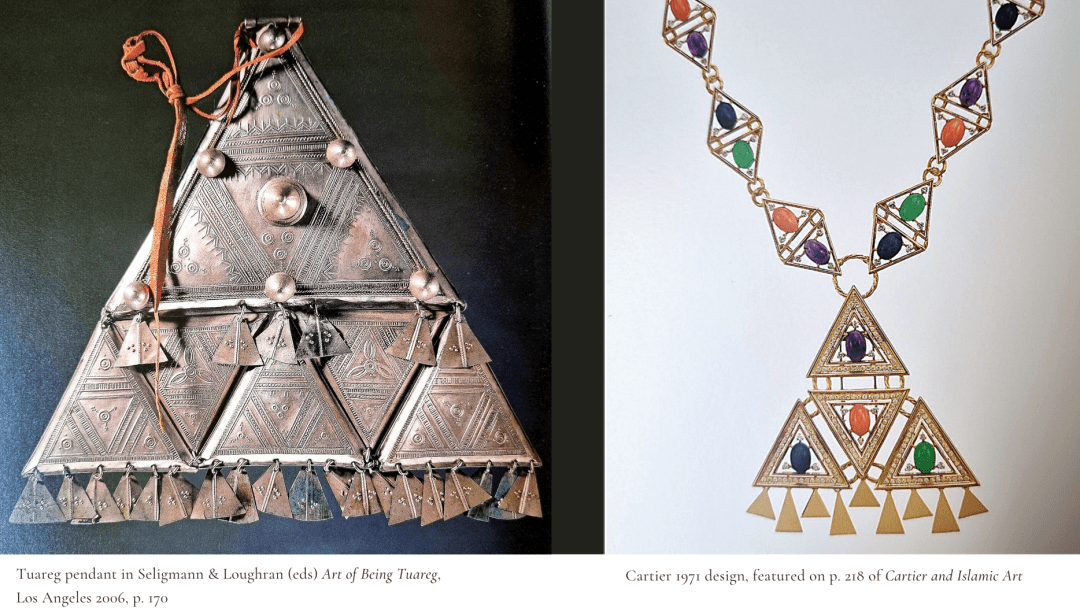
As the timeframe in which the ‘Lexicon of Forms’ came into existence, with all its imprecise denominators as I pointed out above, was at the apex of colonialism, it will not come as a surprise that the origin of some designs is not always clearly identified. An example is the necklace featured on p. 218, designed in 1971. It is described as inspired by Berber (which we now would indicate as Amazigh, following the people’s wish to be named in their own language) fibulae from Kabylia in Algeria (p. 187). While that may certainly hold true for the necklace itself, the pendant seems to me to be based in Tuareg tereout tan idmarden pendants as worn in the Hoggar mountains of Algeria. I was pleasantly surprised to see jewellery of ordinary people (instead of the possessions of shahs and Mughal elite) serve as inspiration for these high-end creations as well, and wonder if other contemporary jewellery examples that form part of North Africa’s and Southwest Asia’s heritage might still go unidentified.

The design and photography of this book are simply fabulous. Both original pieces and Cartier creations are photographed in crisp clarity. The large format allows for endless comparing and admiring, and what I particularly loved are the blow-ups of tiny details at the beginning of each chapter and even the cover: the cover image is a detail of a cigarette case, only 8,7 cm in height! Short intermezzo’s, like a brief essay on the pen boxes of the shah, Mughal jewellery from India or book bindings, provide informative examples on how details traveled to other designs. Each chapter is well referenced: don’t skip the endnotes, they feature many more details and discussions!

Cartier and Islamic Art is a detailed journey into the creative process of this famed jewellery house, placed in the context of its time. From inspirational exhibitions, visits and experiences, via drawings and designs to the breathtaking jewellery creations, this book places western designs and its teachers from the Islamic world side by side. For me, this book was an eye-opener in how deeply rooted abstract jewellery of the early 20th century is in Islamic art: a development in the field of jewellery that has been explored in depth for the first time in this publication. It is a visual feast of stunning, elegant Cartier designs and a wealth of superb original artworks from Southwest Asia, North Africa and India, accompanied by in-depth essays: I am sure you will thoroughly enjoy both!

Cartier and Islamic Art. In Search of Modernity. by Heather Ecker et. al. (eds). Thames & Hudson, 2021

315 pages, full-colour, in English. Available with the publisher, in bookstores and online.

The book was received as review copy by the publisher.

More book reviews on jewellery & art? Browse dozens of books here!

Or join the Jewellery List and receive new book discussions automatically in your inbox!

Sigrid van Roode

Sigrid van Roode is an archeologist, ethnographer and jewellery historian. She considers jewellery heritage and a historic source. She has authored several books on jewellery from North Africa and Southwest Asia, and on archaeological jewellery. Sigrid has lectured for the Society of Jewellery Historians, the National Museum of Antiquities in Leiden and the Sultan Qaboos Cultural Center, among many others. She curates exhibitions and teaches online courses on jewellery from North Africa & Southwest Asia.

DIVA Library

DIVA Library

jewellery research

DIVA Library

Jewellery research is not just looking at beautiful jewellery, but involves a lot of desk study, too: looking for parallels, tracing provenance, finding out more about cultural context and meaning…Which is why I love books about jewellery just as much as jewellery itself, and so I was thrilled to visit the library of DIVA Antwerp: with 23,000 titles on jewellery, this is an incredibly important resource!

Antwerp has been a center of the diamond trade and expertise for centuries, as well as a major hub for silversmithing and jewellery creation. The DIVA museum showcases that history, serves as knowledge center and is a springboard for young designers. A visit to the museum is a treat in itself: each room is carefully designed with its own look & feel and focuses on one aspect of the diamond and jewellery history. From ancient Egyptian objects and their Art Déco counterparts, Moghul splendor from India and religious objects in silver and gold to shining tableware and dazzling parures, each of the six rooms in the museum has its own theme and stories to share.

And behind it all is an even larger treasure: the library. Here, you will find books on everything jewellery related, from archaeological works to modern designers, cultural significance of jewellery, art historian approaches, and related fields in the applied arts. Special care is given to auction house catalogues and even newspaper clippings that will help identify the provenance of jewellery items. Through these becomes possible to trace the journey of a certain piece through repeated auctions and sales. The emphasis of the collection is on Belgian jewellery, notably silver and diamond, but you will find plenty of books on other jewellery fields and geographical areas, too.

The library does not only house books, but other materials as well. Glass negatives, complete archives of designers and traders, model books, sales registers…the antique design drawings I was shown are works of art on their own. A special treat are the antiquarian volumes on jewellery making, which somehow survived the centuries and contain recipes for soldering, technique descriptions and overviews of gem cutting. All of these are carefully stored in custom made boxes, old drawings and prints are carefully restored, so as to survive the next few centuries as well.

The library is more than a static space filled with books, but is a vibrant knowledge hub. Design students come to find inspiration in the collection, regular talks share the many stories in this library with a larger audience, the reading room offers an airy, bright space to sit and enjoy the volumes of your choice. Whether that is to work on your school project or your dissertation, the librarians are happy to help. I definitely will be spending more time here to discover more!

See more about the museum itself here, and more about the library can be found here. The Instagram account of the library @DIVALibrary is a joy to follow, too!

I was shown around the library as a personal gesture by the librarian, with no obligation to write a blog. I am just enthousiastic about this large research library and wanted to share this treasure with you.

More places to go or books to read about jewellery? Explore my suggestions and reviews here!

Or join the Jewellery List to have new updates delivered straight into your inbox: never miss out on a jewellery thing!

Sigrid van Roode

Sigrid van Roode is an archeologist, ethnographer and jewellery historian. She considers jewellery heritage and a historic source. She has authored several books on jewellery from North Africa and Southwest Asia, and on archaeological jewellery. Sigrid has lectured for the Society of Jewellery Historians, the National Museum of Antiquities in Leiden and the Sultan Qaboos Cultural Center, among many others. She curates exhibitions and teaches online courses on jewellery from North Africa & Southwest Asia.

Le Khôl

Le Khôl

Kohl containers in france

Le Khôl

Another lovely book on kohl containers! The Musée International de la Perfumerie in Grasse, in southern France, hosts an exhibition on kohl containers in the winter of 2021-2022: Le Khôl. Le secret d’un regard envoûtant venu d’Orient. The exhibition is accompanied by a concise publication in magazine format, in which various authors provide background information on this elaborate private collection.

The museum was donated a private collection of 268 kohl containers, collected over four decades by Mme. Leblanc in various parts of the world. She describes in the chapter on the history of her collection how she first became enamored with kohl containers in 1967, whilst living in Africa, and how after those first pieces her collection expanded gradually until it encompassed hundreds of pieces from several continents.

A chapter on the history of kohl containers by the head of the department North Africa-Middle East of the Quai Branly-Musée Jacques Chirac, Hana Chidiac, explores how eye make-up was used from Antiquity through the Middle Ages into our own timeframe, as well as how the meaning of kohl was perceived throughout time. Hélène Kessous, anthropologist specialized in India, contributed a chapter on the uses of kohl in India, including the differences between kohl, surma and kajal as well as their respective containers. I enjoyed that this chapter also included a recipe for kajal, as well as short discussions on the magical aspects of kohl and its presence in movies.

The second part of the book is a catalogue of kohl containers from various parts of the world, which I enjoyed reading in tandem with Paint It, Black, the existing and elaborate publication on kohl containers. Le Khôl complements Paint It, Black geographically with kohl containers from further afield such as China, Central and Southwest Asia, adding to your overview of these wonderful items.

Throughout the book, the kohl containers are shown in large, full colour photographs, which make this book a publication you’ll enjoy browsing through. Not all containers in the collection have been included: a selection has been presented, but the pieces shown are varied both geographically and in their shapes and materials, so there is plenty to see and enjoy. The terminology is sometimes a bit Orientalist, using words like secrets, beguiling, seductive, and mysterious – the book does not need these, as the individual chapters and catalogue are interesting enough by themselves.  Le Khôl is a short, sweet presentation of a private collection of kohl containers in a luxurious magazine format, that you will want to add to your bookshelf!

Le Khôl. Le secret d’un regard envoûtant venu d’Orient, by Ludmilla Renardet & Julie Gérard (eds), Editions Faton, 2021

63 pp, full-colour, in French. Available with the publisher, the Musée International de la Parfumerie and online.

The book was purchased through the Institut du Monde Arabe.

Browse other books on personal adornment here!

More on the use of kohl is in the e-course Scents of the Middle East – bringing you the invisible world of fragrance, make-up, henna, hairstyles and much more.

Be the first to know about new books, exhibitions and other jewellery news: join the Jewellery List and receive updates in your inbox!

Sigrid van Roode

Sigrid van Roode is an archeologist, ethnographer and jewellery historian. She considers jewellery heritage and a historic source. She has authored several books on jewellery from North Africa and Southwest Asia, and on archaeological jewellery. Sigrid has lectured for the Society of Jewellery Historians, the National Museum of Antiquities in Leiden and the Sultan Qaboos Cultural Center, among many others. She curates exhibitions and teaches online courses on jewellery from North Africa & Southwest Asia.

Gold of the Great Steppe

Gold of the Great Steppe

The Saka Scythians in Kazakhstan

Gold of the Great Steppe

A glimpse into the world of the Saka Scythians through the results of very recent excavations is the topic of the exhibition Gold of the Great Steppe in the Fitzwilliam Museum in Cambridge. The accompanying publication shows the splendor of Scythian gold ornaments in great detail, combined with the challenges and possibilities of ongoing archaeological research in East Kazakhstan.

Scythian gold is world-famous: several previous exhibitions have had visitors marvel at the craft and skill of Scythian artists. This particular exhibition and publication zoom in on the Saka, one of the peoples that we know under the umbrella name of ‘Scythians’, in eastern Kazakhstan. What is remarkable about the publication is that it has been compiled while research is ongoing: some of the finds presented have been excavated as recently as 2020. The archaeological context is presented alongside the gold from which the book gets its title. Gold of the Great Steppe is not just a catchy title to draw your attention: this book is literally crammed with images of stunning gold pieces, many of which are published for the first time here. Earrings, necklaces, headdresses, horse equipment, dress ornaments, weaponry…all executed with the flowing lines, crisp granulation and masterful decoration that the Saka are famous for. But what makes this book stand out, is the presentation within the archaeological context in which they have been retrieved – it’s like following the archaeologists closely, seeing what they are seeing.

That view starts with the large burial mounds, or kurgans, that dot the steppe landscape. As in many civilizations, where people bury their dead is both highly significant as well as a territorial marker that announces the ties of a particular people to their land. After the introductory chapter on the project itself, the second chapter of the book starts out with a brief presentation of Saka culture in the Altai Mountain range (the Kazakh part of the Altai), in which a brief history is outlined along with written sources and the part archaeological research plays in reconstructing this history. On a side note, the written sources, such as Herodotus and Achaemenid texts, are presented and throughout the book cited without discussion of their cultural bias. The presentation of petroglyphs on the other hand is absolutely enriching for our understanding of the visual language of the Saka, as several of the forms in rock art return in the gold ornaments found in the kurgans. I also enjoyed that a few settlements are included, too: much of our knowledge about the Saka stems from their funerary monuments, and so learning more about their settlements further widens our view, however brief these paragraphs are. The chapter then continues with an in-depth discussion of these funerary monuments. Individual kurgans and the finds encountered are presented, along with excavation photographs, drawings and schematics. The gold artefacts shown in this chapter are not only stunning to behold, but gain in meaning because their context is given as well. At the end of the chapter, a culture emerges that combines mythologies and world views from across the continent, attached great value to horses and combined these two values in a strong visual expression.

The next chapter zooms in on a large kurgan and its contents: kurgan 4 in Eleke Sazy. Meticulous research of this burial leads to the assumption that it might be here that the early Saka culture reached its formative stage, forming the starting point for further developments of Saka culture. Due to the careful and methodical excavation, a reconstruction has been made of its occupant: a young archer, dressed in clothing embellished with gold and wearing several pieces of gold weaponry. Here again, the photography and detailed description of the finds provide the reader with a unique viewpoint, looking over the shoulder of Kazakh archaeologists as they work.

The second half of the book zooms out, from the individual finds and their historic context, to thematic subjects: funerary customs, horse-human relations and gold working. The chapter on funerary customs is absolutely fascinating from both an archaeological and ethnographic perspective. Although I personally feel that drawing a direct parallel between living cultures and archaeological finds that are substantially older is hazardous (and as if reading my mind, the author of this chapter starts out by addressing that exact point!), I have learned a great deal about traditional funerary customs, that do provide food for thought on how we might understand the physical remnants encountered in archaeological research. The chapter on horse-human relations examines how horses were buried in the kurgans: not only where and with what equipment, but also which type of horse. Horses, like humans, have been buried with elaborate trappings and with great care. Interestingly, their ears in some cases have been clipped to mimick the undulating forms of mythological animals in Scythian gold ornaments – another benefit of the excellent conservation circumstances of the Kazakh steppe is that organic material is well preserved. How the gold ornaments, that inspired this exhibition, were made, is the central theme of the last chapter. Here, we see traditional methods of observation combined with chemical analyses, identifying where the gold came from and how it was worked into the fabulous adornments illustrated throughout the book.

As this book presents ongoing research, it does come with a few challenges. The finds themselves for example are so recent that a contextual analysis, placing the Saka within the wider Scythian cultural realm, has not yet been made – the Saka are presented within Kazakhstan only. There is a slight imbalance between the descriptive nature of the text and the interpretations given, likely because the authors are specialists in their fields and connect proverbial dots based on their extensive knowledge. For the reader however, it is sometimes not as clear cut on what grounds conclusions pertaining to mythological or ritualistic assumptions have been drawn.

A very strong point of the book is in its illustrations. For starters, the photographs of the gold ornaments are many and beautiful, allowing the reader to admire them in detail. Sweeping views of the landscape help build an understanding of the natural environment of the Saka, while excavation photographs present finds in their original context, and in doing so convey the amount of work needed in conservation and restoration of individual finds. Maps and schematics aid our understanding of what we are looking at, while reconstruction drawings bring the picture of the past full circle.

All in all, this is not just an art historian book about gold jewellery. This book showcases the possibility encapsulated in ornaments to function as historic sources, if they are studied in and together with their original context.  A single ornament, looted and deprived of its context, loses its voice as carrier of information about the past, and the authors of this book have gone through great lengths to illustrate what information can be derived from ornaments. The archaeologists in Kazakhstan battle looting, time constraints and global warming in their everyday work, while also painstakingly studying material culture to increase our insights into the culture of the Saka steppe nomads. Gold of the Great Steppe book offers a wonderful view into Saka culture, the rich heritage of Kazakhstan, and the hard work of its archaeologists.

Gold of the Great Steppe, by Rebecca Roberts (ed). Paul Holberton Publishing, 2021.

170 pp, full-colour, in English. Available with the publisher and online.

Available with the publisher and online.

The book was gifted as review copy by the publisher.

More on personal adornment & archaeology? Browse dozens of books that you might enjoy, too!

Learn how jewellery developed over a staggering 5,000 years in the e-course on History of Jewellery: see phenomenal creations of the past come to life on your screen!

Get regular updates delivered straight into your inbox by joining the Jewellery List today!

Sigrid van Roode

Sigrid van Roode is an archeologist, ethnographer and jewellery historian. She considers jewellery heritage and a historic source. She has authored several books on jewellery from North Africa and Southwest Asia, and on archaeological jewellery. Sigrid has lectured for the Society of Jewellery Historians, the National Museum of Antiquities in Leiden and the Sultan Qaboos Cultural Center, among many others. She curates exhibitions and teaches online courses on jewellery from North Africa & Southwest Asia.

East meets West

East meets West

The Crusades and the age of decolonization

East meets West

The Macquarie University History Museum has curated a small publication on the occasion of its opening, titled East meets West. The inside cover text provides the goal of this book: ‘East meets West seeks to illuminate the complex intersection of western and eastern culture and civilization in the Eastern Mediterranean during the period of the Crusades through the study of Byzantine and Mamluk Egyptian artworks and illuminated manuscripts.’ That is a tall order, and although the book indeed presents beautiful artworks, its concise size prohibits it from truly exploring the complexity of these cultural interrelations and their continued ripple effects in today’s world.

The introductory chapter and the following chapter on medieval Western understanding of the Islamic world briefly outline the complexity of the Middle Ages both in terms of historic events as well as in later perception. In the introduction it becomes clear that the ‘Age of Decolonisation’ in the title of the book refers to the period after the last Crusade, the 14th century, not to our own timeframe. I could not help but wonder if ‘decolonization’ is the right term to describe the nature of this period, especially when ‘the West’s failure to develop a balanced view on the Crusades’ is given as a reason for a lasting legacy that continues to this very day (p. 10). It is precisely this last part that leaves me wondering: this lasting legacy is alluded to, but never explored further.

A chapter on the Byzantine world introduces how this era connects both the Roman past and the rise of Christianity in the West with the Islamic world. Here, the connection on the Roman and Christian end is emphasized more than the overlap with the Islamic world, although of course the Eastern Orthodox church of today finds its roots in the Byzantine world.  The book then presents four short chapters on material culture that showcase the connection between the European and Arab worlds. The chapter on Mamluk building in Cairo explores the interconnectedness of Islamic and Christian worlds through architecture. Starting with a brief introduction on the Mamluks themselves, who have their origins in both Christian/Eurasian cultures and slavery, the chapter discusses the reuse of building materials in Mamluk architecture – not just Pharaonic blocks, but also material taken from Christian buildings in Syria and Palestine. Vice versa, the inspiration of Syrian church towers for minarets is a great example of cross-cultural exchange. I found this a fascinating topic, as it touches upon practical as well as ideological reasons for cross-cultural reuse.

Next is a brief introduction in the technique of sgrafitto-ware, that was originally developed in the Roman era and passed on to the Islamic world through the Byzantine Empire. The last two chapters present written works: illuminated Book of Hours manuscripts and Islamic calligraphy. Surprisingly, although these chapters sit back-to-back, they are not connected. Both chapters present beautiful examples and an absolutely interesting introduction into the prayers books and calligraphy, but neither refers to the other or places the works presented in the context of mixed artforms that resulted from the interaction between the Islamic and Christian world, such as banderoles with (pseudo)Arabic calligraphy in medieval Christian paintings, or the oriental rugs on the painting of the Annunciation as mentioned in the introduction (p. 13)

The complex, shared history of the European and the Arab world is addressed again in the last chapter of the book. Here, the ‘east-west’-divide is explored through the lens of Australia’s own colonial past and the Middle Ages are redefined as an era of interconnectedness, instead of incidental encounters. This is an important chapter as it delves into how these collections were acquired, and what factors are to be taken into account when studying them: as collected objects are inevitably based on a selection, this layer needs to be peeled off before any assumptions about the objects themselves can be made and this chapter deals with that given in great clarity.

The perspective of the book is one I find truly important: the interconnectedness of two worlds that are too often portrayed as separate planets, the colonialism of the Christian and Islamic worlds in the Middle Ages, and the resulting cultural exchange. Exploring that interconnectedness through material culture is an excellent starting point, although an argument could be made that the title East meets West in all its simplicity in turn belies this interconnectivity. Returning to the inside cover however, I found that one intriguing aspect mentioned here is missing from the book itself: ‘…the impact of the divide between East and West is still evident today. The Crusades changed the world forever.’ This ripple effect of the Crusades in today’s world is alluded to again for example in the last lines of the foreword. Here, we read that ‘although history itself is not repeated, patterns of history are. The violent escalations which erupted in East Jerusalem between the government of Israel and Hamas in May 2021 tragically follow such a pattern’ (p.8). Which pattern, and how that we should place that in the context of the relation between the Christian and Islamic world in the Middle Ages and afterwards is not elaborated upon.

All chapters in the book are illustrated with stunning artworks, expertly photographed and a joy to see – Byzantine glass bracelets and gold ornaments, intricate calligraphy and illumination, views of architectural details, coins, bowls and more offer us a glimpse of the Macquarie University History Museum’s rich collections. What East meets West offers is a beautifully illustrated window into the Macquarie University History Museum collections, while its concise texts provide an introduction into, as well as food for thought on, medieval material culture in the Eastern Mediterranean.

East meets West. The Crusades and the Age of Decolonization, by Martin Bommas (ed). Giles Art Books, 2021. 72 pp, full-colour, in English.

Available with the publisher Giles Art Books and online.

The book was gifted as a advance reading copy by the publisher.

More books on historic interaction and cultural exchange? Find my picks for you here.

See how cultural interaction led to evolving jewellery styles in the e-course on History of Jewellery: 5,000 years of dazzling jewellery development flowing together on your screen – and 8 e-books to go with that!

Never miss out on new books and other jewellery news? Join the Jewellery List and enjoy a bit of sparkle in your inbox!

Sigrid van Roode

Sigrid van Roode is an archeologist, ethnographer and jewellery historian. She considers jewellery heritage and a historic source. She has authored several books on jewellery from North Africa and Southwest Asia, and on archaeological jewellery. Sigrid has lectured for the Society of Jewellery Historians, the National Museum of Antiquities in Leiden and the Sultan Qaboos Cultural Center, among many others. She curates exhibitions and teaches online courses on jewellery from North Africa & Southwest Asia.