Keys as amulets

Keys as amulets

magic of keys

Keys as amulets

Among the forms that are not immediately associated with amulets, is that of a key. Yet they appear as amulet in several ways throughout the Middle East and North Africa, from actual keys to images of keys. You will see them dangling from necklaces, included as miniature charm on charm necklaces, and alluded to in embroidery for example. What is the symbolic meaning of a key? In this article, I will introduce three ways keys hold significance as amulets in the Middle East.

Detail of a silver somt necklace, leather amulet pouches, bright beaded necklaces and keys worn by a Bedouin woman from Oman.

Power of keys: materials and amulets

First off, the material that keys were traditionally made of, is powerful in itself. Jinn are known to be afraid of iron, (see here why that is) and so anything made from iron would keep them at a distance. Keys, which for a long time were made of iron, fit that criterium perfectly. The image of the necklaces worn by a Bedouin woman from Oman shows her wearing a set of keys amidst leather amulet pouches: most likely, the keys also serve an apotropaic function.

A more recent version of a key as amulet is the silver key from Oman, shown below, which is shaped after a modern key. In North Africa, tiny keys sewn on to children’s clothing help prevent an early death. [1] (see here which spirits were feared for harming children). In 1915, a baby boy in Algeria was seen adorned with a series of amulets, including two iron keys, and the author observing that practice also noticed that keys were worn commonly as a charm. [2]

Silver Omani amulets, including a silver key

Key symbolism: locking and unlocking

There is more to keys than just the material they are made of, and is where their function comes into view. Keys, of course, lock and unlock things. The concept of locking and unlocking is closely related to a woman’s fertility: not so much in terms of chastity, but in the context of spirits blocking her from getting pregnant or causing a miscarriage. In that respect, keys function in a similar fashion to knots and knotting (see more about that here).

Here, keys are often combined with locks: amulets in the shape of locks were believed to prevent miscarriage in Egypt, as these ‘lock’ the womb until the time of birth has come. [3] When a birth is difficult, the reverse principle is used, and the key to a saint’s tomb is placed on the lower back of the mother to ease the birth. [4]
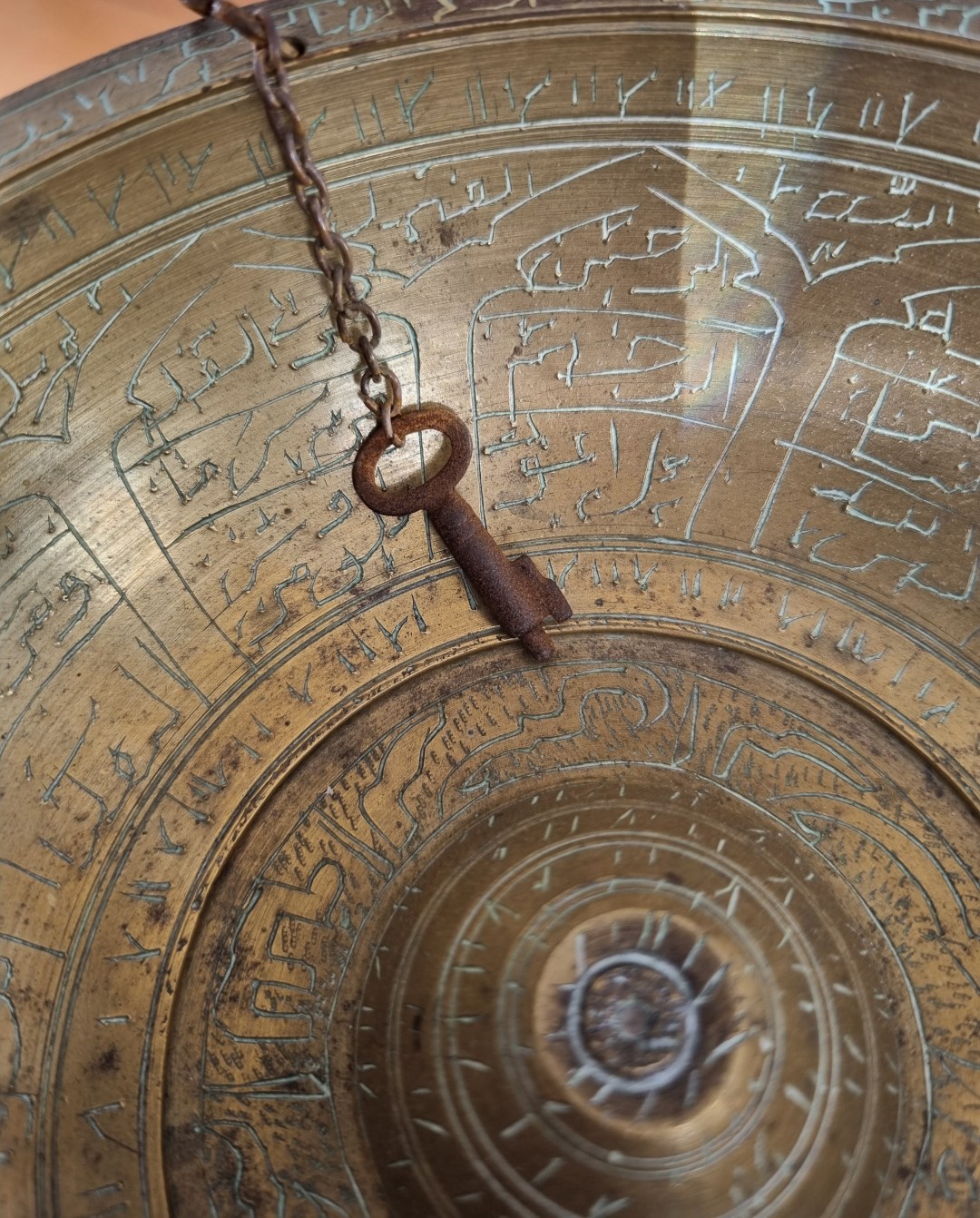
An Islamic magic bowl with a tiny iron key attached

Keys in ritual: protection and knowledge

Keys are also symbolic of accessing protection and knowledge. An example of that are the magical bowls of the Yezidi, where tiny amulet plaquettes are attached to its rim. These are called kilit, which literally means ‘key’ in Kurdic. [5] These amulet plaquettes can also take the form of an actual key, such as shown above.

The general idea is that the key amulet would enhance the efficacy of the bowl by submerging it into the water of the bowl. [6] Bowls like these were used in informal ritual aimed, again, at securing healthy pregnancy and safe births, as well as protection from evil forces. [7]

Keys as amulets: the magic in everyday objects

A seemingly simple household item may hold deep significance on a supernatural level: this example of keys shows how ‘magic’ is not something alien or mysterious, but something that is expressed in forms and shapes most familiar to us.


What kinds of amulets exist in North Africa and the Middle East?

Curious as to what other everyday objects may be used as amulets, and what their meaning is? Find out more about the histories behind amulets in the e-course on Amulets and Magic in Jewellery!

Or start by downloading the free e-book on amulets and jewellery here.

More posts on jewellery and amulets? Browse them all here!

Join the Jewellery List and receive new articles, jewellery news and more in your inbox!

References

[1] Hansmann, L. and L. Kriss-Rettenbeck 1977. Amulet und Talismann. Erscheinungsform und Geschichte. Verlag Georg D.W. Callwey, Munchen, p. 240.

[2] Hilton-Simpson, M.W. 1915. Some Algerian Superstitions Noted among the Shawia Berbers of the Aures Mountains and their Nomad Neighbours, in: Folklore Vol. 26, no. 3, p. 233 and p. 240.

[3] Hansen, N. 2006. Motherhood in the Mother of the World, PhD-thesis, University of Chicago, p. 116.

[4] Idem

[5] Biesterfeld, H. & D. Pielow (eds) 2019. Die Geheimnisse der Oberen und Unteren Welt. Magie im Islam zwischen Glaube und Wissenschaft, Brill, Leiden. p. 469-470 for a description of these bowls.

[6] Idem, p. 469

[7] Idem, p. 472-473


Sigrid van Roode

Sigrid van Roode is an archeologist, ethnographer and jewellery historian. Her main field of expertise is jewellery from North Africa and Southwest Asia, as well as archaeological and archaeological revival jewellery. She has authored several books on jewellery. Sigrid has lectured for the National Museum of Antiquities in Leiden, Turquoise Mountain Jordan, and many others. She provides consultancy and research on jewellery collections for both museums and private collections, teaches courses and curates exhibitions. She is not involved in the business of buying and selling jewellery, and focuses on research, knowledge production, and education only.

Magic of plastic

Magic of plastic

surprising materials

The magic of plastic

Updated Jan 8, 2024

Jewellery made with materials that we consider less valuable, are often not taken seriously. Plastic has that effect in particular, and you may hear comments like: ‘this piece has plastic, so it’s not real’ or even ‘this is a fake because it should have coral instead of plastic.’ But who says that it should…?⁠ Plastic plays a role in ethnic jewellery quite often, and its use extends into the realm of amulets. Here are a few examples.

Plastics in ethnic jewellery: Bakelite

Bakelite, a type of plastic invented in the early 1900s, was widely used in jewellery production in the early 20th century. Its popularity was due to its durability, versatility, and affordability. It could be shaped, carved, and molded into various forms, making it an ideal material for creating intricate and colorful designs.

So instead of thinking about this material as ‘fake’, I feel the use of bakelite in traditional jewellery highlights the intersection of technology and culture and tells us about the changing social and economic circumstances of that time. It shows how people adapted to new materials and incorporated them into their jewellery.

The bright red of the bakelite in the Kabyle brooch shown above (click to enlarge it) shows both the fascination for this new material, and works miracles for the wearer!

Plastics in ethnic jewellery: Imitation amber

One thing these plastics were used for, is to imitate the costly amber. Amber was valued for a number of reasons, including magical ones: a little more about that is here.

An example is the woman from el-Arish, shown in the photo above (click to enlarge it). Around her neck, visible behind the string of Maria Theresia Thalers her child is playing with, she is wearing a necklace made of dark beads: most likely these are the imitation amber beads in a dark cherry hue as shown in the image.

They also exist as proper amber imitations in an opaque amber colour, and are now rare themselves as they are no longer made. ⁠[1]

Plastics in ethnic jewellery: Colour over material

Plastic is also the material chosen for the Bedouin ring, shown above (click to enlarge it) where a piece of battered and damaged plastic has been carefully set in silver. Judging by the wear, it has kept its wearer safe from harm for a lifetime.

That is by virtue of its colour: these bluegreen shades are considered particularly effective against the evil eye, just like turquoise. This piece of plastic serves that purpose perfectly: it is the colour that matters here, not the material.

A plastic bicycle reflector against evil

A wonderful example of jewellery with apotropaic properties is the silver necklace from Oman shown above. It combines several well-known principles of magical protection, and adds to those a reinforcement of its own.

The colour red is the dominant colour when it comes to averting evil, and is present here in three splashes of vibrant red.

Three is a number that is regarded as beneficial, as it represents the trinities of life: man, woman and child, along with birth, life and death.

The dangles confuse evil with their unpredictable swaying and the sound of their jingling, while the tiny crescent moons bring prosperity and growth. ⁠

But it is the center piece that steals the show: a plastic bicycle reflector. Its reflecting capacity averts evil even more on top of all of the above: imagine how these would shine when they catch a ray of sunlight! ⁠I especially like this necklace as it shows that purpose beats material in some cases: there is nothing precious about a plastic reflector, and yet it may save your life from both evil forces and approaching traffic.⁠

Plastic in ethnic jewellery: a wonderful amulet

So you see how plastic may function as amulet in a range of ways. It can be a substitute for something else (such as imitation amber or coral), it can function as fully equal to other materials because of its colour, and it can even be the material of choice precisely because of its own capacities. In all cases, it would have been as real to the wearer as other materials: it is the desired effect that counts!

More on amulets, charms and magic in jewellery? Download your free e-book here, read other posts, or enroll in the e-course on Magic of Jewellery!

Never miss a new article? Join the Jewellery List and have them delivered to your inbox!

References

[1] See the chapter on imitation amber in King, R. 2022 Amber. From Antiquity to Eternity.

Would you like to quote this article? Please do! Here’s how:

S. van Roode, [write the title as you see it above this post], published on the Bedouin Silver website [paste the exact link to this article], accessed on [the date you are reading this article and decided it was useful for you].

Sigrid van Roode

Sigrid van Roode is an archeologist, ethnographer and jewellery historian. Her main field of expertise is jewellery from North Africa and Southwest Asia, as well as archaeological and archaeological revival jewellery. She has authored several books on jewellery. Sigrid has lectured for the National Museum of Antiquities in Leiden, Turquoise Mountain Jordan, and many others. She provides consultancy and research on jewellery collections for both museums and private collections, teaches courses and curates exhibitions. She is not involved in the business of buying and selling jewellery, and focuses on research, knowledge production, and education only.

Shine & Mystery

Shine & Mystery

a stunning private collection

Shine & Mystery

A long-awaited book: the personal collection of Swiss collector and traveler Peter Hösli features in the exhibition Shine & Mystery in the Knauf Museum in Iphofen, Germany, and with the exhibition comes a wonderful catalogue on jewellery from Southwest Asia. And you’re in for a treat!

First, about the title. I usually don’t care much for exoticizing words such as ‘mystery’ in the context of jewellery from Southwest Asia, but there might be a very good reason in this case. After all, the original title of both exhibition and book are in German: Glanz und Geheimnis. Although the title is not explained, I immediately associated it with a previous exhibition, in Cologne, called Pracht und Geheimnis. This has been one of the most influential exhibitions and its accompanying publication is still one of the main reference books for dress and adornment from Palestine and Jordan. It presented the collection of dress and jewellery of Widad Kawar of Tiraz Centre. Tiraz has generously lent costume and dress to this exhibition, too, and so in my mind the dots were easily connected. [1]

Shine & Mystery starts out with a portrait of the collector, Peter Hösli. This is incredibly important: to get the know the person behind a collection. In the short biography we learn how his focus as a collector is on unusual, upper class pieces, more modest middle class pieces as well as on repaired pieces. That last aspect is often overlooked, but it is here we learn of woman’s preferences and choices over the course of her life. And that is indeed what the focal points of the collection should be, according to Peter: they should be a testament to arts and culture, provide an insight in the history of a region or country, and share not only the skill of the silversmith but also the personal stories of the people that wore these items. With these parameters, this stunning collection has been carefully built over the years.

But: those histories and personal stories is not what this book focuses on. Instead, it presents a unique and important angle that I feel should be brought to the forefront more often, and that is the history of collecting itself. In each chapter, Peter shares his own experiences buying jewellery, as well as stories and snapshots of his life traveling and living in the region. I absolutely loved this personal approach, as the aims and goals of the collector and the circumstances of collecting have a profound effect on the collection itself: what is included, what is excluded, and why? An example is the memory of an Omani headdress, which turned out to be way too expensive to purchase at that time (p. 100-101): by including his tales about ‘the ones that got away’, the author shows us how collecting is a constant process of not only selecting and choosing, offer and demand, but also other factors. That places the pieces in this catalogue in a context that is rarely seen, and to me absolutely enhances the value of this book even more. It is like traveling together and looking over the shoulder of the collector.

So what do we see, when we look over the shoulder of the collector? Shine & Mystery presents four chapters, each devoted to a region or country. These are Saudi Arabia, the Levant, Oman and Yemen, each preceded by a personal introduction. And in these chapters, the most wonderful jewellery items are presented in bright, crisp photographs. For each item, a small fact-sheet is included with its name (and where possible its vernacular name), its origin, weight and dimensions, its age and a short description. In these descriptions is a wealth of information about the jewellery pieces and their use: we learn of Najd-headdresses featuring in poems, an inscription against the evil eye, but also highly relevant historic facts such as changing borders. We are accustomed to borders as they are today, and only too often do inhabitants of either side of a border claim a certain jewellery style as their own: a bare fact like a border changing in 1926 (p. 21) forces us to see jewellery on a long term-scale. It’s details like these that are so often left out, and I’m very happy to see them included here.

The jewellery items themselves are just breathtaking, and a testimony to the eye of the collector. I loved the coloured glass and plastic beads on a silver Omani necklace (p. 119), the fragment of a choker necklace repurposed on a headband from Jordan (p. 62), the breathtaking skills of the silversmiths creating these jewels and so much more. The clear, bright photographs really do these pieces justice and the atmospheric close-ups of details bring them to life: I could gaze over the images in this book for hours! There are a few instances where only a detail of a jewel is photographed, not the complete piece, so you need to know what you’re looking at. [2]

The design of the book is carried out with great care and attention to detail. Each section is colour-coded with the colours running off the page, so you see neat blocks of colour on the lower side of the book as well. At the end of the catalogue you’ll find a useful glossary of terms and a bibliography. As this is not so much a book about jewellery history, but a personal catalogue, the bibliography is very brief: there are no references throughout the volume. The only drawback is that it contains Wikipedia-references on topics on which actual literature is abundantly available, including online sources – I must admit this choice surprised me, given the absolute quality of the collection presented.

My advice to you would be straightforward: do not hesitate and buy this book before it is out of print. This catalogue is a very relevant addition to any collector’s or curator’s bookshelf. It contains many rare and outstanding pieces of jewellery that you will not see elsewhere, and the personal experiences with collecting jewellery in the countries of origin themselves are incredibly important to increase our understanding of how these objects are valued and handled. A must-have publication of an incredible collection!

Shine & Mystery. The splendour and power of oriental jewellery. Edited by Markus Mergenthaler, 2023

Full colour, hardback, 191 pages, available in German and in English. Published by Nunnerich-Asmus Verlag and Knauf Museum, Iphofen.

Available with the publisher: click here for the English edition and click here for the German edition.

For orders outside of Europe: you can write to the publisher for a quotation of shipping costs, or alternatively order on Amazon.

Follow Peter Hösli’s amazing Instagram-account here for more jewellery beauty!

The book was received as review copy from the publisher.

More book recommendations on personal adornment from North Africa & Southwest Asia? Browse them all here!

Looking for tips on collecting and caring for your collection? Find everything you need here!

Never miss out when a must-have book appears? Join the Jewellery List and get regular updates in your inbox!

References

[1] Volger, G. (red) 1987. Pracht und Geheimnis. Kleidung und Schmuck aus Palastina und Jordanien, Rautenstrauch-Joest-Museum, Koln. The catalogue Shine & Mystery of this review does not include the dresses of Tiraz, they feature in the exhibition only. The fact that the exhibition is in German shimmers through in the book on occasion: the chapters Saudi-Arabia and Levant have both German and English titles, and the front cover and title pages have a spelling error in the title ‘mystery’. None of this diminishes this book in any way.

[2] Such as on page 23, 25, 66, 82

The Bedouin Silver blog gives credit where credit is due! Transparent referencing and citing sources helps us all grow. Would you like to do the same and quote this article? Here’s how:

S. van Roode, [write the title as you see it above this post], published on the Bedouin Silver website [paste the exact link to this article], accessed on [the date you are reading this article and decided it was useful for you].

The Bedouin Silver Jewellery Blog: Sigrid van Roode

Sigrid van Roode is an archeologist, ethnographer and jewellery historian. Her main field of expertise is jewellery from North Africa and Southwest Asia, as well as archaeological and archaeological revival jewellery. She has authored several books on jewellery, and obtained her PhD at Leiden University on jewellery, informal ritual and collections. Sigrid has lectured for the National Museum of Antiquities in Leiden, Turquoise Mountain Jordan, and many others. She provides consultancy and research on jewellery collections for both museums and private collections, teaches courses and curates exhibitions. She is not involved in the business of buying and selling jewellery, and focuses on research, knowledge production, and education only. Sigrid strongly believes in accessibility of knowledge, and aims to provide reliable and trustworthy content: that’s why the Bedouin Silver blog provides references and citations.

This blog is free: if you’d like to support independent research, please consider enrolling in a course or a jewellery talk. The proceeds directly fund my research work: thank you so much for your support!

Donating to a museum

Donating to a museum

5 steps

Donating your ethnic jewellery collection to a museum

Updated Feb 20, 2025

Thinking of donating your jewellery collection to a museum? That is fabulous! Donating it to a museum is a great way to ensure this heritage is preserved for future generations. But even so, it’s not a decision made lightly, as you entrust the passion of your lifetime to someone else. Therefore, it is very important to explore and carefully weigh your options, so you can decide on a well-informed basis where your collection should go.

I would advise to start that process well in advance, as not every donation is automatically accepted by museums. So how to go about that…?

Here are 5 clear, actionable steps towards donating your jewellery collection.

Step 1: evaluate your reasons

Start by evaluating your reasons for wanting to donate your jewellery collection. For example, you could be downsizing as a result of moving to a smaller home: that happens quite often. Donating for tax reasons is also not unheard of: sizeable donations may come with tax benefits.

When your heirs are not all that interested in your life’s work, the question what should happen to it after you’ve gone becomes all the more pressing, and knowing your collection is safe and cared for provides much needed peace of mind.

What do you envisage their future to be? Do you see them in a jewellery museum, in an ethnographic museum, in an art museum, and could that also be a museum in the communities that these pieces culturally form part of?

Last, but certainly not least, there is your personality to take into account: do you see yourself taking family and friends to a museum to show them your contribution glinting in a showcase, or are you more of a ‘behind-the-scenes’-person?

Just to be clear, both are fine! I can tell you from experience it’s extremely cool to see your jewellery displayed in an actual museum, and also that it’s very, very rewarding to be donating anonymously. When it comes to managing your own expectations, it is very useful to pause for a moment and consider why you would like to donate – do you want to get anything out of it and if so, what would that be?

Once you have a view on the ‘why’ of your plan to donate, it will become easier to find an institution that aligns with your values.

Step 2: contact the museum you have in mind

Ask after their guidelines, policies, criteria and procedures for accepting donations – some museums already have all of this on their website.

Bear in mind that not all museums accept everything: they may decide to accept only a few pieces and leave the rest. And that is a sound decision on their part! Because if all museums accepted everything that was ever collected, what would that mean in terms of storage space and longtime care…?

Contacting the museum of your choice well in advance will be helpful as it allows you to prepare your donation, or to start looking for other museums if your donation should not be a good match.

Don’t forget to ask away when you have contacted a curator to discuss possibilities: what is the museum’s view on deaccession? Do they have plans in place for an open-access database? Will your collection be mainly in storage as reference collection, or will it be visible (even if it is just digitally)?

Step 3: consider tax implications

Donating your collection may have tax implications (both positive and negative), so these should be discussed at an early stage. Getting an appraisal may be useful for tax purposes as well as for providing the museum of your choice with an indication of the value of your donation.

Not every museum requires this though, and you could also decide to simply donate it because of the contribution you’ll make to a shared heritage. Note that laws and legislation vary per country, so consult your tax advisor as well as the museum on this in an early stage.

Step 4: have your documentation up to date

Now this is an important point: increasingly, you’ll be asked to provide documentation of your jewellery, such as its provenance, as well as identifications of the pieces you’re donating.

Museums do not always have the resources available to work on an identification of your pieces themselves, due to budget and time constraints. Notably the provenance documentation will grow in importance over the coming decades.

An up-to-date registration of your collection is also useful in for example an overview of the materials that it consists of: are there materials that require special care in storage?

Another possibility to consider here is making your documentation part of the donation itself. If you own, for example, a library on the topic of your collection (jewellery books, anyone?), adding these to a museum library will effectively turn that into a specialized research library that will benefit students and scholars alike.

Many museums host book sales to support their library or other budgets: any double copies could be sold, and they would still end up in the most appreciating hands.

Worried about that documentation? Check out this free resource on how to get started, or see if the course Organising Your Collection is something for you!

Step 5: talk about terms and conditions you may have for your donation

If you have specific conditions in mind on how your jewellery can or cannot be displayed or used, be sure to discuss these with the museum in advance. Is it enough for you if your collection is not put on display, but available to whoever wants to study it? Do you want your name attached to your collection?

It’s good to be aware that some museums accept only unconditional gifts, meaning they can do with your collection as they please. That may include selling parts of it.

Too many restrictive conditions will make it less desirable for a museum to accept your donation, so this is a point that requires careful consideration and negotiation.

The main thing to keep in mind when donating your collection though is the inevitable transfer from ‘your’ collection to ‘their’ collection. That can be a tough one: a museum may not value the pieces you love the most in the same way you do, and once the collection has been donated, it is no longer yours.

Donating your ethnic jewellery collection to a museum: peace of mind

But when a curator has taken the time to walk you through the donation process, explained the possible future of your pieces in the collection (including deaccession), or made a selection of pieces that are truly an addition to the museum, you can rest assured you will have done everything you can to give your collection a secure, meaningful future.

Never miss a thing on jewellery discoveries? Join the Jewellery List and find them in your inbox each month!

Looking for background information on your jewellery? Have a look at the courses – there’s so much available on the world of the jewellery you love!

More tips on collection management? Check this free resource or download the e-book!

Would you like to quote this article? Please do! Here’s how:

S. van Roode, [write the title as you see it above this post], published on the Bedouin Silver website [paste the exact link to this article], accessed on [the date you are reading this article and decided it was useful for you].

The Bedouin Silver Jewellery Blog: Sigrid van Roode

Sigrid van Roode is an archeologist, ethnographer and jewellery historian. Her main field of expertise is jewellery from North Africa and Southwest Asia, as well as archaeological and archaeological revival jewellery. She has authored several books on jewellery, and obtained her PhD at Leiden University on jewellery, informal ritual and collections. Sigrid has lectured for the National Museum of Antiquities in Leiden, Turquoise Mountain Jordan, and many others. She provides consultancy and research on jewellery collections for both museums and private collections, teaches courses and curates exhibitions. She is not involved in the business of buying and selling jewellery, and focuses on research, knowledge production, and education only. Sigrid strongly believes in accessibility of knowledge, and aims to provide reliable and trustworthy content: that’s why the Bedouin Silver blog provides references and citations.

Food ceremonies & amulets

Food ceremonies & amulets

magic of food

Food ceremonies, rituals and amulets

Updated Jan 1, 2024

Not turning this jewellery blog into a foodie feed…but did you know there is a strong relation between food, ritual and personal adornment in North Africa and Southwest Asia? I have rounded up several examples of jewellery and adornment to show you how food and personal adornment are interrelated.

Food and magic: a connection on many levels

Food is something we depend on. We can’t live without it, and so it is hardly surprising to find the importance of growing, raising and preparing of food resonating in the realm of magic and amulets. This is often related to growth, wealth, health and having children.

The opposite is also true: poisonous foods or animals feature in magic, too, with the aim of fighting evil influences.

Another link between food and magic is medicine: many ingredients used for food preparations are also found in medicine, a field originally closely linked to magic.

There are countless rituals involving beans, sprouts and such aimed at becoming pregnant or keeping spirits away from the house.

And everyday acts from the culinary domain take on new meaning in ritual, such as the pounding of coffee beans [1] referring to sexual relations. Yes, you read that right….do check the reference with this, the story is amazing!

Back to jewellery: that close relation between food and magic can take material form in personal adornment in several ways. First, there are actual edible things that may be worn on the body, but you could also think of imitations of those, both lifelike and in abstract shapes, the names given to jewellery elements and even more indirect connections such as through colours. So how does that work?

Food & amulets: actual ingredients

Starting with actual ingredients, to protect children in Egypt, a small pouch filled with bread and salt would be worn as an amulet to keep spirits away, a practice recorded up until the last century. [2]

A naming ceremony for a baby among the Bisharin, living in Sudan, had visiting guests write down a name suggestion and put that in a dish containing milk, bread and sugar. [3]

The fragrance of cloves was believed to be an aphrodisiac throughout North Africa and Southwest Asia, and so adornment made of cloves was regarded as a powerful means to attract the love of a husband.

Throughout Southwest and Central Asia, red chili peppers are dried and strung on cord to protect houses from evil spirits; tiny peppers in plastic are strung in between evil eye beads (see more about those here) as a powerful amulet. Here, the general idea is that just like peppers irritate your eyes (ever rubbed your eyes after chopping a pepper? You’ll know what I mean…!), they will irritate the evil eye as well.

Food & amulets: imitations of food

Those plastic mini peppers are an example of imitations of food. Another example are silver amulets from the area of Tetuan, Morocco, in the shape of peas in a pod. It’s the first image in the photo gallery with this article: click on the image to enlarge it, they are something special!

This amulet is called arhaz, and it was believed to be bring good luck and fertility to the wearer. [4] The amulets are very recognizable as pea pods, with a slight curve and bulging peas inside. What makes them stand out as an amulet is visible on the example on the right: the zigzag-border is characteristic of amulets and talismans.

Each pod is shown with 5 peas. Renderings of the number 5 in jewellery are known to bring good luck in general, as 5 is the most powerful number. (click here to read more on numerology in jewellery) That number is repeated again on each pea of the pendant on the left, where each pea is further decorated by 4 intersecting lines and a square in the centre. That is also a rendering of the number 5. This repetition of the number 5 and the imagery of the pea pod bursting with fat peas is what would bring good luck and abundance to the wearer.

The peas in the pod also serve as fertility amulet. That is a rather obvious metaphor of course, and one that is used in many cultures.

Food & amulets: names and shapes

In other cases, the relation is more subtle. Oak leaf lettuce (ifrawen ukerush) is rendered in the shape of Kabyle pendants from Algeria, and other pendants from the same region are named after melon seeds (iyes afeqqus). [5]

These are regular pendants on necklaces. They have not separately created as amulet, but still work their magic: melon seeds, as there are so many of them, are often associated with fertility beliefs as well.

Sometimes it is the visual similarity between food and jewellery that is reflected in the name: the habbiyat (chickpea) bracelets derive their name from the many granules on them. One example is shown above: click on the image to enlarge it.

Click here to read more on a special amulet that is actually named after food, which no one seems to remember…!

Food & amulets: embroidery, motifs and colours

Food finds its way into personal adornment in other forms as well.

In Siwa Oasis, Egypt, the colours chosen for embroidery on dresses, pants, shawls and scarves all reflect the colour palette of the dates that Siwa is famous for. The life cycle of date productions directs the rhythm of everyday life in the oasis, and so the embroidery on personal adornment brings that cycle of growth and abundance to the wearer. Palm branches themselves form part of the pattern repertoire.

The Palestinian tatreez elements of wheat stalks, coffee beans, pomegranates and more all form part of the connection with the land [6].

In some cases, it’s impossible to tell whether a magic connotation of an element is related to food, or that that is entirely by coincidence. Doves and fish for example are featured often in jewellery, and are related to blessings, happiness and abundance, but they appear equally often in delicious regional dishes.

The power of everyday life

That close connection does show one thing, though: forms and shapes chosen in personal adornment are rooted in everyday life to a level where distinguishing ‘magic’ as something different from regular existence is impossible.

Incorporating food themes in jewellery shows how its wearers aligned themselves with the rhythm of nature, with the endless cycles of sowing and harvesting, the same cycle that is at the basis of many amulets.

It is in motifs like these that we not only catch a glimpse of the most fervent wishes of women, but also of how they thought of themselves: connected with their world.

More on amulets, charms and magic in jewellery? Download your free e-book here, read other posts, or enroll in the e-course on Magic of Jewellery!

Never miss a new article? Join the Jewellery List and have them delivered to your inbox!

References

[1] See a fascinating article about female Bedouin poetry here, including the reference to pounding coffee beans.

[2] Hansen, N. 2006, Motherhood in the Mother of the World, pp. 222.

[3] Hansen 2006, p. 241.

[4] These three silver amulets are in the collection of the Museu Etnològic I de Cultures del Món in Barcelona, where I photographed them on their Montjuïc location.

[5] Camps Fabrer, H. 1990. Bijoux berbères d’Algérie, Edisud, pp. 44-45.

[6] Ghnaim, W. 2018. Tatreez and Tea.

Sigrid van Roode

Sigrid van Roode is an archeologist, ethnographer and jewellery historian. Her main field of expertise is jewellery from North Africa and Southwest Asia, as well as archaeological and archaeological revival jewellery. She has authored several books on jewellery. Sigrid has lectured for the National Museum of Antiquities in Leiden, Turquoise Mountain Jordan, and many others. She provides consultancy and research on jewellery collections for both museums and private collections, teaches courses and curates exhibitions. She is not involved in the business of buying and selling jewellery, and focuses on research, knowledge production, and education only.