Magic of Amber

Magic of Amber

Magic of amber

amber throughout history

Amber Amulets

Updated Jan 17, 2024

One of the most used components in jewellery from North Africa and Southwest Asia is amber. This fossilized resin has been popular as adornment since prehistoric times, and has been attributed with a variety of magical capacities throughout millennia. What is the significance of amber? Let’s explore how amber has been the go-to substance in a surprisingly large field of problems!

The power of amber: the Roman period

Amber was already highly valued by the Romans, who attributed a great deal of capacities to this material. It was thought to help against throat diseases, to alleviate fever, solve ear aches and problems with sight, and cure stomach pains and problems in the urinary trajectory. [1]

Notably, amber was believed to be specifically effective for women and children; when a woman dreamt of amber ringer rings, this was considered a beneficial omen. [2]

Its scent may also have played a role in its magical powers: rubbing an amber object firmly produces a resinous fragrance. Evidence of amber dice that have been rubbed vigorously in the past may show that gamers sought to influence their throw by activating the magical powers of amber [3], although, as we shall see, I think its static capacity may also have helped to attract winners’ luck.

The fragrance of amber may also be the reason why it was sometimes burned in ritual settings: archaeology only recovers the remains, but it may have been its smell that was the key behind this practice.

Amber in medieval amulets

Amber continued to be much appreciated in the Middle Ages. What people in Europe thought of its powers only becomes clear in the 13th century, when it is listed in a book on the healing capacities of stones as excellent remedy against stomach ache. [4]

A piece of amber was to be put in wine, beer or water and left to sit there for some time, after which you would take it out and drink the fluid – this method of transferring the magical capacity of a substance to a fluid that can be consumed has existed for millennia.

The use of amber against urinary problems was also still very much alive in the Middle Ages: imbuing milk with amber as described above would lighten your load. Here again, the magic works following the lines of analogy, this time because of its yellow hues.

Amber in amulets from the Middle East

In Arabic, amber is called kahramān. Here another magical use reveals itself: the name is related to kahrabah, meaning electricity. When real amber is rubbed, it becomes slightly static. This makes it an excellent substance to attract the love of a husband, as the Bedouin in Palestine believed. [5]

And who knows, maybe the amber carving of Amor, the god of love, from the Roman period served the same purpose…?

Amber also is very powerful against the evil eye in general. The combination of its fragrance (as was already the case with the Romans) and its quality to keep evil at a distance makes it a highly valued prayer bead: these are also held, rubbed and passed through the fingers many times. [6]

Amber in amulets from North Africa

Like in many other parts of the world, amber is used to dispel teething pains. [7] In a way of analogous magic similar to that of earlier periods and cultures, it is considered a warming and invigorating substance. This is why the Amazigh also consider it very useful against rheuma and respiratory inflictions, as well as against skin diseases.

Additionally, to the Amazigh amber represents the warmth of the sun, and as such forms a natural pair with silver elements that invoke the power of the moon. As amber was so highly valued for its beneficial properties as well as visual expression of wealth, amber beads were often strung with small felt pieces in between to keep the beads from damaging. [8]

The long history of amber as an amulet

So what you see, is that the qualities of amber occur in more or less similar forms time and again. It was believed to be useful against ear aches in both ancient Rome and modern Egypt, it works its magic against stomach aches and respiratory problems from the Maghreb to the Levant, and has helped babies through their teething pains since the Middle Ages. Amber has captivated the human imagination since forever!

What other materials were used in amulets?

Want to see more? Check out the video page, where I’m showing a stunning necklace from Morocco with absolutely gorgeous amber beads!

Find out more about the magic of materials in the e-course on Amulets and Magic in Jewellery!

There is a free e-book on amulets in jewellery ready for you here…discover how they work!

Articles like these in your inbox? Join the Jewellery List today and stay in the loop on all things jewellery.

References

[1] Koster, A. 2013. The Cemetery of Noviomagus, p. 174

[2] Davis, G. 2018. Rubbing and Rolling, Burning and Burying: The Magical Use of Amber in Roman London, in: Parker, A. & S. McKie 2018. Material Approaches to Roman Magic. Occult Objects and Supernatural Substances. Oxbow Books, Oxford, p. 71

[3] Idem, p. 75

[4] Hildegard von Bingen, Heilsame Schöpfung, übersetzt und eingeleitet von Ortrun Riha, Beuroner Kunstverlag 2016, p. 278

[5] Biasio, E. 1998. Beduinen im Negev, Zürich, p. 221

[6] Idem, p. 221-222

[7] Draguet, M. 2021. Berber Memories, p. 350

[8] Berber Women of Morocco, Fondation Pierre Bergé/Yves Saint Laurent 2014, p. 73

Would you like to quote this article? Please do! Here’s how:

S. van Roode, [write the title as you see it above this post], published on the Bedouin Silver website [paste the exact link to this article], accessed on [the date you are reading this article and decided it was useful for you].

Sigrid van Roode

Sigrid van Roode is an archeologist, ethnographer and jewellery historian. Her main field of expertise is jewellery from North Africa and Southwest Asia, as well as archaeological and archaeological revival jewellery. She has authored several books on jewellery. Sigrid has lectured for the National Museum of Antiquities in Leiden, Turquoise Mountain Jordan, and many others. She provides consultancy and research on jewellery collections for both museums and private collections, teaches courses and curates exhibitions. She is not involved in the business of buying and selling jewellery, and focuses on research, knowledge production, and education only.

Bahariya discs: Coptic magic

Bahariya discs: Coptic magic

Bahariya discs

connecting cultures

The Bahariya discs: Coptic magic in jewellery

Updated July 28, 2024

The decoration on a piece of jewellery sometimes is puzzling. An example is the round disc worn by women in the Bahariya oasis in Egypt’s Western Desert until the 1960’s. Because the origin of this jewellery item has long been subject of discussion, it is a very illustrative case to discuss in more detail.

What do the disc pendants from Bahariya Oasis look like?

The image below shows a pendant from Bahariya Oasis. Like all its siblings, it is made of blank metal instead of silver. They are quite rare: in the last 25 years, I have come across an original Bahariya ornament only once. [1]

This probably is due to the fact that they were a ‘limited production’: they are known to have been made by two Coptic silversmiths, who lived in the oasis until one of them died. At that point, the other one decided to move out of the oasis and settled in Cairo. They were the only ones that created these discs: with their demise and relocation, no other discs were made.

From that moment onwards, the people of the oasis had to buy their jewellery from elsewhere; the two Copts were the last silversmiths in Bahariya. But what do the engravings on these discs represent?

Decoding the symbolism on the Bahariya discs

These discs have been interpreted as derivates of Egyptian zār-amulets, or as Nubian imitation coins, and their possible relation to the Siwa adrim has been investigated as well. But none of these are right. They are not zār, they are not coins, they are not related to the adrim.

So where does the unique decoration on the amulets finds its source…?

It has been suggested that the two silversmiths may not have been as well versed in both technique and decoration, since they were Copts and had little rapport with Islam. [2] So basically, the silversmiths just didn’t get it? That can’t be it.

Because it is not uncommon for silversmiths to be of another social group or faith than the group the smith is catering to. Most of the silversmiths in the Middle East were Jews up until 1948, and they made jewellery for Muslim, Jewish and Christian clients.

But the silversmiths may still be the cental clue here….

Coptic magic: papyri and images

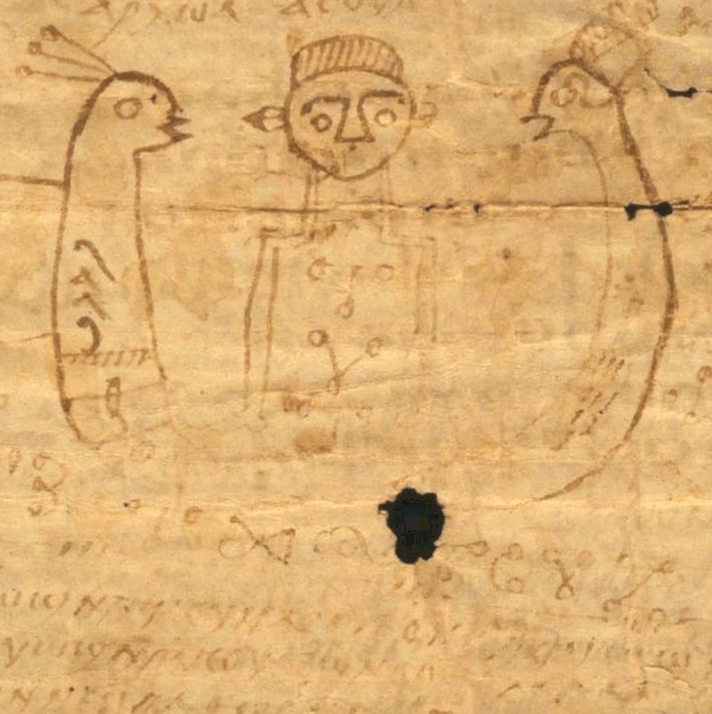
Let’s have a closer look at the image on this disc shown above. In the middle, a standing figure is visible, hands raised, flanked by two amorph blobs. The head of the figure is detailed with wide open eyes, a broad nose, and curious horizontal strikes through the head.

On top of the head, a few vertical lines are visible. Imagine my surprise when I saw a page of a Coptic magical book, featuring a very similar setup, notably in the detailing of the head! [3]

The two ‘blobs’ in the magical book appear to be creatures with the head of birds, while the arrow through the head and the headgear itself are also recognizable in their watered-down rendering on the pendant.

Papyrus RMO inv. F 1964/4.14, 11th century

Another form often found on the Bahariya discs is that of a square with a human neck and head, flanked by two vegetal motifs. This representation as well features in Coptic magical papyri, such as visible in Pap. Heidelberg Kopt. 685. [4] Might the iconography of the Bahariya amulets be based on Coptic charms?

Coptic smiths, Coptic charms in traditional jewellery?

I feel that one fact has been overlooked in determining what the depiction on the Bahariya pendant could mean. It is the simple fact that the smiths were Copts that may prove to be the explanation for the iconography on the amulets.

Not because they were less skilled than Muslim smiths, nor because they had no interest in creating amulets for rituals outside their faith, but because they based their designs on the iconography that was well-known and used in their religion.

With this possible origin however, we still don’t know what these pendants meant to their wearers, who were largely Muslim. As both silversmiths have passed away, they can no longer share their story.

Did they use a magical papyrus as their sourcebook? Was there any other reason to decide for this type of decoration? In this particular case, it is too late to find out for sure.

What this example does illustrate however is the importance of regarding jewellery in its wider sociocultural context instead of only as adornment.

Where can I find more on the historical background of amulets in the Middle East?

Find out more about the social meaning of amulets in the e-course on Amulets and Magic in Jewellery!

Or start by downloading the free e-book explaining 6 ways amulets work here.

More articles on jewellery & amulets? Browse them all here!

Always the first to get new articles? Join the Jewellery List and bling up your inbox!

This post is based on the chapter ‘The Evil Eye and Other Problems’ on magic and jewellery in my book Desert Silver.

References

[1] Weissenberger, M., 1998. Les bijoux des oasis égyptiennes, in: Bliss, F. 1998. Artisanat et artisanat d’art dans les oasis du desert occidental egyptien, Rüdiger Köppe Verlag, Köln p. 319, also mentions that these amulets have completely disappeared from the markets.

[2] Weissenberger 1998, p. 319

[3] Raven, M. 2012. Egyptian Magic. AUC Press, Cairo, p. 172

[4] Heidelberg Inv. Kopt. 685 (Meyer) Lage 5 Seite 12 and 9, digitally available on the website of the Papyrological Institute of Heidelberg university here

The Bedouin Silver blog gives credit where credit is due! Transparent referencing and citing sources helps us all grow. Would you like to do the same and quote this article? Here’s how:

S. van Roode, [write the title as you see it above this post], published on the Bedouin Silver website [paste the exact link to this article], accessed on [the date you are reading this article and decided it was useful for you].

Sigrid van Roode

Sigrid van Roode is an archeologist, ethnographer and jewellery historian. Her main field of expertise is jewellery from North Africa and Southwest Asia, as well as archaeological and archaeological revival jewellery. She has authored several books on jewellery, and obtained her PhD at Leiden University on the jewellery of the Egyptian zar-ritual. Sigrid has lectured for the National Museum of Antiquities in Leiden, Turquoise Mountain Jordan, and many others. She provides consultancy and research on jewellery collections for both museums and private collections, teaches courses and curates exhibitions. She is not involved in the business of buying and selling jewellery, and focuses on research, knowledge production, and education only.
Berber Memories

Berber Memories

Berber Memories

private collection

Berber Memories

Updated August 11, 2024

It has been some time since an overview of Amazigh jewellery has been published, but the latest publication of a private collection is not to be missed! The impressive volume Berber Memories presents the stunning Gillion Crowet-collection in nearly 600 wonderfully illustrated pages.

Berber Memories: the outline

The collection itself has been assembled by the couple Anne-Marie and Roland Gillion Crowet during 5 decades of travel in Morocco. It consists of hundreds of spectacular objects, all provided with a caption by their daughter, Nathalie de Merode.

The text of this hefty volume (it weighs several kilos!) is by renowned art historian Michel Draguet. The book is divided into two parts, and I will walk you through both of them to give you an idea of the scope of this publication.

Before we start, it is important to note that the author is an art historian, as opposed to for example an anthropologist or ethnographer. This difference is most noticeable in his choice of words, for example in his treatment of the topic ‘Ornamentation vs Decoration’ (p. 47): the discourse presented there is based on Western theoretical approaches of art. The emic perspective, how the Amazigh themselves experience their jewellery, is not explicitly included here or elsewhere in the book (the acknowledgements do extend heartfelt thanks to quite a number of knowledgeable people).

Speaking of Amazigh, the book consistently uses the word ‘Berber’: although the Amazigh have been rejecting the word ‘Berber’ for quite some time now and reclaim their own name, this is not addressed. It struck me as odd, as this book does much to celebrate Amazigh history and culture.

Berber Memories: Part 1, ‘Gazing’

The first part is an excellent introduction into Amazigh history. Where other jewellery books do not include Amazigh history or present it briefly, here the author takes his time to explore. This is incredibly valuable, as it is a history of exchange, cultural contacts, and adaptations to changing climate circumstances, all of which have left their mark on jewellery traditions.

What is more, this history is not presented as indisputable facts: where conflicting views exist, these are briefly introduced, enabling the reader to obtain a sense of both the ‘unknowns’ of history as well as of the way how any historical tale is shaped by the cultural background of those that write it.

What emerges is a portrait of the Amazigh people not as a monolithic entity, but as an ever-changing, rich ‘pluralistic culture’ (p. 79). Starting out in the Neolithic, the book discusses interaction across the Sahara all the way to Egypt, and later with Phoenician and Roman cultures, followed by the Arab conquests and their profound consequences for the Amazigh, the rise and fall of Amazigh empires, the balance between nomads and city-dwellers, Jews and Muslims, and the adapting and improving of techniques like for example enameling.

The author uses jewellery to illustrate his point at regular intervals, such as the balanced discussion of the khamsa, produced by Jewish craftsmen, worn by Jews and Muslims alike, and incorporating much older beliefs. All in all, this part provides insight in the venerable time-depth of Amazigh history.

Berber Memories: Part 2: ‘Feeling’

The second part introduces the world of women. Here, jewellery is combined with poetry, craftmanship and body aesthetic to illustrate its place in a wider context. This is a hugely important factor that I can’t emphasize enough: jewellery does not exist in a vacuum.

It is closely related to rug making, basketry, clothing, body aesthetic and oral traditions. This wider significance is touched upon here and there in the book, by likening jewellery patterns and styles to other examples of personal adornment and objects in the personal space.

Also introduced are the uses of jewellery as capital, as amulet and as status indicator, before moving to the jewellery pieces themselves.

The collection is presented regionally, starting out in the north and ending in the south. Each section starts with a map of the area, which I love: this way, you’ll get a sense of where the jewellery comes from and how jewellery designs are interrelated. Additionally, on the inside of the cover you will find a map of Morocco, on which jewellery items and drawings of regional dress by Jean Besancenot have been placed –a very helpful visual tool to get a general idea of main regional differences for anyone unfamiliar with the wide variety of Amazigh jewellery in Morocco.

Throughout the book, the historic photographs of Besancenot and others have been paired with the jewellery items shown, which makes for a visual dialogue between the black-and-white photographs and the splendor of the colour images of jewellery.

Berber Memories: the collection Gillion Crowet

Part 2 continues with the presentation of the collection – and what a superb collection it is! Iconic fibulas, stunning headdresses and head ornaments, sumptuous necklaces and rich bracelets form the vast majority of the collection. Each of these has been expertly photographed and displayed in such a manner that the wide variety of techniques, colours and shapes can be fully appreciated.

A very strong point of the collection is that it shows variety within the same type of ornament: for example, the famous worm-hole fibulas are represented by no less than 40 pages with nearly as many different pairs. I find this to be very instructive for the way we look at jewellery. There is not one ‘standard type’ with a ‘standard composition’, which somehow excludes other executions of the same sort of ornament as ‘not right’. See more about how that line of thinking comes about in this article.

The collection Gillion Crowet illustrates the point abundantly, by showing us a wide range of ever so slightly differing jewellery items within a singular type. Here, the art historian expertise of the author is to the advantage of the reader: his descriptions guide the eye and enable us to take in details, appreciate choices made by the craftsmen and see the evolving of styles.

Alongside these jewels, there is a vast amount of information about production centers, techniques used, materials sourced and traded, interwoven with meaning and power attributed to shapes and styles. We learn how climatic, economic and political factors caused silversmiths to relocate, trade centers to flourish or dwindle, and techniques to travel: an exceptional view on the background of these jewellery items.

Berber Memories: the meaning of jewellery

The meaning of patterns, colours and materials to their wearers varies immensely, not only over time but also geographically. This is partly due to the manner in which knowledge about meaning, magic and power is transmitted, both within the culture and certainly to cultural outsiders.

What is a meaningful shape in one region may carry less importance in the next, and what an older generation recognized as significant may have changed for a younger generation.

Another reason for this variety in agency is because it is attributed to objects by humans: they do not intrinsically carry it, which is why they lose their voice if their meaning is no longer understood. Naturally, these meanings and powers attributed to material forms evolve over time, following changing circumstances of the cultures that bring them forth. The book deals with this given in a number of cases, by presenting varying explanations for one and the same shape simultaneously.

This results in a overview of what individual shapes might mean, instead of presenting these as sole truths. Examples are the well-reasoned discussion about the possibly anthropomorphic elements known as atnarich (p. 312), the meaning attached to amber (p. 350) and many other elements.

Berber Memories: a few critical observations

Notwithstanding the importance of this volume, there are a few critical observations to made as well. Every now and then little inconsistencies pop up, like the assertion that Amazigh necklaces ‘generally feature enameled pendants’ (p. 128): the abundance of jewellery without enameled pendants in the book proves otherwise.

Some attributions I can’t quite follow as well, like the statement that the support system of a particular head ornament with three hooks is based on the ‘bulla etrusca model’ (p. 332) – I fail to see the connection, or how an Etruscan chest pendant of 300 BC would be the model for the ‘support system’ of this head ornament. Perhaps there is a similarity that I’m missing, but the direct linkage of Etruscan piece as model for a type of Amazigh jewellery without presenting solid proof of continuation in between is a step too far for me.

Berber Memories – an invaluable reference source

I highly recommend, no, I urge you to buy this book before this, too, becomes one of those sought after out-of-print books that we all know so well: it is remarkably friendly priced for such an important volume. The collection of jewellery presented is outstanding and a testimony to the long and rich cultural history of the Amazigh. Together with the wide historical overview, the wealth of old photographs and the detailed information per region this monumental book constitutes an invaluable reference source for the finest of Amazigh jewellery.

Berber Memories. Women and Jewellery in Morocco (2021). By Michel Draguet.

600 pages, full-colour, available in both French and English.

Available through the publisher Mercatorfonds, distributor Yale University Press and all major bookstores (online and offline).

The book was gifted as advance review copy by the publisher. Images sourced from the publishers’ website.

More book reviews like these? Find dozens of them here!

Always the first to receive reviews and other jewellery news in your inbox? Join the Jewellery List and stay in the know.

Collecting jewellery yourself? The Collector’s Handbook is a resource made for you!

Would you like to quote this article? Please do! Here’s how:

S. van Roode, [write the title as you see it above this post], published on the Bedouin Silver website [paste the exact link to this article], accessed on [the date you are reading this article and decided it was useful for you].

Sigrid van Roode

Sigrid van Roode is an archeologist, ethnographer and jewellery historian. Her main field of expertise is jewellery from North Africa and Southwest Asia, as well as archaeological and archaeological revival jewellery. She has authored several books on jewellery, and obtained her PhD at Leiden University on the jewellery of the Egyptian zar-ritual. Sigrid has lectured for the National Museum of Antiquities in Leiden, Turquoise Mountain Jordan, and many others. She provides consultancy and research on jewellery collections for both museums and private collections, teaches courses and curates exhibitions. She is not involved in the business of buying and selling jewellery, and focuses on research, knowledge production, and education only.

A shackled jinn from Oman

A shackled jinn from Oman

jewellery as protection

A shackled jinn from Oman

Updated June 25, 2025

Jewellery regularly doubles as protection, as it is worn so close to the body. Often this form of protection is of general nature, but every now and then it makes uses of specific elements to ward off a particular evil. This pendant from Oman hides such an element on its reverse side: a tiny figure of a shackled human form. What does this mean, and what does it tell us about the women who wore this necklace?

The image of a jinn on the Omani kirsh kitab

The disc-shaped pendant is known by several names. The most often used name is somt, which is also used for other round pendants of the same size. [1] In one publication it is called kirsh kitab. [2] A similarly shaped pendant with a comparable reverse side is called kokh, again in one publication: this pendant is decorated with gold leaf on its front side rather than an inscription. [3]

The pendant carries an inscription on its front side. This is the Throne Verse, one of the most powerful verses of the Quran and often used for protection. You will find it often on amulets throughout the Middle East and North Africa.

On the reverse side, in many cases you will find a stylized depiction of a human-shaped figure. This is an image only known to the woman wearing it. You would not be able to see it from the outside. Mostly, this figure is explained as a jinn, held captive by the power of the Throne Verse.

As such, these pendants offer protection from evil spirits in general. The figure however is in some cases said to carry a name. This jinn is not any jinn, but a very particular one. So which jinn is this, and why is it engraved on the back side of an Omani pendant?

The jinn on an Omani pendant: the Bahla Witch?

Forster explains the figure as a representation of the Bahla Witch.[4] Bahla, a fortress town in Oman, has a reputation for the presence of both jinn and witches. [5] The pendant would protect the wearer from witchcraft and jinn alike. As this pendant was worn in a much larger area than just Bahla however, this interpretation may well be true for the inhabitants of the town itself, but there is another possibility that would make sense to many women.

The jinn on an Omani pendant: Umm as-Subyān

This other explanation is that of the human figure as Umm as-Subyān, ‘Mother of Children’. [6] This female jinn is well known beyond Oman and appears also further on the Arab Peninsula. But who is Umm as-Subyān?

In the most benign version, she is said to cause nightmares in children and uncomfortable wet dreams for boys in particular. But, there is more to her than just a night filled with bad dreams. She may be really dangerous.

Anne Regourd has researched how this jinn features in Yemeni oral traditions. [7] These tales share a more gruesome side to Umm as-Subyāns character: she lures young children away from their mothers and eats them, and she also takes newborns. Another tale records how she is capable of possessing young men and women, who then can’t seem to marry, no matter how much they try.

Regourd concludes that Umm as-Subyān is intent on preventing the arrival of children. She tries to prevent marriage altogether, and if a union does succeed, she takes and kills the offspring.

In short, Umm as-Subyān embodies what every woman feared: the inability to have children. [8]

Having children: fertility amulets in the Middle East

Why is not having children something to be afraid of? Fertility was one of the most fundamental aspects of a woman’s life. Having children was important: they assisted from a young age in the daily running of household and work, and would take care of their parents when these grew old. Remember, this is a past in which no retirement funds or care-homes existed!

Not having children could even be reason for divorce. Add to that a high infant mortality rate, and the pressure women were undeer becomes apparent. All over the Arab world, jealous jinn were thought to obstruct attempts at getting pregnant and bearing healthy children.

In this respect, Umm as-Subyān is comparable to for example the Qarina in Egypt [9] and La Taba in Morocco [10]. All three target newborns and young children, and cause infertility or miscarriages in young women.

Many women took precautions to make sure these jinn were rendered harmless, and these precautions often took the form of personal adornment. Jewellery is worn close to the body, and so forms a barrier between you, and the outer world full of dangers.

An Omani pendant with a hidden message

In the case of Umm as-Subyān, two ways of averting her are in both the name humans use when talking about her, and the way she is depicted on the pendant. The name ‘Mother of Children’ uses reverse magic. She is called by the exact opposite of her actions, a form often seen in informal magical practices around the world.

In the image on the pendant, the stylized figure is shackled around her ankles and wrists. Immobilized, she is not able to come for the wearers’ children or prevent her from getting married.

Jewellery reveals a woman’s world of worry

As with anything jinn-related, there is not one definitive identification or final explanation. With the presence of the Throne Verse, the pendant protects against evil influences in general.

The tiny shackled figure, in the story of Umm as-Subyān, reveals a world of worry for women, and so the pendant protects them from what well may have been one of their worst fears.

Where can I find more on women and amulets in the Middle East?

Find out more about the historic value of amulets in the e-course on Amulets and Magic in Jewellery!

Or start by downloading the free e-book on amulets and jewellery here.

More posts on jewellery and amulets? Browse them all here!

Join the Jewellery List and receive new articles, jewellery news and more in your inbox!

References

See the book chapter on these amulets by James Redman, which discusses the texts and context of precisely this pendant type in much more depth. This chapter was published in Nov 2020, after the writing of this blog post. Highly recommended reading!

 [1] A. Forster 2000. Disappearing Treasures of Oman. Archway Books, Somerset, p. 38-39

[2] P. Shelton, R. Richmond & M. Morris, Oman Adorned.

[3] J.S. Rajab 1998, Silver Jewellery of Oman. Tareq Rajab Museum, Kuwait, p. 63

[4] Forster 2000, p. 40

[5] See L.J. Borger 2011, By the Pricking of My Thumbs, Something Wicked This Way Comes: Omani Perceptions of the Supernatural. Independent Study Project (ISP) Collection. 1039., for a discussion of the supernatural in Omani society.

[6] P. Shelton, R. Richmond & M. Morris, Oman Adorned, p. 102; L. Mols, Kunst uit Zilver. Traditionele sieraden van Oman, in: L. Mols & B. Boelens (red) Oman, p. 137

[7] A. Regourd 2012, Représentations d’Umm Sibyan dans les contes yéménites : de la dévoreuse d’enfant à la djinniyya possédant les humains, in: A. Caiozzo & N. Ernoult (eds), Femmes médiatrices et ambivalentes. Mythes et imaginaires, Paris, Colin, pp. 63 – 72

[8] Regourd 2012, p. 72

[9] See my article in RAWI Magazine for the qarina

[10] J. Bois, La Sorcellerie au Maroc, nouvelle édition 2014, Dar al-Amane, Rabat p. 198.

The Bedouin Silver blog gives credit where credit is due! Transparent referencing and citing sources helps us all grow. Would you like to do the same and quote this article? Here’s how:

S. van Roode, [write the title as you see it above this post], published on the Bedouin Silver website [paste the exact link to this article], accessed on [the date you are reading this article and decided it was useful for you].

The Bedouin Silver Jewellery Blog: Sigrid van Roode

Sigrid van Roode is an archeologist, ethnographer and jewellery historian. Her main field of expertise is jewellery from North Africa and Southwest Asia, as well as archaeological and archaeological revival jewellery. She has authored several books on jewellery, and obtained her PhD at Leiden University on jewellery, informal ritual and collections. Sigrid has lectured for the National Museum of Antiquities in Leiden, Turquoise Mountain Jordan, and many others. She provides consultancy and research on jewellery collections for both museums and private collections, teaches courses and curates exhibitions. She is not involved in the business of buying and selling jewellery, and focuses on research, knowledge production, and education only. Sigrid strongly believes in accessibility of knowledge, and aims to provide reliable and trustworthy content: that’s why the Bedouin Silver blog provides references and citations.

Juifs du Maroc

Juifs du Maroc

Juifs du Maroc

photography
jean besancenot

Juifs du Maroc

One of the photographers whose work is widely circulated in the jewellery world is Jean Besancenot. His portraits of men and women from Morocco are featured both on the Internet and in books, as they provide detailed insight into how dress and adornment were worn. The Musée d’art et d’histoire du Judaisme in Paris has selected a variety of his photographs for their exhibition Juifs du Maroc – Photographies de Jean Besancenot 1934 – 1937. Unfortunately, I have not been able to admire the exhibition itself, but the accompanying publication is a delight.

The main asset of this book, besides the photographs themselves of course, is that it provides personal and historical context to the photographs. This is very valuable, as photographs often circulate in a vacuum and the who, what and why of their background is not always presented. This concise book combines the photographs with original notes from the photographer. These are taken from his 1988 publication Costumes du Maroc as well as from his notes that are kept in the Institut du Monde Arabe in Paris. Additionally, essays from various other authors provide context to the photographer as well as the world he was photographing. A personal account of the daughter of one of the young men portraited relates how she discovered it was her father – throughout the book the names of the persons portraited are given where possible. An essay about costume and dress along with a glossary complete this exploration into Jewish dress in Morocco.

The photographs themselves are subdivided into several regional areas. First, the cities are presented, followed by inhabitants of the Souss region, the Todhra and Dades Valleys, the region around Tafafilet and finally the Draa Valley. Each photograph is presented with an excerpt from his notes, detailing dress and jewellery items or presenting general observations. We learn for example how Jewish women would use the same facial designs as their Amazigh neighbours, because they shared the same local beliefs; the difference being that Jewish women did not tattoo these signs but painted them on with the paint mixture known as harqus (p. 62 and 108).

This book is not a complete overview of dress and adornment of the Jewish population in Morocco, and is not intended as such. Rather, it offers glimpses of this world through the photographs. By reading the captions and short descriptions with the pictures, you’ll learn a great deal about the names of items of dress and adornment and the occasions on which certain items would have been worn. Through the captions, we also get an idea of what the photographer wanted to convey. Many photographs are indeed posed portraits, but unlike the staged studio portraits we also encounter in North Africa: here, the ladies themselves showed the photographer how a certain dress was worn and what jewellery it would be paired with. Occasionally, the photographer himself orchestrated a picture, like the group photo of several ladies from Tahala (p. 51). His reason for this group photo was to show the abundance and similarities of jewellery worn. The context given about the motives of both photographer and photographed allows us to place the result in more context.

What I liked most about this book, apart from the amount of information it provides, is the incidental candid snapshot. As most of the photographs are portraits, the persons in them clearly pose: eyes downcast and posing with the static awkwardness we all feel when asked to stand still for a picture. But a few photos break this mould: a glance upwards in a synagogue courtyard where a few boys are sitting, a woman pouring water from a container, a radiant smile…

This is a book you will want to add to your bookshelf!

Juifs du Maroc. Photographies de Jean Besancenot, 1934-1937. 159 pp, black & white with a few colour plates, in French. Available through the super helpful shop of the Musée d’art et de l’histoire de Judaisme, Paris.

The book was purchased from the museum.

More books on personal adornment? Browse dozens of titles here!

Get regular updates, book recommendations and jewellery articles delivered straight into your inbox by joining the Jewellery List today!

Sigrid van Roode

Sigrid van Roode is an archeologist, ethnographer and jewellery historian. She considers jewellery heritage and a historic source. She has authored several books on jewellery from North Africa and Southwest Asia, and on archaeological jewellery. Sigrid has lectured for the Society of Jewellery Historians, the National Museum of Antiquities in Leiden and the Sultan Qaboos Cultural Center, among many others. She curates exhibitions and teaches online courses on jewellery from North Africa & Southwest Asia.