East meets West

East meets West

The Crusades and the age of decolonization

East meets West

The Macquarie University History Museum has curated a small publication on the occasion of its opening, titled East meets West. The inside cover text provides the goal of this book: ‘East meets West seeks to illuminate the complex intersection of western and eastern culture and civilization in the Eastern Mediterranean during the period of the Crusades through the study of Byzantine and Mamluk Egyptian artworks and illuminated manuscripts.’ That is a tall order, and although the book indeed presents beautiful artworks, its concise size prohibits it from truly exploring the complexity of these cultural interrelations and their continued ripple effects in today’s world.

The introductory chapter and the following chapter on medieval Western understanding of the Islamic world briefly outline the complexity of the Middle Ages both in terms of historic events as well as in later perception. In the introduction it becomes clear that the ‘Age of Decolonisation’ in the title of the book refers to the period after the last Crusade, the 14th century, not to our own timeframe. I could not help but wonder if ‘decolonization’ is the right term to describe the nature of this period, especially when ‘the West’s failure to develop a balanced view on the Crusades’ is given as a reason for a lasting legacy that continues to this very day (p. 10). It is precisely this last part that leaves me wondering: this lasting legacy is alluded to, but never explored further.

A chapter on the Byzantine world introduces how this era connects both the Roman past and the rise of Christianity in the West with the Islamic world. Here, the connection on the Roman and Christian end is emphasized more than the overlap with the Islamic world, although of course the Eastern Orthodox church of today finds its roots in the Byzantine world.  The book then presents four short chapters on material culture that showcase the connection between the European and Arab worlds. The chapter on Mamluk building in Cairo explores the interconnectedness of Islamic and Christian worlds through architecture. Starting with a brief introduction on the Mamluks themselves, who have their origins in both Christian/Eurasian cultures and slavery, the chapter discusses the reuse of building materials in Mamluk architecture – not just Pharaonic blocks, but also material taken from Christian buildings in Syria and Palestine. Vice versa, the inspiration of Syrian church towers for minarets is a great example of cross-cultural exchange. I found this a fascinating topic, as it touches upon practical as well as ideological reasons for cross-cultural reuse.

Next is a brief introduction in the technique of sgrafitto-ware, that was originally developed in the Roman era and passed on to the Islamic world through the Byzantine Empire. The last two chapters present written works: illuminated Book of Hours manuscripts and Islamic calligraphy. Surprisingly, although these chapters sit back-to-back, they are not connected. Both chapters present beautiful examples and an absolutely interesting introduction into the prayers books and calligraphy, but neither refers to the other or places the works presented in the context of mixed artforms that resulted from the interaction between the Islamic and Christian world, such as banderoles with (pseudo)Arabic calligraphy in medieval Christian paintings, or the oriental rugs on the painting of the Annunciation as mentioned in the introduction (p. 13)

The complex, shared history of the European and the Arab world is addressed again in the last chapter of the book. Here, the ‘east-west’-divide is explored through the lens of Australia’s own colonial past and the Middle Ages are redefined as an era of interconnectedness, instead of incidental encounters. This is an important chapter as it delves into how these collections were acquired, and what factors are to be taken into account when studying them: as collected objects are inevitably based on a selection, this layer needs to be peeled off before any assumptions about the objects themselves can be made and this chapter deals with that given in great clarity.

The perspective of the book is one I find truly important: the interconnectedness of two worlds that are too often portrayed as separate planets, the colonialism of the Christian and Islamic worlds in the Middle Ages, and the resulting cultural exchange. Exploring that interconnectedness through material culture is an excellent starting point, although an argument could be made that the title East meets West in all its simplicity in turn belies this interconnectivity. Returning to the inside cover however, I found that one intriguing aspect mentioned here is missing from the book itself: ‘…the impact of the divide between East and West is still evident today. The Crusades changed the world forever.’ This ripple effect of the Crusades in today’s world is alluded to again for example in the last lines of the foreword. Here, we read that ‘although history itself is not repeated, patterns of history are. The violent escalations which erupted in East Jerusalem between the government of Israel and Hamas in May 2021 tragically follow such a pattern’ (p.8). Which pattern, and how that we should place that in the context of the relation between the Christian and Islamic world in the Middle Ages and afterwards is not elaborated upon.

All chapters in the book are illustrated with stunning artworks, expertly photographed and a joy to see – Byzantine glass bracelets and gold ornaments, intricate calligraphy and illumination, views of architectural details, coins, bowls and more offer us a glimpse of the Macquarie University History Museum’s rich collections. What East meets West offers is a beautifully illustrated window into the Macquarie University History Museum collections, while its concise texts provide an introduction into, as well as food for thought on, medieval material culture in the Eastern Mediterranean.

East meets West. The Crusades and the Age of Decolonization, by Martin Bommas (ed). Giles Art Books, 2021. 72 pp, full-colour, in English.

Available with the publisher Giles Art Books and online.

The book was gifted as a advance reading copy by the publisher.

More books on historic interaction and cultural exchange? Find my picks for you here.

See how cultural interaction led to evolving jewellery styles in the e-course on History of Jewellery: 5,000 years of dazzling jewellery development flowing together on your screen – and 8 e-books to go with that!

Never miss out on new books and other jewellery news? Join the Jewellery List and enjoy a bit of sparkle in your inbox!

Sigrid van Roode

Sigrid van Roode is an archeologist, ethnographer and jewellery historian. She considers jewellery heritage and a historic source. She has authored several books on jewellery from North Africa and Southwest Asia, and on archaeological jewellery. Sigrid has lectured for the Society of Jewellery Historians, the National Museum of Antiquities in Leiden and the Sultan Qaboos Cultural Center, among many others. She curates exhibitions and teaches online courses on jewellery from North Africa & Southwest Asia.

Splendour and Shine II

Splendour and Shine II

regional dress and adornment

Splendour and Shine

Jewellery and dress are not static. They change over time, sometimes only marginally, sometimes profoundly. Some are ‘frozen’ in a particular form, and some continue to inspire new forms. These changes during a lifetime and exchanges between cultures are the central theme of the exhibition Splendour and Shine in the Flow of Time, that is on view in the Kreismuseum Zons, Germany, during the winter of 2021-2022. I had the pleasure of attending the opening of the exhibition, and brought the accompanying publication home with me: another highly informative read!

As in her earlier publication Splendour and Shine in the River of Time, which accompanied the exhibition in Liechtenstein, Irene Steiner combines traditional jewellery and dress from the German-speaking world with that of the rest of the world.  In 9 chapters, the book discusses change and developments starting out with traditional dress that has virtually remained unchanged for over a century and ending with the existence of traditional dress in a global world. The many dresses and items of adornment shown serve as case studies to present a train of thought, and that makes this book densely packed with food for thought. There is not enough space for an in-depth discussion of all of these, but the entire book hands us several points of view and case studies to consider, combining both past and present.

The publication is also a visual reference, as many varieties of a certain type of ornament are shown in the images. The photographs are many and, as a result, often small, but they will bring you a good idea of the wide variety in dress and adornment. Think of buttons, rings, belt- and shoe buckles for example, but an overview of brass dangles that would have been worked into a bridal crown is presented as well, including their various executions and their meaning. In this respect, the book also offers a wide range of research possibilities by showing several examples of details that are waiting to be researched and documented before they become forgotten: how to create such an intricate bridal crown for example, or the meaning and provenance of a certain necklace (p. 46-47). There is still a lot that regional dress and jewellery has to share that is not fully understood, and the book makes an important contribution to the study of this type of heritage in highlighting these possibilities.

What you will get from this book is both an understanding of details of regional European dress as well as many avenues for exploring the themes and concepts beyond dress and adornment: you will find yourself pondering the many angles in this book long after you have read it. I thoroughly enjoyed it as an exhibition publication that goes beyond captioning the exhibited pieces, offering many thoughts on how we regard regional jewellery and dress, and what has created the circumstances under which we have grown accustomed to seeing them in a particular way. Why is regional dress from German-speaking Europe associated with the Oktoberfeste for example, and how did jewellery from North Africa, Southwest Asia and the Arab Peninsula end up in oriental dance? The book is bilingual, and the abundance of photographs will make you enjoy this book for quite some time!

Splendor and Shine in the Flow of Time. Ethnic jewellery and traditional costume in a changing world, by Irene Steiner.

92 pages, full-colour, bilingual German/English. Available with the author.

The book was purchased in the Kreismuseum Zons.

More rare books on private collections? See my recommendations for you here!

Join the Jewellery List to receive updates on new books and exhibitions – never miss out on anything jewellery!

Sigrid van Roode

Sigrid van Roode is an archeologist, ethnographer and jewellery historian. She considers jewellery heritage and a historic source. She has authored several books on jewellery from North Africa and Southwest Asia, and on archaeological jewellery. Sigrid has lectured for the Society of Jewellery Historians, the National Museum of Antiquities in Leiden and the Sultan Qaboos Cultural Center, among many others. She curates exhibitions and teaches online courses on jewellery from North Africa & Southwest Asia.

Creating Splendour & Shine

Creating Splendour & Shine

‘Splendour and Shine in the Flow of Time- Ethnic jewellery and traditional costume in a changing world’ is the title of a new exhibition by Irene Steiner in the Kreismuseums Zons, Germany. The exhibition will open this month and combines dress and adornment from Europe and abroad. The accompanying book will also appear this month (September 2021), and as usual Irene has left no stone unturned when it comes to our perspectives on dress and jewellery from the recent past. We sat down digitally in advance of the opening of the exhibition and talked about so many things related to curating an exhibition, working with jewellery, the current discussions about non-Western and Western adornment…Irene shares her personal and professional view on her work with us in this article.

How did you first become interested in ethnography? What sparked your interest?

Ethnologists are in a sense “fence sitters” – like, among others, diplomats, shamans, healers, interpreters and witches (in old high German “hagazussa”, old Icelandic literally “tunrida”) – they move between “worlds”, between realities separated in space, time, language or otherwise. Ethnology puts many things into perspective that at first seem self-evident. It is – broken down abstractly – about discovering, documenting, communicating, and researching cultural phenomena and structures. I always wanted to become an ethnologist. My parents were very interested in art history and travelled a lot. That left its mark on me. At the same time, there was a desire to fight disease and misery. I studied Ethnology/African studies and medicine at the University of Cologne. I dealt with topics of comparative religion, ethnomedicine, constructivism, women’s studies, material culture and especially jewellery and regional clothing. In 1996, I graduated with a master’s degree in ethnology, and in 2000, I became a medical doctor. The opportunity to work more intensively as an ethnologist arose when my daughters grew up.

You connect and research adornment from all over the world in your exhibitions: could you tell us a little about how that works and what its results are?

Moving freely between cultures and disciplines, all jewellery traditions were fascinating to me from the beginning. The classical separation of ethnology and folklore until 2000, only made sense in terms of sources and some methods. In terms of content, many disciplines could never understand the separation of “European cultures” and “the rest of the world”. Even around 1900, many cultural researchers, linguists, archaeologists, historians, and others conducted their researches both far away and at home; the boundaries between disciplines were more fluid as well.

But with this fluidity, how is it that non-Western jewellery is so often perceived as different from Western jewellery?

The fact that non-Western jewellery was perceived and researched as “different” had many causes.

On the one hand, jewellery research in Europe was initially devoted to the jewellery of the upper social classes (nobility, upper middle classes). Jewellery objects of the rural population were assigned to folklore and considered inferior, so to speak. Like “folk jewellery”, “ethnic jewellery” was perceived and collected as exotic “ornaments”, but rarely systematically researched or presented in its internal differentiations and in relation to individual wearers and their lives.

This led to categories created by scholarly discourse – whether consciously or unconsciously – of “primitive art” (non-Western), “folk art” (rural-“peasant”-European), as well as “applied” and “abstract”/”real” art. Non-European and rural European jewellery is often treated exclusively typologically, implicitly denying its individuality and artistic value. Moreover, traditional European jewellery was long regarded as a “cultural asset that had descended from the upper classes” and, just like non-European jewellery, was perceived as “simple”, i.e., less valuable, and artistically inferior.

On the other hand, the idea prevailed that there were “advanced cultures” – among them many European cultures – that were superior to other forms of human life. How deeply rooted this thinking is, can be seen – among other things – in the still difficult conceptualisations of topics in jewellery and textile research. In this exhibition and in my new book, I have provocatively included European region-specific jewellery under “ethnic jewellery”, although the term “ethnic” itself is very problematic.

How do you yourself deal with these differences and similarities?

For me personally, significant parallels and differences are equally interesting in my field of investigation. From the cultural anthropological perspective, it is ultimately about cultural metastructures, be it in a functional, structuralist and/or cultural materialistic sense.

Beyond that, I do try, like all curators, to make the object speak and to make people, especially the women who wore the jewellery, visible. How did they manage their lives?  What structures did they live in? What were their realities like? I often dream that all the wearers and owners of the exhibited objects could be present at the vernissage to tell their personal stories.

The cross-cultural and cross-epochal approach is laborious. On the one hand, time periods in a region are to be researched and presented correctly. On the other hand, the overarching theme has to serve as a guide through entire worlds. It is like commuting between a detailed and an overview view and, figuratively speaking, quickly leads to a loss of “depth of field”.

It takes a good network of specialists, a lot of literature, many databases, and a lot of time. I dream of a large digital archive on traditional costumes and jewellery worldwide, preferably with every comparative object that has ever been documented, the one virtual meta-reference collection, so to speak. The first ethno-mathematical studies on pattern analysis in textiles already exist. Having been involved in the development of health economic meta-analyses myself, this idea fascinates me, but the implementation is methodologically and financially very costly.

The young generation of many countries that were traditionally “researched” in the Eurocentric discourse are now creating their own scientific discourses independent of the Western scientific hegemonic claim. Communities are writing their own history, and this will lead to new insights and discourses. In my new book, I try to let the people who work with and wear traditional costumes, speak for themselves. My vision is the same for “non-Western” countries: research that writes the respective history “from the inside out”, i. e. together with or from within the cultural communities. This requires more trained “cultural native speakers” as scholars, financial resources, and an openness of international discourse.

In this sense, the present exhibition can only outline some topics, give impulses, and perhaps create stimuli for further research.

How do you decide what to show and what to leave out?

The selection of objects is a lengthy process, especially since each selection creates bias, but, on the other hand, it is also necessary for the presentation of the main theme. For me, a multitude of pieces does not devalue the single object, because each element is part of a big puzzle. I like to show many different contrasting pieces to arouse curiosity. At the same time, I have also selected groups of comparative objects in some places to show series of development, local variations in form, or individual variations of a “type of object”. The currently popular reduction to “top objects” visually enhances the value attributed to things. At the same time, this may distort the representation of the original context, especially in the case of objects of everyday use also shown here. For example, the traditional costume of a single woman often included numerous outfits at the same time. I show this “pars pro toto”, because of the lack of space, partly on the bonnets. Likewise, internal variation and individuality only become visible, when comparing several objects of one genre. For example, in the case of the well-known Schwälmer Betzel (caps), one was never exactly like the other.

It would take an entire museum to outline the jewellery regions and traditions of a country like Yemen. Here, the selection is particularly difficult. Thus, I chose objects from many parts of the country – important, rare, but also widespread pieces – to give as comprehensive an impression as possible.

The title is Splendour and Shine in the Flow of Time: what is the exhibition about? What will visitors see?

On the “classical” themes of “life course” and “cultural change”, the exhibition shows over 30 traditional costumes and more than 500 jewellery objects from over 50 countries worldwide in four halls. Small regional focal points are Lower Saxony, Franconia, Romania, the Maghreb and the Arabian Peninsula, and headdresses from German-speaking regions of traditional costume. Festive, and everyday jewellery, and mainly festive costumes are shown. Another room shows photographic studies by Markus Bullik on the theme “In the face of traditional costume”. Both the changes in traditional costume and jewellery in the course of an individual’s life and the change in traditions across generations, through technological and cultural change, flight, displacement and migration, processes of exchange and appropriation are topics that are presented.

In what way is this different from the exhibition of almost the same name in Liechtenstein in 2020?

The exhibition “Splendor and Shine in the River of Time” at the Liechtenstein National Museum in 2020 was oriented towards the life cycle of the individual, from the cradle to the grave. About half of the objects shown there, will also be shown in Zons in two halls, with some changes and additions to the classic theme of the life course. Many of the objects with a close regional connection to the Principality of Liechtenstein and the neighbouring regions will not be on display in Zons. Instead, we are now exhibiting regional clothing and jewellery on topics of cultural change that have not been shown before, which has also resulted in a new, second catalogue, containing again more than 400 illustrations. Because of its focus on cultural change, the new exhibition in Zons is therefore called “Splendour and Shine in the Flow of Time”.

What is the main goal of this exhibition for you? What would you like visitors to remember?

Both glimpses into the world as well as glimpses into the past are worthwhile, not only from an aesthetic point of view.

“Phylogenetically proven orders” such as age classification and kinship systems, religious structures, etc., have been accompanying humanity from the very beginning. One problem of postmodernity, with all its freedoms, is fragmentation; identities, relationships and loyalties appear to be freely selectable; age classes are dissolving, religious reference systems are disappearing, and orders are disintegrating. In a sense, “social entropy” is increasing, which is an overload for many people. In this sense, many cultures are becoming deficient in the context of globalisation. A look into the past makes man-made systems of order – for better or worse – visible on the subject of clothing and jewellery.

Many regional traditions are dying out, their “language”, and furthermore, their craft techniques are being lost. Today, in contrast to earlier times, we have more opportunities to preserve artifacts today, and like our predecessors, we still have the task of documenting them for posterity. In addition, regional clothing and jewellery offer many ideas for highly topical issues such as sustainability, identity, interculturality, and others. Beyond all theories, they remain fascinating objects of art in their time-defying beauty, simply splendour beyond all transience.

I would be delighted if the colourfulness, diversity, and uniqueness of traditional forms of clothing and jewellery would fascinate visitors, spark curiosity, and contribute to openness and mutual appreciation in a multicultural world.

Articles like these straight into your inbox? Join the Jewellery List and receive jewellery insights every month!

See more on museums and exhibitions on personal adornment here: enjoy!

Sigrid van Roode

Sigrid van Roode is an archeologist, ethnographer and jewellery historian. She considers jewellery heritage and a historic source. She has authored several books on jewellery from North Africa and Southwest Asia, and on archaeological jewellery. Sigrid has lectured for the Society of Jewellery Historians, the National Museum of Antiquities in Leiden and the Sultan Qaboos Cultural Center, among many others. She curates exhibitions and teaches online courses on jewellery from North Africa & Southwest Asia.

Numerology in jewellery

Numerology in jewellery

magic of numbers

Numerology in jewellery from the Middle East

Updated November 21, 2025

Numerology and jewellery: an introduction to numbers in adornment

Numerology—the belief that numbers carry symbolic meaning—has played a subtle yet powerful role in jewellery design across the Middle East and North Africa. In this post, I explore how numbers like three, five and seven are woven into the forms of adornment.

These are not decorative choices alone: they reflect magical thinking, protection, and deeply held cultural associations. From dangling elements arranged in odd-numbered clusters to elements alluding to the heavens, numerology has left its imprint on the very structure of traditional jewellery.

Odd and even: why uneven counts matter in Middle Eastern jewellery

That visualization of numerology starts with the difference between even and uneven numbers. Why is there often an uneven number of dangles on a pendant, for example? In jewellery, symmetry and evenness are preferably avoided. Usually, the number of bells and dangles on a particular pendant or amulet will be uneven, which is believed to be a way of warding off the evil eye.

In some regions, an even number is considered to be outright dangerous as the symmetric perfection of an even number will, it is believed, attract the evil eye. Click here to read more about the evil eye in jewellery.

The power of three: triads, triplets and jewellery symbolism

Three is considered to denote the sacred cycle of life (birth, existence and death) and spells are often recited three times.

Many festivities last for three days to enhance their efficacy and good fortune, and triangles, having three sides, are considered a powerful charm. Three is also the old conjunction of man, woman and child and as such was an important number in Antiquity.

Many deities were grouped into trinities or triads, and one deity could also be venerated in three forms. Those three forms would be based on the cycle of life and death, and usually are some manifestation of beginning, middle and end.

In jewellery, three-sided symbols or forms made of three’s are said to have great power: the six-pointed star of hexagram is a double triangle, for example. The threefold repetition of decorative motifs is another way to include the power of this number in jewellery.

Five and the khamsa: the number 5 in amulets and protection

Five is the number most commonly used in jewellery, and some cultures consider the fifth day of the week, Thursday, to be sacred, believing that anything undertaken on this day has more chance of success than activities undertaken on other days of the week.

That is because the number five is associated with the five pillars of Islam, the five fingers of the hand and the five daily prayers.

Five also has a profound cosmic meaning: it visualizes humankind in the center of the four cardinal directions, and as such is a beautiful metaphor for Creation itself.

In jewellery design, five becomes apparent through the arranging of elements in groups of five, or the number of dangles underneath pendants.

And of course it manifests in the khamsa: click here to read more about the powers and history of the khamsa!

Seven and the starry sky: celestial numbering in jewellery design

Seven has been symbolically meaningful since ancient Egypt, where the goddess Isis, renowned for her magical powers, is surrounded by seven scorpions.

Many shrines in North Africa and Southwest Asia need to be circumambulated seven times. This also holds true for the Kaaba in Mecca, which pilgrims circle seven times counterclockwise.

Seven has a cosmic meaning as well: in Antiquity, the seven visible planets were an important element of astronomy and astrology. Click here to read more about astrology in jewellery.

How numerology operates in Middle Eastern jewellery design

All these numbers are repeatedly worked into general jewellery decoration as well, and that is how numerology influences jewellery design. [1] Take a moment to closely at your favourite piece of jewellery. Count its dangles, observe its design: do you notice a motif often occurs in three’s, five’s or seven’s?

Triangles with three points, squares with four points, crosses with five points (the intersection is seen as a point as well), and their combinations, all provide geometrical decorations generally designed to ward off evil.

When actual, written numbers are worked into a magic square, they combine their powers into an effective amulet tailored for the person wearing it.

Understanding jewellery through numbers: a closing reflection

So you see, the arrangement of elements in jewellery may look general, and even be standardized patterning, but it finds its origin in the highly meaningful rendition of numbers.

The use of numerology in jewellery offers a key to understanding how form and meaning intertwine in traditional adornment of the Middle East and North Africa. Numbers such as three, five and seven are embedded in amulets, pendants and jewellery structures—not simply as decoration, but as carriers of cultural logic, ritual purpose and protective power. For collectors, museum curators or anyone drawn to the material culture of the region, recognising these numeric patterns opens a richer appreciation of both jewellery and the societies that produced it.

Where can I learn more about symbolism in jewellery design?

Six ways how magic influences jewellery design: want to know how? Download your free e-book on amulets here!

Other jewellery & magic blogs? Browse them all here!

Find out more about the magic of numbers in the e-course on Amulets and Magic in Jewellery!

This post is based on the chapter ‘The Evil Eye and Other Problems’ in my book Desert Silver.

References

[1] Westermarck, E, 1904. The magic origin of Moorish designs, in: The Journal of the Anthropological Institute of Great Britain and Ireland, Vol 34

Lead image has been created adapting works from The British Libary and HmmlOrientalia.

The Bedouin Silver blog gives credit where credit is due! Transparent referencing and citing sources helps us all grow. Would you like to do the same and quote this article? Here’s how:

S. van Roode, [write the title as you see it above this post], published on the Bedouin Silver website [paste the exact link to this article], accessed on [the date you are reading this article and decided it was useful for you].

The Bedouin Silver Jewellery Blog: Sigrid van Roode

Sigrid van Roode is an archeologist, ethnographer and jewellery historian. Her main field of expertise is jewellery from North Africa and Southwest Asia, as well as archaeological and archaeological revival jewellery. She has authored several books on jewellery, and obtained her PhD at Leiden University on jewellery, informal ritual and collections. Sigrid has lectured for the National Museum of Antiquities in Leiden, Turquoise Mountain Jordan, and many others. She provides consultancy and research on jewellery collections for both museums and private collections, teaches courses and curates exhibitions. She is not involved in the business of buying and selling jewellery, and focuses on research, knowledge production, and education only. Sigrid strongly believes in accessibility of knowledge, and aims to provide reliable and trustworthy content: that’s why the Bedouin Silver blog provides references and citations.

This blog is free: if you’d like to support independent research, please consider enrolling in a course or a jewellery talk. The proceeds directly fund my research work: thank you so much for your support!

Bahariya discs: Coptic magic

Bahariya discs: Coptic magic

Bahariya discs

connecting cultures

The Bahariya discs: Coptic magic in jewellery

Updated July 28, 2024

The decoration on a piece of jewellery sometimes is puzzling. An example is the round disc worn by women in the Bahariya oasis in Egypt’s Western Desert until the 1960’s. Because the origin of this jewellery item has long been subject of discussion, it is a very illustrative case to discuss in more detail.

What do the disc pendants from Bahariya Oasis look like?

The image below shows a pendant from Bahariya Oasis. Like all its siblings, it is made of blank metal instead of silver. They are quite rare: in the last 25 years, I have come across an original Bahariya ornament only once. [1]

This probably is due to the fact that they were a ‘limited production’: they are known to have been made by two Coptic silversmiths, who lived in the oasis until one of them died. At that point, the other one decided to move out of the oasis and settled in Cairo. They were the only ones that created these discs: with their demise and relocation, no other discs were made.

From that moment onwards, the people of the oasis had to buy their jewellery from elsewhere; the two Copts were the last silversmiths in Bahariya. But what do the engravings on these discs represent?

Decoding the symbolism on the Bahariya discs

These discs have been interpreted as derivates of Egyptian zār-amulets, or as Nubian imitation coins, and their possible relation to the Siwa adrim has been investigated as well. But none of these are right. They are not zār, they are not coins, they are not related to the adrim.

So where does the unique decoration on the amulets finds its source…?

It has been suggested that the two silversmiths may not have been as well versed in both technique and decoration, since they were Copts and had little rapport with Islam. [2] So basically, the silversmiths just didn’t get it? That can’t be it.

Because it is not uncommon for silversmiths to be of another social group or faith than the group the smith is catering to. Most of the silversmiths in the Middle East were Jews up until 1948, and they made jewellery for Muslim, Jewish and Christian clients.

But the silversmiths may still be the cental clue here….

Coptic magic: papyri and images

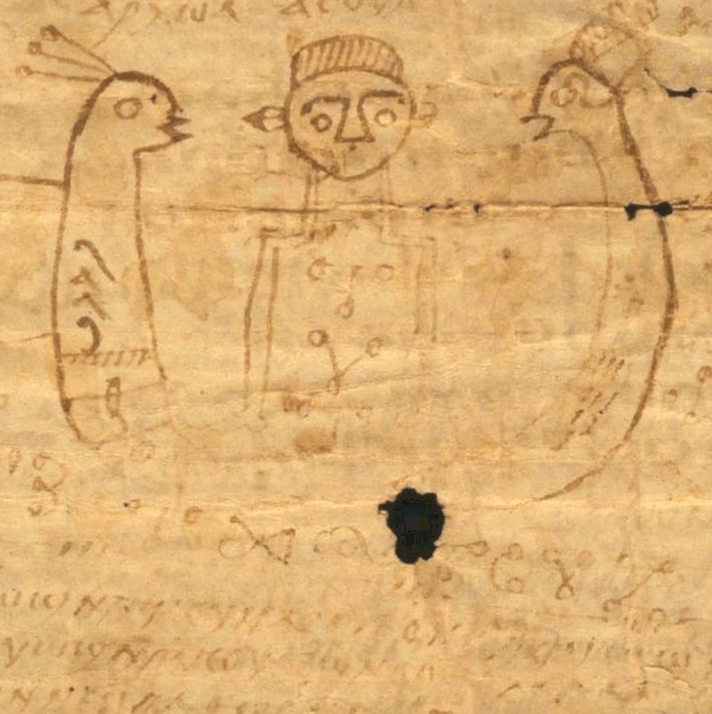
Let’s have a closer look at the image on this disc shown above. In the middle, a standing figure is visible, hands raised, flanked by two amorph blobs. The head of the figure is detailed with wide open eyes, a broad nose, and curious horizontal strikes through the head.

On top of the head, a few vertical lines are visible. Imagine my surprise when I saw a page of a Coptic magical book, featuring a very similar setup, notably in the detailing of the head! [3]

The two ‘blobs’ in the magical book appear to be creatures with the head of birds, while the arrow through the head and the headgear itself are also recognizable in their watered-down rendering on the pendant.

Papyrus RMO inv. F 1964/4.14, 11th century

Another form often found on the Bahariya discs is that of a square with a human neck and head, flanked by two vegetal motifs. This representation as well features in Coptic magical papyri, such as visible in Pap. Heidelberg Kopt. 685. [4] Might the iconography of the Bahariya amulets be based on Coptic charms?

Coptic smiths, Coptic charms in traditional jewellery?

I feel that one fact has been overlooked in determining what the depiction on the Bahariya pendant could mean. It is the simple fact that the smiths were Copts that may prove to be the explanation for the iconography on the amulets.

Not because they were less skilled than Muslim smiths, nor because they had no interest in creating amulets for rituals outside their faith, but because they based their designs on the iconography that was well-known and used in their religion.

With this possible origin however, we still don’t know what these pendants meant to their wearers, who were largely Muslim. As both silversmiths have passed away, they can no longer share their story.

Did they use a magical papyrus as their sourcebook? Was there any other reason to decide for this type of decoration? In this particular case, it is too late to find out for sure.

What this example does illustrate however is the importance of regarding jewellery in its wider sociocultural context instead of only as adornment.

Where can I find more on the historical background of amulets in the Middle East?

Find out more about the social meaning of amulets in the e-course on Amulets and Magic in Jewellery!

Or start by downloading the free e-book explaining 6 ways amulets work here.

More articles on jewellery & amulets? Browse them all here!

Always the first to get new articles? Join the Jewellery List and bling up your inbox!

This post is based on the chapter ‘The Evil Eye and Other Problems’ on magic and jewellery in my book Desert Silver.

References

[1] Weissenberger, M., 1998. Les bijoux des oasis égyptiennes, in: Bliss, F. 1998. Artisanat et artisanat d’art dans les oasis du desert occidental egyptien, Rüdiger Köppe Verlag, Köln p. 319, also mentions that these amulets have completely disappeared from the markets.

[2] Weissenberger 1998, p. 319

[3] Raven, M. 2012. Egyptian Magic. AUC Press, Cairo, p. 172

[4] Heidelberg Inv. Kopt. 685 (Meyer) Lage 5 Seite 12 and 9, digitally available on the website of the Papyrological Institute of Heidelberg university here

The Bedouin Silver blog gives credit where credit is due! Transparent referencing and citing sources helps us all grow. Would you like to do the same and quote this article? Here’s how:

S. van Roode, [write the title as you see it above this post], published on the Bedouin Silver website [paste the exact link to this article], accessed on [the date you are reading this article and decided it was useful for you].

Sigrid van Roode

Sigrid van Roode is an archeologist, ethnographer and jewellery historian. Her main field of expertise is jewellery from North Africa and Southwest Asia, as well as archaeological and archaeological revival jewellery. She has authored several books on jewellery, and obtained her PhD at Leiden University on the jewellery of the Egyptian zar-ritual. Sigrid has lectured for the National Museum of Antiquities in Leiden, Turquoise Mountain Jordan, and many others. She provides consultancy and research on jewellery collections for both museums and private collections, teaches courses and curates exhibitions. She is not involved in the business of buying and selling jewellery, and focuses on research, knowledge production, and education only.