Creating Splendour & Shine

Creating Splendour & Shine

‘Splendour and Shine in the Flow of Time- Ethnic jewellery and traditional costume in a changing world’ is the title of a new exhibition by Irene Steiner in the Kreismuseums Zons, Germany. The exhibition will open this month and combines dress and adornment from Europe and abroad. The accompanying book will also appear this month (September 2021), and as usual Irene has left no stone unturned when it comes to our perspectives on dress and jewellery from the recent past. We sat down digitally in advance of the opening of the exhibition and talked about so many things related to curating an exhibition, working with jewellery, the current discussions about non-Western and Western adornment…Irene shares her personal and professional view on her work with us in this article.

How did you first become interested in ethnography? What sparked your interest?

Ethnologists are in a sense “fence sitters” – like, among others, diplomats, shamans, healers, interpreters and witches (in old high German “hagazussa”, old Icelandic literally “tunrida”) – they move between “worlds”, between realities separated in space, time, language or otherwise. Ethnology puts many things into perspective that at first seem self-evident. It is – broken down abstractly – about discovering, documenting, communicating, and researching cultural phenomena and structures. I always wanted to become an ethnologist. My parents were very interested in art history and travelled a lot. That left its mark on me. At the same time, there was a desire to fight disease and misery. I studied Ethnology/African studies and medicine at the University of Cologne. I dealt with topics of comparative religion, ethnomedicine, constructivism, women’s studies, material culture and especially jewellery and regional clothing. In 1996, I graduated with a master’s degree in ethnology, and in 2000, I became a medical doctor. The opportunity to work more intensively as an ethnologist arose when my daughters grew up.

You connect and research adornment from all over the world in your exhibitions: could you tell us a little about how that works and what its results are?

Moving freely between cultures and disciplines, all jewellery traditions were fascinating to me from the beginning. The classical separation of ethnology and folklore until 2000, only made sense in terms of sources and some methods. In terms of content, many disciplines could never understand the separation of “European cultures” and “the rest of the world”. Even around 1900, many cultural researchers, linguists, archaeologists, historians, and others conducted their researches both far away and at home; the boundaries between disciplines were more fluid as well.

But with this fluidity, how is it that non-Western jewellery is so often perceived as different from Western jewellery?

The fact that non-Western jewellery was perceived and researched as “different” had many causes.

On the one hand, jewellery research in Europe was initially devoted to the jewellery of the upper social classes (nobility, upper middle classes). Jewellery objects of the rural population were assigned to folklore and considered inferior, so to speak. Like “folk jewellery”, “ethnic jewellery” was perceived and collected as exotic “ornaments”, but rarely systematically researched or presented in its internal differentiations and in relation to individual wearers and their lives.

This led to categories created by scholarly discourse – whether consciously or unconsciously – of “primitive art” (non-Western), “folk art” (rural-“peasant”-European), as well as “applied” and “abstract”/”real” art. Non-European and rural European jewellery is often treated exclusively typologically, implicitly denying its individuality and artistic value. Moreover, traditional European jewellery was long regarded as a “cultural asset that had descended from the upper classes” and, just like non-European jewellery, was perceived as “simple”, i.e., less valuable, and artistically inferior.

On the other hand, the idea prevailed that there were “advanced cultures” – among them many European cultures – that were superior to other forms of human life. How deeply rooted this thinking is, can be seen – among other things – in the still difficult conceptualisations of topics in jewellery and textile research. In this exhibition and in my new book, I have provocatively included European region-specific jewellery under “ethnic jewellery”, although the term “ethnic” itself is very problematic.

How do you yourself deal with these differences and similarities?

For me personally, significant parallels and differences are equally interesting in my field of investigation. From the cultural anthropological perspective, it is ultimately about cultural metastructures, be it in a functional, structuralist and/or cultural materialistic sense.

Beyond that, I do try, like all curators, to make the object speak and to make people, especially the women who wore the jewellery, visible. How did they manage their lives?  What structures did they live in? What were their realities like? I often dream that all the wearers and owners of the exhibited objects could be present at the vernissage to tell their personal stories.

The cross-cultural and cross-epochal approach is laborious. On the one hand, time periods in a region are to be researched and presented correctly. On the other hand, the overarching theme has to serve as a guide through entire worlds. It is like commuting between a detailed and an overview view and, figuratively speaking, quickly leads to a loss of “depth of field”.

It takes a good network of specialists, a lot of literature, many databases, and a lot of time. I dream of a large digital archive on traditional costumes and jewellery worldwide, preferably with every comparative object that has ever been documented, the one virtual meta-reference collection, so to speak. The first ethno-mathematical studies on pattern analysis in textiles already exist. Having been involved in the development of health economic meta-analyses myself, this idea fascinates me, but the implementation is methodologically and financially very costly.

The young generation of many countries that were traditionally “researched” in the Eurocentric discourse are now creating their own scientific discourses independent of the Western scientific hegemonic claim. Communities are writing their own history, and this will lead to new insights and discourses. In my new book, I try to let the people who work with and wear traditional costumes, speak for themselves. My vision is the same for “non-Western” countries: research that writes the respective history “from the inside out”, i. e. together with or from within the cultural communities. This requires more trained “cultural native speakers” as scholars, financial resources, and an openness of international discourse.

In this sense, the present exhibition can only outline some topics, give impulses, and perhaps create stimuli for further research.

How do you decide what to show and what to leave out?

The selection of objects is a lengthy process, especially since each selection creates bias, but, on the other hand, it is also necessary for the presentation of the main theme. For me, a multitude of pieces does not devalue the single object, because each element is part of a big puzzle. I like to show many different contrasting pieces to arouse curiosity. At the same time, I have also selected groups of comparative objects in some places to show series of development, local variations in form, or individual variations of a “type of object”. The currently popular reduction to “top objects” visually enhances the value attributed to things. At the same time, this may distort the representation of the original context, especially in the case of objects of everyday use also shown here. For example, the traditional costume of a single woman often included numerous outfits at the same time. I show this “pars pro toto”, because of the lack of space, partly on the bonnets. Likewise, internal variation and individuality only become visible, when comparing several objects of one genre. For example, in the case of the well-known Schwälmer Betzel (caps), one was never exactly like the other.

It would take an entire museum to outline the jewellery regions and traditions of a country like Yemen. Here, the selection is particularly difficult. Thus, I chose objects from many parts of the country – important, rare, but also widespread pieces – to give as comprehensive an impression as possible.

The title is Splendour and Shine in the Flow of Time: what is the exhibition about? What will visitors see?

On the “classical” themes of “life course” and “cultural change”, the exhibition shows over 30 traditional costumes and more than 500 jewellery objects from over 50 countries worldwide in four halls. Small regional focal points are Lower Saxony, Franconia, Romania, the Maghreb and the Arabian Peninsula, and headdresses from German-speaking regions of traditional costume. Festive, and everyday jewellery, and mainly festive costumes are shown. Another room shows photographic studies by Markus Bullik on the theme “In the face of traditional costume”. Both the changes in traditional costume and jewellery in the course of an individual’s life and the change in traditions across generations, through technological and cultural change, flight, displacement and migration, processes of exchange and appropriation are topics that are presented.

In what way is this different from the exhibition of almost the same name in Liechtenstein in 2020?

The exhibition “Splendor and Shine in the River of Time” at the Liechtenstein National Museum in 2020 was oriented towards the life cycle of the individual, from the cradle to the grave. About half of the objects shown there, will also be shown in Zons in two halls, with some changes and additions to the classic theme of the life course. Many of the objects with a close regional connection to the Principality of Liechtenstein and the neighbouring regions will not be on display in Zons. Instead, we are now exhibiting regional clothing and jewellery on topics of cultural change that have not been shown before, which has also resulted in a new, second catalogue, containing again more than 400 illustrations. Because of its focus on cultural change, the new exhibition in Zons is therefore called “Splendour and Shine in the Flow of Time”.

What is the main goal of this exhibition for you? What would you like visitors to remember?

Both glimpses into the world as well as glimpses into the past are worthwhile, not only from an aesthetic point of view.

“Phylogenetically proven orders” such as age classification and kinship systems, religious structures, etc., have been accompanying humanity from the very beginning. One problem of postmodernity, with all its freedoms, is fragmentation; identities, relationships and loyalties appear to be freely selectable; age classes are dissolving, religious reference systems are disappearing, and orders are disintegrating. In a sense, “social entropy” is increasing, which is an overload for many people. In this sense, many cultures are becoming deficient in the context of globalisation. A look into the past makes man-made systems of order – for better or worse – visible on the subject of clothing and jewellery.

Many regional traditions are dying out, their “language”, and furthermore, their craft techniques are being lost. Today, in contrast to earlier times, we have more opportunities to preserve artifacts today, and like our predecessors, we still have the task of documenting them for posterity. In addition, regional clothing and jewellery offer many ideas for highly topical issues such as sustainability, identity, interculturality, and others. Beyond all theories, they remain fascinating objects of art in their time-defying beauty, simply splendour beyond all transience.

I would be delighted if the colourfulness, diversity, and uniqueness of traditional forms of clothing and jewellery would fascinate visitors, spark curiosity, and contribute to openness and mutual appreciation in a multicultural world.

Articles like these straight into your inbox? Join the Jewellery List and receive jewellery insights every month!

See more on museums and exhibitions on personal adornment here: enjoy!

Sigrid van Roode

Sigrid van Roode is an archeologist, ethnographer and jewellery historian. She considers jewellery heritage and a historic source. She has authored several books on jewellery from North Africa and Southwest Asia, and on archaeological jewellery. Sigrid has lectured for the Society of Jewellery Historians, the National Museum of Antiquities in Leiden and the Sultan Qaboos Cultural Center, among many others. She curates exhibitions and teaches online courses on jewellery from North Africa & Southwest Asia.

Numerology in jewellery

Numerology in jewellery

magic of numbers

Numerology in jewellery from the Middle East

Updated November 21, 2025

Numerology and jewellery: an introduction to numbers in adornment

Numerology—the belief that numbers carry symbolic meaning—has played a subtle yet powerful role in jewellery design across the Middle East and North Africa. In this post, I explore how numbers like three, five and seven are woven into the forms of adornment.

These are not decorative choices alone: they reflect magical thinking, protection, and deeply held cultural associations. From dangling elements arranged in odd-numbered clusters to elements alluding to the heavens, numerology has left its imprint on the very structure of traditional jewellery.

Odd and even: why uneven counts matter in Middle Eastern jewellery

That visualization of numerology starts with the difference between even and uneven numbers. Why is there often an uneven number of dangles on a pendant, for example? In jewellery, symmetry and evenness are preferably avoided. Usually, the number of bells and dangles on a particular pendant or amulet will be uneven, which is believed to be a way of warding off the evil eye.

In some regions, an even number is considered to be outright dangerous as the symmetric perfection of an even number will, it is believed, attract the evil eye. Click here to read more about the evil eye in jewellery.

The power of three: triads, triplets and jewellery symbolism

Three is considered to denote the sacred cycle of life (birth, existence and death) and spells are often recited three times.

Many festivities last for three days to enhance their efficacy and good fortune, and triangles, having three sides, are considered a powerful charm. Three is also the old conjunction of man, woman and child and as such was an important number in Antiquity.

Many deities were grouped into trinities or triads, and one deity could also be venerated in three forms. Those three forms would be based on the cycle of life and death, and usually are some manifestation of beginning, middle and end.

In jewellery, three-sided symbols or forms made of three’s are said to have great power: the six-pointed star of hexagram is a double triangle, for example. The threefold repetition of decorative motifs is another way to include the power of this number in jewellery.

Five and the khamsa: the number 5 in amulets and protection

Five is the number most commonly used in jewellery, and some cultures consider the fifth day of the week, Thursday, to be sacred, believing that anything undertaken on this day has more chance of success than activities undertaken on other days of the week.

That is because the number five is associated with the five pillars of Islam, the five fingers of the hand and the five daily prayers.

Five also has a profound cosmic meaning: it visualizes humankind in the center of the four cardinal directions, and as such is a beautiful metaphor for Creation itself.

In jewellery design, five becomes apparent through the arranging of elements in groups of five, or the number of dangles underneath pendants.

And of course it manifests in the khamsa: click here to read more about the powers and history of the khamsa!

Seven and the starry sky: celestial numbering in jewellery design

Seven has been symbolically meaningful since ancient Egypt, where the goddess Isis, renowned for her magical powers, is surrounded by seven scorpions.

Many shrines in North Africa and Southwest Asia need to be circumambulated seven times. This also holds true for the Kaaba in Mecca, which pilgrims circle seven times counterclockwise.

Seven has a cosmic meaning as well: in Antiquity, the seven visible planets were an important element of astronomy and astrology. Click here to read more about astrology in jewellery.

How numerology operates in Middle Eastern jewellery design

All these numbers are repeatedly worked into general jewellery decoration as well, and that is how numerology influences jewellery design. [1] Take a moment to closely at your favourite piece of jewellery. Count its dangles, observe its design: do you notice a motif often occurs in three’s, five’s or seven’s?

Triangles with three points, squares with four points, crosses with five points (the intersection is seen as a point as well), and their combinations, all provide geometrical decorations generally designed to ward off evil.

When actual, written numbers are worked into a magic square, they combine their powers into an effective amulet tailored for the person wearing it.

Understanding jewellery through numbers: a closing reflection

So you see, the arrangement of elements in jewellery may look general, and even be standardized patterning, but it finds its origin in the highly meaningful rendition of numbers.

The use of numerology in jewellery offers a key to understanding how form and meaning intertwine in traditional adornment of the Middle East and North Africa. Numbers such as three, five and seven are embedded in amulets, pendants and jewellery structures—not simply as decoration, but as carriers of cultural logic, ritual purpose and protective power. For collectors, museum curators or anyone drawn to the material culture of the region, recognising these numeric patterns opens a richer appreciation of both jewellery and the societies that produced it.

Where can I learn more about symbolism in jewellery design?

Six ways how magic influences jewellery design: want to know how? Download your free e-book on amulets here!

Other jewellery & magic blogs? Browse them all here!

Find out more about the magic of numbers in the e-course on Amulets and Magic in Jewellery!

This post is based on the chapter ‘The Evil Eye and Other Problems’ in my book Desert Silver.

References

[1] Westermarck, E, 1904. The magic origin of Moorish designs, in: The Journal of the Anthropological Institute of Great Britain and Ireland, Vol 34

Lead image has been created adapting works from The British Libary and HmmlOrientalia.

The Bedouin Silver blog gives credit where credit is due! Transparent referencing and citing sources helps us all grow. Would you like to do the same and quote this article? Here’s how:

S. van Roode, [write the title as you see it above this post], published on the Bedouin Silver website [paste the exact link to this article], accessed on [the date you are reading this article and decided it was useful for you].

The Bedouin Silver Jewellery Blog: Sigrid van Roode

Sigrid van Roode is an archeologist, ethnographer and jewellery historian. Her main field of expertise is jewellery from North Africa and Southwest Asia, as well as archaeological and archaeological revival jewellery. She has authored several books on jewellery, and obtained her PhD at Leiden University on jewellery, informal ritual and collections. Sigrid has lectured for the National Museum of Antiquities in Leiden, Turquoise Mountain Jordan, and many others. She provides consultancy and research on jewellery collections for both museums and private collections, teaches courses and curates exhibitions. She is not involved in the business of buying and selling jewellery, and focuses on research, knowledge production, and education only. Sigrid strongly believes in accessibility of knowledge, and aims to provide reliable and trustworthy content: that’s why the Bedouin Silver blog provides references and citations.

This blog is free: if you’d like to support independent research, please consider enrolling in a course or a jewellery talk. The proceeds directly fund my research work: thank you so much for your support!

Magic of Amber

Magic of Amber

Magic of amber

amber throughout history

Amber Amulets

Updated Jan 17, 2024

One of the most used components in jewellery from North Africa and Southwest Asia is amber. This fossilized resin has been popular as adornment since prehistoric times, and has been attributed with a variety of magical capacities throughout millennia. What is the significance of amber? Let’s explore how amber has been the go-to substance in a surprisingly large field of problems!

The power of amber: the Roman period

Amber was already highly valued by the Romans, who attributed a great deal of capacities to this material. It was thought to help against throat diseases, to alleviate fever, solve ear aches and problems with sight, and cure stomach pains and problems in the urinary trajectory. [1]

Notably, amber was believed to be specifically effective for women and children; when a woman dreamt of amber ringer rings, this was considered a beneficial omen. [2]

Its scent may also have played a role in its magical powers: rubbing an amber object firmly produces a resinous fragrance. Evidence of amber dice that have been rubbed vigorously in the past may show that gamers sought to influence their throw by activating the magical powers of amber [3], although, as we shall see, I think its static capacity may also have helped to attract winners’ luck.

The fragrance of amber may also be the reason why it was sometimes burned in ritual settings: archaeology only recovers the remains, but it may have been its smell that was the key behind this practice.

Amber in medieval amulets

Amber continued to be much appreciated in the Middle Ages. What people in Europe thought of its powers only becomes clear in the 13th century, when it is listed in a book on the healing capacities of stones as excellent remedy against stomach ache. [4]

A piece of amber was to be put in wine, beer or water and left to sit there for some time, after which you would take it out and drink the fluid – this method of transferring the magical capacity of a substance to a fluid that can be consumed has existed for millennia.

The use of amber against urinary problems was also still very much alive in the Middle Ages: imbuing milk with amber as described above would lighten your load. Here again, the magic works following the lines of analogy, this time because of its yellow hues.

Amber in amulets from the Middle East

In Arabic, amber is called kahramān. Here another magical use reveals itself: the name is related to kahrabah, meaning electricity. When real amber is rubbed, it becomes slightly static. This makes it an excellent substance to attract the love of a husband, as the Bedouin in Palestine believed. [5]

And who knows, maybe the amber carving of Amor, the god of love, from the Roman period served the same purpose…?

Amber also is very powerful against the evil eye in general. The combination of its fragrance (as was already the case with the Romans) and its quality to keep evil at a distance makes it a highly valued prayer bead: these are also held, rubbed and passed through the fingers many times. [6]

Amber in amulets from North Africa

Like in many other parts of the world, amber is used to dispel teething pains. [7] In a way of analogous magic similar to that of earlier periods and cultures, it is considered a warming and invigorating substance. This is why the Amazigh also consider it very useful against rheuma and respiratory inflictions, as well as against skin diseases.

Additionally, to the Amazigh amber represents the warmth of the sun, and as such forms a natural pair with silver elements that invoke the power of the moon. As amber was so highly valued for its beneficial properties as well as visual expression of wealth, amber beads were often strung with small felt pieces in between to keep the beads from damaging. [8]

The long history of amber as an amulet

So what you see, is that the qualities of amber occur in more or less similar forms time and again. It was believed to be useful against ear aches in both ancient Rome and modern Egypt, it works its magic against stomach aches and respiratory problems from the Maghreb to the Levant, and has helped babies through their teething pains since the Middle Ages. Amber has captivated the human imagination since forever!

What other materials were used in amulets?

Want to see more? Check out the video page, where I’m showing a stunning necklace from Morocco with absolutely gorgeous amber beads!

Find out more about the magic of materials in the e-course on Amulets and Magic in Jewellery!

There is a free e-book on amulets in jewellery ready for you here…discover how they work!

Articles like these in your inbox? Join the Jewellery List today and stay in the loop on all things jewellery.

References

[1] Koster, A. 2013. The Cemetery of Noviomagus, p. 174

[2] Davis, G. 2018. Rubbing and Rolling, Burning and Burying: The Magical Use of Amber in Roman London, in: Parker, A. & S. McKie 2018. Material Approaches to Roman Magic. Occult Objects and Supernatural Substances. Oxbow Books, Oxford, p. 71

[3] Idem, p. 75

[4] Hildegard von Bingen, Heilsame Schöpfung, übersetzt und eingeleitet von Ortrun Riha, Beuroner Kunstverlag 2016, p. 278

[5] Biasio, E. 1998. Beduinen im Negev, Zürich, p. 221

[6] Idem, p. 221-222

[7] Draguet, M. 2021. Berber Memories, p. 350

[8] Berber Women of Morocco, Fondation Pierre Bergé/Yves Saint Laurent 2014, p. 73

Would you like to quote this article? Please do! Here’s how:

S. van Roode, [write the title as you see it above this post], published on the Bedouin Silver website [paste the exact link to this article], accessed on [the date you are reading this article and decided it was useful for you].

Sigrid van Roode

Sigrid van Roode is an archeologist, ethnographer and jewellery historian. Her main field of expertise is jewellery from North Africa and Southwest Asia, as well as archaeological and archaeological revival jewellery. She has authored several books on jewellery. Sigrid has lectured for the National Museum of Antiquities in Leiden, Turquoise Mountain Jordan, and many others. She provides consultancy and research on jewellery collections for both museums and private collections, teaches courses and curates exhibitions. She is not involved in the business of buying and selling jewellery, and focuses on research, knowledge production, and education only.

Bahariya discs: Coptic magic

Bahariya discs: Coptic magic

Bahariya discs

connecting cultures

The Bahariya discs: Coptic magic in jewellery

Updated July 28, 2024

The decoration on a piece of jewellery sometimes is puzzling. An example is the round disc worn by women in the Bahariya oasis in Egypt’s Western Desert until the 1960’s. Because the origin of this jewellery item has long been subject of discussion, it is a very illustrative case to discuss in more detail.

What do the disc pendants from Bahariya Oasis look like?

The image below shows a pendant from Bahariya Oasis. Like all its siblings, it is made of blank metal instead of silver. They are quite rare: in the last 25 years, I have come across an original Bahariya ornament only once. [1]

This probably is due to the fact that they were a ‘limited production’: they are known to have been made by two Coptic silversmiths, who lived in the oasis until one of them died. At that point, the other one decided to move out of the oasis and settled in Cairo. They were the only ones that created these discs: with their demise and relocation, no other discs were made.

From that moment onwards, the people of the oasis had to buy their jewellery from elsewhere; the two Copts were the last silversmiths in Bahariya. But what do the engravings on these discs represent?

Decoding the symbolism on the Bahariya discs

These discs have been interpreted as derivates of Egyptian zār-amulets, or as Nubian imitation coins, and their possible relation to the Siwa adrim has been investigated as well. But none of these are right. They are not zār, they are not coins, they are not related to the adrim.

So where does the unique decoration on the amulets finds its source…?

It has been suggested that the two silversmiths may not have been as well versed in both technique and decoration, since they were Copts and had little rapport with Islam. [2] So basically, the silversmiths just didn’t get it? That can’t be it.

Because it is not uncommon for silversmiths to be of another social group or faith than the group the smith is catering to. Most of the silversmiths in the Middle East were Jews up until 1948, and they made jewellery for Muslim, Jewish and Christian clients.

But the silversmiths may still be the cental clue here….

Coptic magic: papyri and images

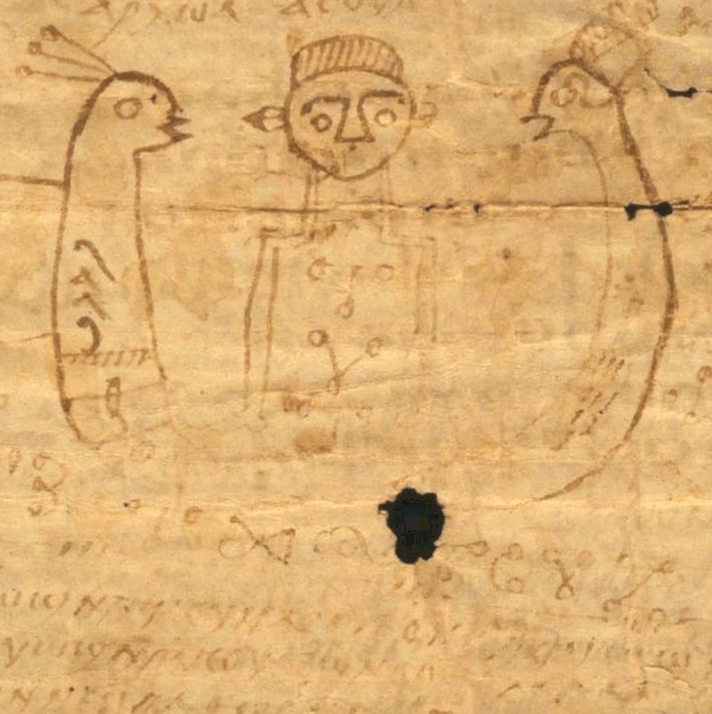
Let’s have a closer look at the image on this disc shown above. In the middle, a standing figure is visible, hands raised, flanked by two amorph blobs. The head of the figure is detailed with wide open eyes, a broad nose, and curious horizontal strikes through the head.

On top of the head, a few vertical lines are visible. Imagine my surprise when I saw a page of a Coptic magical book, featuring a very similar setup, notably in the detailing of the head! [3]

The two ‘blobs’ in the magical book appear to be creatures with the head of birds, while the arrow through the head and the headgear itself are also recognizable in their watered-down rendering on the pendant.

Papyrus RMO inv. F 1964/4.14, 11th century

Another form often found on the Bahariya discs is that of a square with a human neck and head, flanked by two vegetal motifs. This representation as well features in Coptic magical papyri, such as visible in Pap. Heidelberg Kopt. 685. [4] Might the iconography of the Bahariya amulets be based on Coptic charms?

Coptic smiths, Coptic charms in traditional jewellery?

I feel that one fact has been overlooked in determining what the depiction on the Bahariya pendant could mean. It is the simple fact that the smiths were Copts that may prove to be the explanation for the iconography on the amulets.

Not because they were less skilled than Muslim smiths, nor because they had no interest in creating amulets for rituals outside their faith, but because they based their designs on the iconography that was well-known and used in their religion.

With this possible origin however, we still don’t know what these pendants meant to their wearers, who were largely Muslim. As both silversmiths have passed away, they can no longer share their story.

Did they use a magical papyrus as their sourcebook? Was there any other reason to decide for this type of decoration? In this particular case, it is too late to find out for sure.

What this example does illustrate however is the importance of regarding jewellery in its wider sociocultural context instead of only as adornment.

Where can I find more on the historical background of amulets in the Middle East?

Find out more about the social meaning of amulets in the e-course on Amulets and Magic in Jewellery!

Or start by downloading the free e-book explaining 6 ways amulets work here.

More articles on jewellery & amulets? Browse them all here!

Always the first to get new articles? Join the Jewellery List and bling up your inbox!

This post is based on the chapter ‘The Evil Eye and Other Problems’ on magic and jewellery in my book Desert Silver.

References

[1] Weissenberger, M., 1998. Les bijoux des oasis égyptiennes, in: Bliss, F. 1998. Artisanat et artisanat d’art dans les oasis du desert occidental egyptien, Rüdiger Köppe Verlag, Köln p. 319, also mentions that these amulets have completely disappeared from the markets.

[2] Weissenberger 1998, p. 319

[3] Raven, M. 2012. Egyptian Magic. AUC Press, Cairo, p. 172

[4] Heidelberg Inv. Kopt. 685 (Meyer) Lage 5 Seite 12 and 9, digitally available on the website of the Papyrological Institute of Heidelberg university here

The Bedouin Silver blog gives credit where credit is due! Transparent referencing and citing sources helps us all grow. Would you like to do the same and quote this article? Here’s how:

S. van Roode, [write the title as you see it above this post], published on the Bedouin Silver website [paste the exact link to this article], accessed on [the date you are reading this article and decided it was useful for you].

Sigrid van Roode

Sigrid van Roode is an archeologist, ethnographer and jewellery historian. Her main field of expertise is jewellery from North Africa and Southwest Asia, as well as archaeological and archaeological revival jewellery. She has authored several books on jewellery, and obtained her PhD at Leiden University on the jewellery of the Egyptian zar-ritual. Sigrid has lectured for the National Museum of Antiquities in Leiden, Turquoise Mountain Jordan, and many others. She provides consultancy and research on jewellery collections for both museums and private collections, teaches courses and curates exhibitions. She is not involved in the business of buying and selling jewellery, and focuses on research, knowledge production, and education only.

Berber Memories

Berber Memories

Berber Memories

private collection

Berber Memories

Updated August 11, 2024

It has been some time since an overview of Amazigh jewellery has been published, but the latest publication of a private collection is not to be missed! The impressive volume Berber Memories presents the stunning Gillion Crowet-collection in nearly 600 wonderfully illustrated pages.

Berber Memories: the outline

The collection itself has been assembled by the couple Anne-Marie and Roland Gillion Crowet during 5 decades of travel in Morocco. It consists of hundreds of spectacular objects, all provided with a caption by their daughter, Nathalie de Merode.

The text of this hefty volume (it weighs several kilos!) is by renowned art historian Michel Draguet. The book is divided into two parts, and I will walk you through both of them to give you an idea of the scope of this publication.

Before we start, it is important to note that the author is an art historian, as opposed to for example an anthropologist or ethnographer. This difference is most noticeable in his choice of words, for example in his treatment of the topic ‘Ornamentation vs Decoration’ (p. 47): the discourse presented there is based on Western theoretical approaches of art. The emic perspective, how the Amazigh themselves experience their jewellery, is not explicitly included here or elsewhere in the book (the acknowledgements do extend heartfelt thanks to quite a number of knowledgeable people).

Speaking of Amazigh, the book consistently uses the word ‘Berber’: although the Amazigh have been rejecting the word ‘Berber’ for quite some time now and reclaim their own name, this is not addressed. It struck me as odd, as this book does much to celebrate Amazigh history and culture.

Berber Memories: Part 1, ‘Gazing’

The first part is an excellent introduction into Amazigh history. Where other jewellery books do not include Amazigh history or present it briefly, here the author takes his time to explore. This is incredibly valuable, as it is a history of exchange, cultural contacts, and adaptations to changing climate circumstances, all of which have left their mark on jewellery traditions.

What is more, this history is not presented as indisputable facts: where conflicting views exist, these are briefly introduced, enabling the reader to obtain a sense of both the ‘unknowns’ of history as well as of the way how any historical tale is shaped by the cultural background of those that write it.

What emerges is a portrait of the Amazigh people not as a monolithic entity, but as an ever-changing, rich ‘pluralistic culture’ (p. 79). Starting out in the Neolithic, the book discusses interaction across the Sahara all the way to Egypt, and later with Phoenician and Roman cultures, followed by the Arab conquests and their profound consequences for the Amazigh, the rise and fall of Amazigh empires, the balance between nomads and city-dwellers, Jews and Muslims, and the adapting and improving of techniques like for example enameling.

The author uses jewellery to illustrate his point at regular intervals, such as the balanced discussion of the khamsa, produced by Jewish craftsmen, worn by Jews and Muslims alike, and incorporating much older beliefs. All in all, this part provides insight in the venerable time-depth of Amazigh history.

Berber Memories: Part 2: ‘Feeling’

The second part introduces the world of women. Here, jewellery is combined with poetry, craftmanship and body aesthetic to illustrate its place in a wider context. This is a hugely important factor that I can’t emphasize enough: jewellery does not exist in a vacuum.

It is closely related to rug making, basketry, clothing, body aesthetic and oral traditions. This wider significance is touched upon here and there in the book, by likening jewellery patterns and styles to other examples of personal adornment and objects in the personal space.

Also introduced are the uses of jewellery as capital, as amulet and as status indicator, before moving to the jewellery pieces themselves.

The collection is presented regionally, starting out in the north and ending in the south. Each section starts with a map of the area, which I love: this way, you’ll get a sense of where the jewellery comes from and how jewellery designs are interrelated. Additionally, on the inside of the cover you will find a map of Morocco, on which jewellery items and drawings of regional dress by Jean Besancenot have been placed –a very helpful visual tool to get a general idea of main regional differences for anyone unfamiliar with the wide variety of Amazigh jewellery in Morocco.

Throughout the book, the historic photographs of Besancenot and others have been paired with the jewellery items shown, which makes for a visual dialogue between the black-and-white photographs and the splendor of the colour images of jewellery.

Berber Memories: the collection Gillion Crowet

Part 2 continues with the presentation of the collection – and what a superb collection it is! Iconic fibulas, stunning headdresses and head ornaments, sumptuous necklaces and rich bracelets form the vast majority of the collection. Each of these has been expertly photographed and displayed in such a manner that the wide variety of techniques, colours and shapes can be fully appreciated.

A very strong point of the collection is that it shows variety within the same type of ornament: for example, the famous worm-hole fibulas are represented by no less than 40 pages with nearly as many different pairs. I find this to be very instructive for the way we look at jewellery. There is not one ‘standard type’ with a ‘standard composition’, which somehow excludes other executions of the same sort of ornament as ‘not right’. See more about how that line of thinking comes about in this article.

The collection Gillion Crowet illustrates the point abundantly, by showing us a wide range of ever so slightly differing jewellery items within a singular type. Here, the art historian expertise of the author is to the advantage of the reader: his descriptions guide the eye and enable us to take in details, appreciate choices made by the craftsmen and see the evolving of styles.

Alongside these jewels, there is a vast amount of information about production centers, techniques used, materials sourced and traded, interwoven with meaning and power attributed to shapes and styles. We learn how climatic, economic and political factors caused silversmiths to relocate, trade centers to flourish or dwindle, and techniques to travel: an exceptional view on the background of these jewellery items.

Berber Memories: the meaning of jewellery

The meaning of patterns, colours and materials to their wearers varies immensely, not only over time but also geographically. This is partly due to the manner in which knowledge about meaning, magic and power is transmitted, both within the culture and certainly to cultural outsiders.

What is a meaningful shape in one region may carry less importance in the next, and what an older generation recognized as significant may have changed for a younger generation.

Another reason for this variety in agency is because it is attributed to objects by humans: they do not intrinsically carry it, which is why they lose their voice if their meaning is no longer understood. Naturally, these meanings and powers attributed to material forms evolve over time, following changing circumstances of the cultures that bring them forth. The book deals with this given in a number of cases, by presenting varying explanations for one and the same shape simultaneously.

This results in a overview of what individual shapes might mean, instead of presenting these as sole truths. Examples are the well-reasoned discussion about the possibly anthropomorphic elements known as atnarich (p. 312), the meaning attached to amber (p. 350) and many other elements.

Berber Memories: a few critical observations

Notwithstanding the importance of this volume, there are a few critical observations to made as well. Every now and then little inconsistencies pop up, like the assertion that Amazigh necklaces ‘generally feature enameled pendants’ (p. 128): the abundance of jewellery without enameled pendants in the book proves otherwise.

Some attributions I can’t quite follow as well, like the statement that the support system of a particular head ornament with three hooks is based on the ‘bulla etrusca model’ (p. 332) – I fail to see the connection, or how an Etruscan chest pendant of 300 BC would be the model for the ‘support system’ of this head ornament. Perhaps there is a similarity that I’m missing, but the direct linkage of Etruscan piece as model for a type of Amazigh jewellery without presenting solid proof of continuation in between is a step too far for me.

Berber Memories – an invaluable reference source

I highly recommend, no, I urge you to buy this book before this, too, becomes one of those sought after out-of-print books that we all know so well: it is remarkably friendly priced for such an important volume. The collection of jewellery presented is outstanding and a testimony to the long and rich cultural history of the Amazigh. Together with the wide historical overview, the wealth of old photographs and the detailed information per region this monumental book constitutes an invaluable reference source for the finest of Amazigh jewellery.

Berber Memories. Women and Jewellery in Morocco (2021). By Michel Draguet.

600 pages, full-colour, available in both French and English.

Available through the publisher Mercatorfonds, distributor Yale University Press and all major bookstores (online and offline).

The book was gifted as advance review copy by the publisher. Images sourced from the publishers’ website.

More book reviews like these? Find dozens of them here!

Always the first to receive reviews and other jewellery news in your inbox? Join the Jewellery List and stay in the know.

Collecting jewellery yourself? The Collector’s Handbook is a resource made for you!

Would you like to quote this article? Please do! Here’s how:

S. van Roode, [write the title as you see it above this post], published on the Bedouin Silver website [paste the exact link to this article], accessed on [the date you are reading this article and decided it was useful for you].

Sigrid van Roode

Sigrid van Roode is an archeologist, ethnographer and jewellery historian. Her main field of expertise is jewellery from North Africa and Southwest Asia, as well as archaeological and archaeological revival jewellery. She has authored several books on jewellery, and obtained her PhD at Leiden University on the jewellery of the Egyptian zar-ritual. Sigrid has lectured for the National Museum of Antiquities in Leiden, Turquoise Mountain Jordan, and many others. She provides consultancy and research on jewellery collections for both museums and private collections, teaches courses and curates exhibitions. She is not involved in the business of buying and selling jewellery, and focuses on research, knowledge production, and education only.