Bahariya discs: Coptic magic

Bahariya discs: Coptic magic

Bahariya discs

connecting cultures

The Bahariya discs: Coptic magic in jewellery

Updated July 28, 2024

The decoration on a piece of jewellery sometimes is puzzling. An example is the round disc worn by women in the Bahariya oasis in Egypt’s Western Desert until the 1960’s. Because the origin of this jewellery item has long been subject of discussion, it is a very illustrative case to discuss in more detail.

What do the disc pendants from Bahariya Oasis look like?

The image below shows a pendant from Bahariya Oasis. Like all its siblings, it is made of blank metal instead of silver. They are quite rare: in the last 25 years, I have come across an original Bahariya ornament only once. [1]

This probably is due to the fact that they were a ‘limited production’: they are known to have been made by two Coptic silversmiths, who lived in the oasis until one of them died. At that point, the other one decided to move out of the oasis and settled in Cairo. They were the only ones that created these discs: with their demise and relocation, no other discs were made.

From that moment onwards, the people of the oasis had to buy their jewellery from elsewhere; the two Copts were the last silversmiths in Bahariya. But what do the engravings on these discs represent?

Decoding the symbolism on the Bahariya discs

These discs have been interpreted as derivates of Egyptian zār-amulets, or as Nubian imitation coins, and their possible relation to the Siwa adrim has been investigated as well. But none of these are right. They are not zār, they are not coins, they are not related to the adrim.

So where does the unique decoration on the amulets finds its source…?

It has been suggested that the two silversmiths may not have been as well versed in both technique and decoration, since they were Copts and had little rapport with Islam. [2] So basically, the silversmiths just didn’t get it? That can’t be it.

Because it is not uncommon for silversmiths to be of another social group or faith than the group the smith is catering to. Most of the silversmiths in the Middle East were Jews up until 1948, and they made jewellery for Muslim, Jewish and Christian clients.

But the silversmiths may still be the cental clue here….

Coptic magic: papyri and images

Let’s have a closer look at the image on this disc shown above. In the middle, a standing figure is visible, hands raised, flanked by two amorph blobs. The head of the figure is detailed with wide open eyes, a broad nose, and curious horizontal strikes through the head.

On top of the head, a few vertical lines are visible. Imagine my surprise when I saw a page of a Coptic magical book, featuring a very similar setup, notably in the detailing of the head! [3]

The two ‘blobs’ in the magical book appear to be creatures with the head of birds, while the arrow through the head and the headgear itself are also recognizable in their watered-down rendering on the pendant.
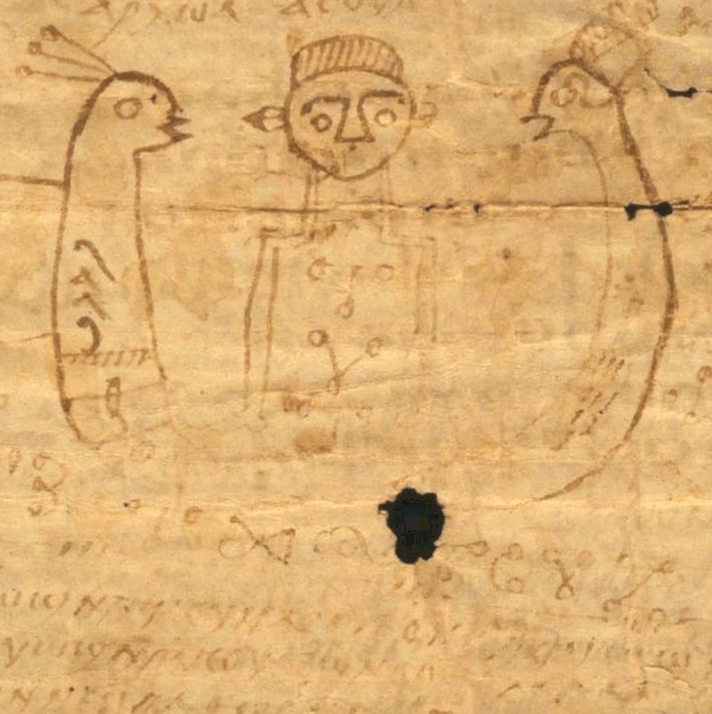
Papyrus RMO inv. F 1964/4.14, 11th century

Another form often found on the Bahariya discs is that of a square with a human neck and head, flanked by two vegetal motifs. This representation as well features in Coptic magical papyri, such as visible in Pap. Heidelberg Kopt. 685. [4] Might the iconography of the Bahariya amulets be based on Coptic charms?

Coptic smiths, Coptic charms in traditional jewellery?

I feel that one fact has been overlooked in determining what the depiction on the Bahariya pendant could mean. It is the simple fact that the smiths were Copts that may prove to be the explanation for the iconography on the amulets.

Not because they were less skilled than Muslim smiths, nor because they had no interest in creating amulets for rituals outside their faith, but because they based their designs on the iconography that was well-known and used in their religion.

With this possible origin however, we still don’t know what these pendants meant to their wearers, who were largely Muslim. As both silversmiths have passed away, they can no longer share their story.

Did they use a magical papyrus as their sourcebook? Was there any other reason to decide for this type of decoration? In this particular case, it is too late to find out for sure.

What this example does illustrate however is the importance of regarding jewellery in its wider sociocultural context instead of only as adornment.

Where can I find more on the historical background of amulets in the Middle East?

Find out more about the social meaning of amulets in the e-course on Amulets and Magic in Jewellery!

Or start by downloading the free e-book explaining 6 ways amulets work here.

More articles on jewellery & amulets? Browse them all here!

Always the first to get new articles? Join the Jewellery List and bling up your inbox!

This post is based on the chapter ‘The Evil Eye and Other Problems’ on magic and jewellery in my book Desert Silver.

References

[1] Weissenberger, M., 1998. Les bijoux des oasis égyptiennes, in: Bliss, F. 1998. Artisanat et artisanat d’art dans les oasis du desert occidental egyptien, Rüdiger Köppe Verlag, Köln p. 319, also mentions that these amulets have completely disappeared from the markets.

[2] Weissenberger 1998, p. 319

[3] Raven, M. 2012. Egyptian Magic. AUC Press, Cairo, p. 172

[4] Heidelberg Inv. Kopt. 685 (Meyer) Lage 5 Seite 12 and 9, digitally available on the website of the Papyrological Institute of Heidelberg university here

The Bedouin Silver blog gives credit where credit is due! Transparent referencing and citing sources helps us all grow. Would you like to do the same and quote this article? Here’s how:

S. van Roode, [write the title as you see it above this post], published on the Bedouin Silver website [paste the exact link to this article], accessed on [the date you are reading this article and decided it was useful for you].

Sigrid van Roode

Sigrid van Roode is an archeologist, ethnographer and jewellery historian. Her main field of expertise is jewellery from North Africa and Southwest Asia, as well as archaeological and archaeological revival jewellery. She has authored several books on jewellery, and obtained her PhD at Leiden University on the jewellery of the Egyptian zar-ritual. Sigrid has lectured for the National Museum of Antiquities in Leiden, Turquoise Mountain Jordan, and many others. She provides consultancy and research on jewellery collections for both museums and private collections, teaches courses and curates exhibitions. She is not involved in the business of buying and selling jewellery, and focuses on research, knowledge production, and education only.

A shackled jinn from Oman

A shackled jinn from Oman

jewellery as protection

A shackled jinn from Oman

Updated June 25, 2025

Jewellery regularly doubles as protection, as it is worn so close to the body. Often this form of protection is of general nature, but every now and then it makes uses of specific elements to ward off a particular evil. This pendant from Oman hides such an element on its reverse side: a tiny figure of a shackled human form. What does this mean, and what does it tell us about the women who wore this necklace?

The image of a jinn on the Omani kirsh kitab

The disc-shaped pendant is known by several names. The most often used name is somt, which is also used for other round pendants of the same size. [1] In one publication it is called kirsh kitab. [2] A similarly shaped pendant with a comparable reverse side is called kokh, again in one publication: this pendant is decorated with gold leaf on its front side rather than an inscription. [3]

The pendant carries an inscription on its front side. This is the Throne Verse, one of the most powerful verses of the Quran and often used for protection. You will find it often on amulets throughout the Middle East and North Africa.

On the reverse side, in many cases you will find a stylized depiction of a human-shaped figure. This is an image only known to the woman wearing it. You would not be able to see it from the outside. Mostly, this figure is explained as a jinn, held captive by the power of the Throne Verse.

As such, these pendants offer protection from evil spirits in general. The figure however is in some cases said to carry a name. This jinn is not any jinn, but a very particular one. So which jinn is this, and why is it engraved on the back side of an Omani pendant?

The jinn on an Omani pendant: the Bahla Witch?

Forster explains the figure as a representation of the Bahla Witch.[4] Bahla, a fortress town in Oman, has a reputation for the presence of both jinn and witches. [5] The pendant would protect the wearer from witchcraft and jinn alike. As this pendant was worn in a much larger area than just Bahla however, this interpretation may well be true for the inhabitants of the town itself, but there is another possibility that would make sense to many women.

The jinn on an Omani pendant: Umm as-Subyān

This other explanation is that of the human figure as Umm as-Subyān, ‘Mother of Children’. [6] This female jinn is well known beyond Oman and appears also further on the Arab Peninsula. But who is Umm as-Subyān?

In the most benign version, she is said to cause nightmares in children and uncomfortable wet dreams for boys in particular. But, there is more to her than just a night filled with bad dreams. She may be really dangerous.

Anne Regourd has researched how this jinn features in Yemeni oral traditions. [7] These tales share a more gruesome side to Umm as-Subyāns character: she lures young children away from their mothers and eats them, and she also takes newborns. Another tale records how she is capable of possessing young men and women, who then can’t seem to marry, no matter how much they try.

Regourd concludes that Umm as-Subyān is intent on preventing the arrival of children. She tries to prevent marriage altogether, and if a union does succeed, she takes and kills the offspring.

In short, Umm as-Subyān embodies what every woman feared: the inability to have children. [8]

Having children: fertility amulets in the Middle East

Why is not having children something to be afraid of? Fertility was one of the most fundamental aspects of a woman’s life. Having children was important: they assisted from a young age in the daily running of household and work, and would take care of their parents when these grew old. Remember, this is a past in which no retirement funds or care-homes existed!

Not having children could even be reason for divorce. Add to that a high infant mortality rate, and the pressure women were undeer becomes apparent. All over the Arab world, jealous jinn were thought to obstruct attempts at getting pregnant and bearing healthy children.

In this respect, Umm as-Subyān is comparable to for example the Qarina in Egypt [9] and La Taba in Morocco [10]. All three target newborns and young children, and cause infertility or miscarriages in young women.

Many women took precautions to make sure these jinn were rendered harmless, and these precautions often took the form of personal adornment. Jewellery is worn close to the body, and so forms a barrier between you, and the outer world full of dangers.

An Omani pendant with a hidden message

In the case of Umm as-Subyān, two ways of averting her are in both the name humans use when talking about her, and the way she is depicted on the pendant. The name ‘Mother of Children’ uses reverse magic. She is called by the exact opposite of her actions, a form often seen in informal magical practices around the world.

In the image on the pendant, the stylized figure is shackled around her ankles and wrists. Immobilized, she is not able to come for the wearers’ children or prevent her from getting married.

Jewellery reveals a woman’s world of worry

As with anything jinn-related, there is not one definitive identification or final explanation. With the presence of the Throne Verse, the pendant protects against evil influences in general.

The tiny shackled figure, in the story of Umm as-Subyān, reveals a world of worry for women, and so the pendant protects them from what well may have been one of their worst fears.

Where can I find more on women and amulets in the Middle East?

Find out more about the historic value of amulets in the e-course on Amulets and Magic in Jewellery!

Or start by downloading the free e-book on amulets and jewellery here.

More posts on jewellery and amulets? Browse them all here!

Join the Jewellery List and receive new articles, jewellery news and more in your inbox!

References

See the book chapter on these amulets by James Redman, which discusses the texts and context of precisely this pendant type in much more depth. This chapter was published in Nov 2020, after the writing of this blog post. Highly recommended reading!

 [1] A. Forster 2000. Disappearing Treasures of Oman. Archway Books, Somerset, p. 38-39

[2] P. Shelton, R. Richmond & M. Morris, Oman Adorned.

[3] J.S. Rajab 1998, Silver Jewellery of Oman. Tareq Rajab Museum, Kuwait, p. 63

[4] Forster 2000, p. 40

[5] See L.J. Borger 2011, By the Pricking of My Thumbs, Something Wicked This Way Comes: Omani Perceptions of the Supernatural. Independent Study Project (ISP) Collection. 1039., for a discussion of the supernatural in Omani society.

[6] P. Shelton, R. Richmond & M. Morris, Oman Adorned, p. 102; L. Mols, Kunst uit Zilver. Traditionele sieraden van Oman, in: L. Mols & B. Boelens (red) Oman, p. 137

[7] A. Regourd 2012, Représentations d’Umm Sibyan dans les contes yéménites : de la dévoreuse d’enfant à la djinniyya possédant les humains, in: A. Caiozzo & N. Ernoult (eds), Femmes médiatrices et ambivalentes. Mythes et imaginaires, Paris, Colin, pp. 63 – 72

[8] Regourd 2012, p. 72

[9] See my article in RAWI Magazine for the qarina

[10] J. Bois, La Sorcellerie au Maroc, nouvelle édition 2014, Dar al-Amane, Rabat p. 198.

The Bedouin Silver blog gives credit where credit is due! Transparent referencing and citing sources helps us all grow. Would you like to do the same and quote this article? Here’s how:

S. van Roode, [write the title as you see it above this post], published on the Bedouin Silver website [paste the exact link to this article], accessed on [the date you are reading this article and decided it was useful for you].

The Bedouin Silver Jewellery Blog: Sigrid van Roode

Sigrid van Roode is an archeologist, ethnographer and jewellery historian. Her main field of expertise is jewellery from North Africa and Southwest Asia, as well as archaeological and archaeological revival jewellery. She has authored several books on jewellery, and obtained her PhD at Leiden University on jewellery, informal ritual and collections. Sigrid has lectured for the National Museum of Antiquities in Leiden, Turquoise Mountain Jordan, and many others. She provides consultancy and research on jewellery collections for both museums and private collections, teaches courses and curates exhibitions. She is not involved in the business of buying and selling jewellery, and focuses on research, knowledge production, and education only. Sigrid strongly believes in accessibility of knowledge, and aims to provide reliable and trustworthy content: that’s why the Bedouin Silver blog provides references and citations.

Wild Beads of Africa

Wild Beads of Africa

Wild Beads of Africa

antique powderglass beads

Wild Beads of Africa

Beads are among the oldest forms of personal adornment that we know of. They have been produced since prehistoric times and continue to hold attraction up until today. They are eagerly collected and studied, and a unique private collection of 19th century powderglass beads is the topic of the volume Wild Beads of Africa.

Published in 2017 already, this is not a new book, but in 2021 it has become available through major channels like Amazon which has sparked a renewed interest in this publication. The collection of beads is that of songwriter Billy Steinberg (you are sure to know his works, Like A Virgin for Madonna and True Colours for Cyndi Lauper, for example), described by none other than bead specialist Jamey D. Allen. So what does this book offer?

First off, this is a highly technical book. By that I mean that the beads themselves and the techniques used to produce and describe them take center stage. In this respect, the beads are presented as decontextualized, collected objects. The beads are characterized as little artworks (which undeniably they are), not as material culture of a people. That is also where the title comes from: Wild Beads is a referral to the art historian term of Wild Beasts, indicating artists of the Fauvist-style (‘wild beasts’ is fauves in French), and through this title the collector celebrates the artistic ties between African works and expressionist artists. There is no background information on the peoples that created and valued them, or on their function and meaning in the societies from which they originate. What is missing entirely from this volume for example is a map of Africa indicating where the peoples mentioned in the text live, such as the Krobo and the Ashanti. So, the book is about beads, not about people. This is clearly indicated in the text where the scope of the book is laid out (p. 23), but I wanted to stress this angle to avoid any confusion as to the nature of the book.

The accompanying texts by Jamey D. Allen take us on a journey in beadmaking where no stone is left unturned when it comes to powderglass. In the back of the book, a glossary of names, terms and beadmaking techniques is a veritable encyclopedia of bead terms. The author presents us with an abundance of facts and descriptions of beadmaking. He offers his own hypothesis on how old powderglass beads were actually created, provides clues and tips on how to discern between old and new beads based on production and wear analysis, and provides detailed descriptions for each bead in the book. Very important in the introduction are the sections that deal with the names of the beads and the values attached to them. You may for example have come across the term Bodom beads for this type of beads, but these are actually quite rare: this word is only used for the beads belonging to the Queen Mother of the Ashanti.

The photography of the beads is simply breathtaking. Each bead is photographed larger than lifesize, which allows for viewing details like inclusions of seed beads and fragments of trade beads, surface wear and pattern, relief structure and of course the colours! As an archaeologist, I would also be interested in the perforation as that tells us a lot about use and wear, but that is a topic for another book. The photographs truly allow the reader to appreciate the achievements of these beadmakers. In between the descriptions of the beads, the collector shares his thoughts and feelings about individual beads in small text boxes: through these we learn what personal values these beads hold for modern collectors.

Wild Beads of Africa does not offer researcg other than technical, but opens the door to an endless range of possibilities. The production process as put forward by the author not only serves to create better reproductions, but will undoubtedly be of equal value to researchers of the past. A tantalizing hint as to the possible existence of multiple bead industries (p. 11) begs to be investigated further, as this will tell us about intercultural contacts, trade and influences. This research angle is also of interest to study the contacts between West Africa and the West through its materiality. The Krobo identify Krobo Mountain as a place where beads were created, but were forcibly removed from this location by the British in 1892 (p. 22). What stories do these beads hold in terms of colonial history, or values attached to place and process? And now that we know certain beads were only worn by the Queen Mother of the Ashanti for example, what does this tell us about hierarchy, social structure and use of resources?

If you are a collector or curator of powderglass beads, you will find this book an absolute treasure of information for identifying beads and distinguishing old from new production, as well as a very valuable visual reference source. If you are a scholar of material culture, this book is an excellent stepping stone to get a grasp on this materiality and from there identify new avenues of research. And if you enjoy art for its aesthetics only, by all means indulge yourself in this book: you will not regret it!

Wild Beads of Africa. Old powderglass beads from the collection of Billy Steinberg (2017). By Billy Steinberg, Jamey D. Allen and Fredrik Nilsen. 215 pages, full-colour, in English.

Available through the website www.wildbeadsofafrica.com and Amazon.

The book was purchased via Amazon.

Link to website published with written permission of Mr. Steinberg.

More books on beads and personal adornment? Browse a selection here!

Sigrid van Roode

Sigrid van Roode is an archeologist, ethnographer and jewellery historian. She considers jewellery heritage and a historic source. She has authored several books on jewellery from North Africa and Southwest Asia, and on archaeological jewellery. Sigrid has lectured for the Society of Jewellery Historians, the National Museum of Antiquities in Leiden and the Sultan Qaboos Cultural Center, among many others. She curates exhibitions and teaches online courses on jewellery from North Africa & Southwest Asia.

Knot magic in adornment

Knot magic in adornment

the magic of tying

Knot magic in adornment

Updated Jun 25, 2025

In many forms of adornment from the Middle East and North Africa, you’ll find a form of intricacy. Interwoven patterns, knots and complex shapes are added to jewellery and adornment for a reason: there is power in intricacy. That power goes back to the cultural significance of knotting, tying and binding.  In this article, we’ll have a look at the magical meanings behind that simple act we all carry out on a daily basis, and that is tying a knot in something.

The history of knot spells

Knots are an ambivalent symbol; they are believed to have curative properties, but they are also said to restrain, bind and strangle.

Even in everyday language, the mention of knotting and untying is often used as a reference to having or solving problems: in Cairo for example, the question ‘Did you get untied?’ actually means ‘Did you solve your problems?’ [1] This power attached to knots dates back deep in in history. One way of undoing magic spells cast on you is untying the knots with which these have been bound together: untying knots is undoing magic.

Babylonian cuneiform texts from as far back as the eighth century BC reveal spells using knots [2], and in ancient Egypt, the hieroglyph denoting protection depicts a series of knots in a rope. In ancient Rome, the Hercules knot was regarded as a powerful talismanic symbol.

Knot magic in the Middle East: what do knots mean?

Knots have many meanings in magic: they can bind, but also strangle. In contemporary Egypt, a wool cord with seven knots, called an ‘uqad,is used to combat fever. The knots are tied by a ritual practitioner who subsequently blows on them, a practice also mentioned in sura 113 of the Qur’an.

The symbolism of knots in the Middle East is powerful. In Syria, both bride and groom take care not to have anything knotted in or on their wedding costume in order to ensure fertility and health. A Palestine lullaby sings ‘Oh our moon, oh sleepy one, loosen your girth and go to sleep’: the loosening of the girdle brings about a state of relaxedness and comfort. [3]

The importance of knots in transition stages is illustrated by a death ritual of the Mandeans in Iraq and Iran. When a sick person is dying, he is washed and clothed in new clothes, but the knot of his girdle is left unfinished. Upon the moment of actual passing, the knot is completed, and after death the last, final knot is tied and the girdle arranged properly. [4]

Knot magic as protection

Intricate knots are often present in amulets: their goal is to utterly confuse the evil eye in order to distract its attention from the wearer or inhabitant of the house. Knot patterns on engraved seals serve the same purpose, besides their wonderful ornamental value, and mark the end of Quranic verses on written amulets. [5]

Written spells are sometimes seen encircled by a border of knots or braids [6], another example of the way these intricate motifs helped to keep evil out and thus enhance the power of the spell.

Tying a knot in your hair was also considered an effective way against spirit possession in Sudan: if you had been previously possessed and were to attend a possession ritual for someone else, tying a knot into your hair would ensure you would not be bothered by a spirit. [7]

What do knots of fabric in trees mean?

Related to tying knots is the use of textile scraps in places that carry significance. Trees near shrines, graves, tombs and (surprisingly often) ancient ruins sometimes carry worn and bleached pieces of textile in their branches. These are tied there on behalf of sick people, hoping the saint, deceased or spirit of the place will heal the owner.

That this practice is still very much alive is for example seen in the visitor regulations of the Shah-i-Zinda mausoleum complex in Samarkand: the rules clearly state that tying a knot is forbidden.

Tying knots: a small ritual of the everyday

You see how a seemingly mundane object, the knot, may represent so much more than just a utilitarian aspect of life. Because beyond the directly utilitarian, the act of tying a knot is often highly meaningful, but after a while all we are left with is the material component of ritual: a simple knot.

Although these materials remnants of magic are inconspicuous and often do not survive in the archaeological record [8], they are among the most used forms of everyday magic and can be seen everywhere if you realize where to look!

Where can I find more on everyday practices in magic and jewellery?

Find out more about the magic of acts and gestures in the e-course on Amulets and Magic in Jewellery,

…explore more articles on magic in jewellery from the Middle East here

or download the free e-book on amulets and talismans!

This post is partly based on the chapter ‘The Evil Eye and Other Problems’ on magic and jewellery in my book Desert Silver.

References

[1] Early, E. 1993. Baladi women of Cairo: playing with an egg and a stone. American University in Cairo Press, Cairo, p. 127

[2] Day, C. 1950. Knots and Knot Lore, in: Western Folklore, Vol 9, no. 3

[3] Masterman. E.W.G. 1901. Dress and Personal Adornment in Modern Palestine, in: The Biblical World, Vol. 18 No. 3

[4] Drower, E.S. 1937, The Mandaeans of Iraq and Iran, p. 260

[5] An example is seen in V. Porter, 2017. Arabic and Persian Seals and Amulets in the British Museum, p. 179

[6] Nünlist, T, 2019. Enzauberte Amulettrollen, in: Günther, S. and D. Pielow (eds), Die Geheimnisse der Oberen und Unteren Welt: Magie im Islam zwischen Glaube und Wissenschaft, Brill, Leiden, p. 252

[7] Zvenkovsky, S. 1950. Zar and Tambura as practiced by the women of Omdurman, in: Sudan Notes and Records Vol. 31, no. 1, p. 81

[8] Like noted for example by Cameron Moffett, 2019, in The Amulets of Roman Wroxeter: Evidence for Everyday magic, in: Transactions of the Shropshire Archaeological and Historical Society 94, p. 46

The Bedouin Silver blog gives credit where credit is due! Transparent referencing and citing sources helps us all grow. Would you like to do the same and quote this article? Here’s how:

S. van Roode, [write the title as you see it above this post], published on the Bedouin Silver website [paste the exact link to this article], accessed on [the date you are reading this article and decided it was useful for you].

The Bedouin Silver Jewellery Blog: Sigrid van Roode

Sigrid van Roode is an archeologist, ethnographer and jewellery historian. Her main field of expertise is jewellery from North Africa and Southwest Asia, as well as archaeological and archaeological revival jewellery. She has authored several books on jewellery, and obtained her PhD at Leiden University on jewellery, informal ritual and collections. Sigrid has lectured for the National Museum of Antiquities in Leiden, Turquoise Mountain Jordan, and many others. She provides consultancy and research on jewellery collections for both museums and private collections, teaches courses and curates exhibitions. She is not involved in the business of buying and selling jewellery, and focuses on research, knowledge production, and education only. Sigrid strongly believes in accessibility of knowledge, and aims to provide reliable and trustworthy content: that’s why the Bedouin Silver blog provides references and citations.

Magical knowledge

Magical knowledge

levels of knowledge

Magical knowledge

There are effects of jewellery that everyone knows about and that practically go without saying, and there are effects for which more specialist training is needed. But who knows what, and how did they learn? There is a shifting amount of information on the part of both maker and wearer. And what is more: what do we miss?

Levels of knowledge

1 – General protection. This is the most widespread level of knowledge: literally everyone recognizes these, no secrets to be found here. General protection comes in general shapes, like triangles, circles, dots, hands, eyes, main colours and tassels, to name but a few. Their use in jewellery is so self-evident that they are present as standard part of a set decoration scheme: they are not adapted to individual requests but rather form the backbone of the visual language of jewellery.

2 – Reaching a general goal. When a person runs into problems of a general nature, the knowledge of someone who has dealt with these is needed. Here, we enter the world of wise women. They will know which colour stimulates breastfeeding, how to avert chronic headaches, what to do in case of jaundice and what to in case of infertility, fever or matters of the heart. [1] They keep and share the stories and songs that go with each remedy, colour and pattern. The reputation of these women as healers may extend through word of mouth to considerable distances, but is in general limited to family and wider social circles only.

3- Reaching a specific goal. Finally, when a specific goal is to be reached, we shift into the world of purpose-made amulets. For these types of adornment literacy is often required, a wider knowledge of the calculation of spells and numbers, of ingredients and celestial constellations.

Transmitting knowledge

These three levels of knowledge come with their own way of transmitting them. [2] Information about general protection is so common that you would be immersed in this while growing up in your community. This is called horizontal transmission. The level of knowledge elder women had accumulated, would be passed on between generations, from mother to daughter: a vertical transmission. And finally, specific knowledge requires talent, years of training and study that only a few complete.

The local factor

The second type of knowledge, which is used to combat challenges of a general nature, is the most difficult to interpret as a cultural outsider. A cultural outsider in this case is not just someone from a different country, but could be someone from as nearby as the next village. This is because this type of knowledge is characterized by a high degree of locality. It is shared within the family, or in wider circles within a village or clan. Local knowledge also incorporates the natural environment: trees, wells and other prominent features of the landscape often form an intrinsic part of the remedy. A certain stone for example must be sourced from a particular wadi, while wells and trees are said to possess powers that could amplify the efficacy of an amulet.

Vanishing worlds

It is also the type of knowledge that is vanishing the most. For general patterns in jewellery, early descriptions sometimes mention their explanation and meaning. Written amulets are based on magical works that are centuries old and continue to be available. Local knowledge however has not nearly as often been described or even paid attention to. [3] For my current PhD-research, I have been working through the jewellery collections of a number of museums. In the few instances where the precise uses of amulets have been documented, an incredibly wide world opened up that would not have revealed itself by its materiality alone. Thousands of seemingly insignificant pieces like pebbles, bone fragments or pieces of wood alongside coloured beads, coins and pendants protected their wearers and helped them heal from a variety of conditions such as joint aches, back aches, deafness, eye diseases and possession.

Similar, but not the same

It is this local factor that is often underestimated when amuletic jewellery is described. What carries meaning in one place does not automatically carry the same meaning in another: it is a bit much to claim the entire Arab world, with all its variety in peoples, religions and lifestyles, attaches the exact same meaning to a particular material. Of course, there are colours and materials that are broadly recognized for their capacities, such as red and blue or silver and gold. There is however another world beneath the surface of beaded necklaces, headdresses and natural materials set in silver where local knowledge makes all the difference. I’m working on an article on these locally used jewellery items: it’s through the magical capacities of jewellery items that the unwritten stories of a local community reveal themselves!

Interested in how jewellery works as amulet? Download your free e-book here!

More articles on magic in jewellery? Browse them all here!

Monthly emails with new articles, jewellery news and books I came across? Join the Jewellery List and never miss out on a thing.

References

[1] An example is how women in Siwa oasis, Egypt, keep a collection of useful stones that remedy a variety of conditions, as described in Vale, M.M. 2011. Sand and Silver. Jewellery, Costume and Life in Siwa Oasis. York Publishing Services, York

[2] For an overview of knowledge and transmission, see the exhibition publication Secrecy: who’s allowed to know what. Museum der Kulturen, Basel

[3] See for example Popper-Giveon, Abu Rabia & Ventura 2014. White stone to blue bead, in: Material Religion Volume 10, issue 2, pp. 134-136 where this problem is designated

Sigrid van Roode

Sigrid van Roode is an archeologist, ethnographer and jewellery historian. She considers jewellery heritage and a historic source. She has authored several books on jewellery from North Africa and Southwest Asia, and on archaeological jewellery. Sigrid has lectured for the Society of Jewellery Historians, the National Museum of Antiquities in Leiden and the Sultan Qaboos Cultural Center, among many others. She curates exhibitions and teaches online courses on jewellery from North Africa & Southwest Asia.