Binding magic in jewellery

Binding magic in jewellery

keeping it together

Binding magic in jewellery: pins

Updated Jan 28, 2024

The most mundane, everyday things can be transformed into magical objects simply by analogy, and that is what makes this form of magical activities so relatable. Fastening something is one of those acts that can carry a deeper meaning, and the object that goes with it becomes important, too. And clothing pins, also known as fibulas, are perfect for that goal!

Pinning a fibula: the magic behind it

This is basically a specific form of binding magic, where pins to keep clothing together gain a different meaning.

I talked about the magic of tying and girding in another blog post, and pinning your clothing together works along the same lines. The clothing pins that are used to keep fabric together, can be transformed into very powerful magical objects when they are used in ritual.

The analogy is of course very clear: a clothing pin holds two separate pieces of dress together, and so it would also be very useful in rituals to keep persons together.

When you fasten a fibula (see how to do that here), you actually have to carry out a number of steps: it does not close automatically by itself. And that is where the magic is, in those acts of deliberately fastening…clothing pins are the perfect object for love-magic!

Fibula magic in ancient times

The Romans already used their pins or fibulas (the Latin word is still in use to indicate these pins) as such. Some 2,000 years ago, you could buy an inscribed fibula to present to a lady: it would say something like ‘Hello, gorgeous!’, or, if you were bolder, ‘mix yourself with me’ – I’ll leave it up to you to figure out what they meant by that!

The point is that the fibula would work as a magical tool. [1] Once the lady in question would pin her clothes with it, it was hoped your relationship with her would immediately grow stronger.

Some 1,000 years earlier, three imported bronze fibulas were left behind in a shallow pit on the edge of a moor in The Netherlands. They were a gift to the gods, or whatever beings were believed to inhabit that place, and they were a precious gift, too.

Those fibulas were imported from Scandinavia and did not form part of traditional dress in what later would become The Netherlands: a treasure worthy of the gods. [2] You’ll see it in the collage below.

Gloomy photo of a swamp with a Bronze Age jewellery hoard

Fibula magic in North Africa

In a different world and a different time, fibulas have a very similar protective power. In Morocco, clothing pins are considered powerful because their sturdy pin has the power to harm the evil eye, a meaning also found widely in the rest of the Maghreb. [3]

Many shapes on fibulas are designed to attract good fortune and to keep evil at a distance, while their triangular form alludes to the powers of the number 3 (see more about the magic of numbers in this blog post). Fibulas are also the perfect piece of jewellery to attach amulet boxes to, which would be suspended from either the fibula itself or from the chain between them.

But here as well, their importance as something that holds to halves together, shines through.

The fibulas are part of the dowry, given to the bride by her husband and his family, and here the magic of pinning reinforces the bond between both the husband and wife and their respective families.

Adorning the bride with her jewellery, including fastening her fibula set, was part of the transformative magic in Libya, which would accompany the bride during her transition from unmarried girl to married woman. [4]

Belt buckle magic in Europe

And that power of fastening is found as a theme in other parts of the world, too.

Belt buckles function in much the same way: they, too, hold something together. As such, it became very popular as a form in European rings from the 17th century onwards. The belt buckle symbolized eternal love and loyalty – even beyond death, which is why you will also find it in mourning rings. Together with the shape of the ring itself as an endless cycle, the belt buckle firmly connects two halves for all eternity.

Pinning, fastening, closing: magic in adornment

So whether it is clothing pins or belt buckles: by fastening something, humans have tried to influence the natural course of events for millennia!


Find out more about the histories behind amulets in the e-course on Amulets and Magic in Jewellery!

Or start by downloading the free e-book on amulets and jewellery here.

More posts on jewellery and amulets? Browse them all here!

Join the Jewellery List and receive new articles, jewellery news and more in your inbox!

References

[1] Peter Wells notes that fibulas in Europe’s prehistory, when they are depicted, are always shown ‘open’, and wonders if that has something to do with magic: nothing is definitive yet, nothing is sealed, the future is open. Wells 2012, How Ancient Europeans Saw the World, p.111.

[2] I wrote about these in Bos, J. & S. van Roode 2019. Landschap vol Leven. BLKVLD Uitgevers Publishers.

[3] Cynthia Becker, Amazigh Textiles and Dress in Morocco. Metaphors of Motherhood, in: African Arts vol 39 no. 6 (2006), p. 44

[4] Elena Schenone Alberini, Las mujeres Libias en la litteratura oral. Ritos de paso y roles de genero, in: Orafrica no 6, 2010.

Would you like to quote this article? Please do! Here’s how:

S. van Roode, [write the title as you see it above this post], published on the Bedouin Silver website [paste the exact link to this article], accessed on [the date you are reading this article and decided it was useful for you].

Sigrid van Roode

Sigrid van Roode is an archeologist, ethnographer and jewellery historian. Her main field of expertise is jewellery from North Africa and Southwest Asia, as well as archaeological and archaeological revival jewellery. She has authored several books on jewellery. Sigrid has lectured for the National Museum of Antiquities in Leiden, Turquoise Mountain Jordan, and many others. She provides consultancy and research on jewellery collections for both museums and private collections, teaches courses and curates exhibitions. She is not involved in the business of buying and selling jewellery, and focuses on research, knowledge production, and education only.

What is ‘Kuchi jewellery’?

What is ‘Kuchi jewellery’?

Afghanistan adornment

What is ‘Kuchi’ jewellery?

Updated Dec 27, 2023

It’s a popular term: ‘Kuchi jewellery’, a firm favourite in so-called tribal fusion dance costumes. Also spelled Koochi or Kochi, it often refers to jewellery with colourful glass insets, broadly coming from Afghanistan and Pakistan. But what does ‘Kuchi’ mean?

A Pashtun dress ornament from Afghanistan

Who are the Kuchi?

Basically, ‘Kuchi’ is not a specific people, but a generic term used for a wide range of peoples in Afghanistan, but also in Pakistan and Iran. [1] The word ‘kuch’ itself is Farsi and means ‘migration’. The term is used widely these days, both in the region itself and by cultural outsiders, but as you might expect, ‘Kuchi’ is not what those peoples called themselves.

This is also where it gets complicated when it comes to jewellery research, because as ‘Kuchi’ is a relatively recent term, you will not find references to ‘Kuchi jewellery’ in any of the older standard works on jewellery from Afghanistan. [2]

‘Kuchi’ is not a specific tribe or people. ‘Kuchi’ is a generic term that did not exist before the 1980s

Tribes in Afghanistan: more than just one people

The geographic area inhabited by the peoples called ‘Kuchi’ today is incredibly complex when it comes to tribal, cultural and ethnic identities and affiliations. I wrote a little about the difficulties of pinning just one label on jewellery here, and those difficulties apply to ‘Kuchi jewellery’ as well.

Political, social, religious and cultural changes in the past decades have left their mark on the many peoples living in this region as well as on borders of countries. The Pashtun are the largest group, but Turkmen, Uzbek, Tajik, Kazakh, Baluch and Hazara people live in current-day Afghanistan as well.

As a result of decades of war, many have fled to Pakistan and further afield – it is impossible to capture the details and the effects of recent history in one short blog post, but a list of resources to start reading is here.

Pashtun silver ring with red glass

What is Kuchi jewellery?

Under this umbrella term, many styles and people who wore these items ressort. The jewellery styles share a visual language with the western Himalayas and are worn as far away as northern India as well.

There is no straightforward, clear distinction in attributing jewellery items in a region with such a kaleidoscope of peoples, shifting allegiances and changing spheres of influence. An in-depth study of the jewellery we simply call ‘Kuchi’ today could shed light on all of these aspects, as jewellery is a powerful historic source.

Afghan jewellery heritage

Alfred Janata has attempted to provide an overview as best he could in his book on Afghan jewellery.

The ornaments with red, green and blue glass that are most often labeled as ‘kuchi’ were mainly sold in Khost in the eastern Afghan province of Paktya, but created in Pakistan: once again, current-day borders are not synonym with cultural differences. According to Janata, these ornaments were worn by nomadic women who either spent the winter season in Paktya or whose migration routes crossed this province. [3].

Ornaments with smaller inlays of green and red glass (so not blue) were called Katawaz according to Janata, and may have been worn by nomadic women traveling between the winter pastures in Paktya and Katawaz, where the summer pastures were located. [4]

The famous chokers with glass inlays and dangles were worn mainly by the Pashtun in the south and southeast of Afghanistan [5], and so the book provides an overview of Afghanistan’s jewellery heritage.

Two Afghani chokers, likely Pashtun

Kuchi ornaments

The article by Hejzlarova, Susek et al [6] presents several types of ornament worn by the people called Kuchi today. They note most of the jewellery worn by women focuses on the upper part of the body like head adornment, ear and nose plugs, choker necklaces, amulet necklaces, rings and bracelets.

See more on Kuchi Afghan vanity grooming sets here

Kuchi jewellery is not made of sterling silver, but of an alloy comparable to nickel silver or ‘German’ silver, consisting of copper, zinc and nickel. The small amount of silver in these jewels was obtained from silver coins.

Modern-day Kuchi jewellery and the West

Nowadays, the jewellery pieces offered as ‘kuchi’ are usually entirely newly produced, due to the high demand for these pieces in the West. In these, a new colour palette emerges: pink, neon green, purple or bright yellow glass have been added to the original colour schemes.

The use of uniform colours in jewellery pieces is also indicative of new production: pieces executed in one colour only, notably the popular chokers, are almost certainly newly made. Actual vintage pieces have become increasingly rare.

That is not simply a matter of ‘fake’ items: creating and selling jewellery is the main source of income for many displaced people in this war-torn region. It has become a symbol of identity proudly worn by Afghans in the diaspora.

In that respect, the term ‘kuchi’ has taken on new meaning: from a term coined by cultural outsiders with little to no regard for the differences (and similarities!) of the many cultural groups in the region, it has evolved into a term used by people from Afghanistan as well to represent their cultural heritage. [7]

Afghani styles of many peoples

So, while ‘Kuchi jewellery’ remains a generic term for the jewellery styles of many social groups in Afghanistan and beyond, a group of jewellery that needs much more detailed research to pinpoint their similarities and differences, one thing is clear: it is an expression of heritage and identity for many.

Where can I find more on traditional jewellery from Southwest Asia and North Africa?

More on traditional jewellery from Southwest Asia and North Africa? Browse the jewellery blog here!

Never miss a thing on jewellery news? Join the Jewellery List and find them in your inbox each month!

Looking for background information on your jewellery? Have a look at the courses – there’s so much available on the world of the jewellery you love!

More tips on collection management and research? Check this free resource or download the e-book!

References

[1] Tapper, R. 2008. Who are the Kuchi? Nomad self-identities in Afghanistan, in: Journal of the Royal Anthropological Institute 14, pp. 97-116.

[2] Janata, A. 1981. Schmuck in Afghanistan, does not mention ‘Kuchi’ for example – the term was not used as widely as it is today. Neither do Stuckert & Bucherer-Dietschi  1981, Schmuck und Silberschmiedearbeiten in Afghanistan und Zentralasien : Schmuck in Sammlungen, Bibliotheca Afghanica, which has an emphasis on Turkmen jewellery in Afghanistan.

[3] Janata 1981, p. 68.

[4] Janata 1981, p. 70.

[5] Janata 1981, p. 74.

[6] Hejzlarova, T., L. Dusek (2019) Kuchi Jewellery, in: Annals of the Naprstek Museum 40/2, pp. 27-48.

[7] Among many other things: the adaptation of the world ‘kuchi’ has many other implications, as the article by Tapper explores. See also Hejzlarova et al., p. 33, who observe there is very little known about this type of jewellery, but an abundance of misinformation in circulation.

The Bedouin Silver blog gives credit where credit is due! Transparent referencing and citing sources helps us all grow. Would you like to do the same and quote this article? Here’s how:

S. van Roode, [write the title as you see it above this post], published on the Bedouin Silver website [paste the exact link to this article], accessed on [the date you are reading this article and decided it was useful for you].

The Bedouin Silver Jewellery Blog: Sigrid van Roode

Sigrid van Roode is an archeologist, ethnographer and jewellery historian. Her main field of expertise is jewellery from North Africa and Southwest Asia, as well as archaeological and archaeological revival jewellery. She has authored several books on jewellery, and obtained her PhD at Leiden University on jewellery, informal ritual and collections. Sigrid has lectured for the National Museum of Antiquities in Leiden, Turquoise Mountain Jordan, and many others. She provides consultancy and research on jewellery collections for both museums and private collections, teaches courses and curates exhibitions. She is not involved in the business of buying and selling jewellery, and focuses on research, knowledge production, and education only. Sigrid strongly believes in accessibility of knowledge, and aims to provide reliable and trustworthy content: that’s why the Bedouin Silver blog provides references and citations.

Keys as amulets

Keys as amulets

magic of keys

Keys as amulets

Among the forms that are not immediately associated with amulets, is that of a key. Yet they appear as amulet in several ways throughout the Middle East and North Africa, from actual keys to images of keys. You will see them dangling from necklaces, included as miniature charm on charm necklaces, and alluded to in embroidery for example. What is the symbolic meaning of a key? In this article, I will introduce three ways keys hold significance as amulets in the Middle East.

Detail of a silver somt necklace, leather amulet pouches, bright beaded necklaces and keys worn by a Bedouin woman from Oman.

Power of keys: materials and amulets

First off, the material that keys were traditionally made of, is powerful in itself. Jinn are known to be afraid of iron, (see here why that is) and so anything made from iron would keep them at a distance. Keys, which for a long time were made of iron, fit that criterium perfectly. The image of the necklaces worn by a Bedouin woman from Oman shows her wearing a set of keys amidst leather amulet pouches: most likely, the keys also serve an apotropaic function.

A more recent version of a key as amulet is the silver key from Oman, shown below, which is shaped after a modern key. In North Africa, tiny keys sewn on to children’s clothing help prevent an early death. [1] (see here which spirits were feared for harming children). In 1915, a baby boy in Algeria was seen adorned with a series of amulets, including two iron keys, and the author observing that practice also noticed that keys were worn commonly as a charm. [2]

Silver Omani amulets, including a silver key

Key symbolism: locking and unlocking

There is more to keys than just the material they are made of, and is where their function comes into view. Keys, of course, lock and unlock things. The concept of locking and unlocking is closely related to a woman’s fertility: not so much in terms of chastity, but in the context of spirits blocking her from getting pregnant or causing a miscarriage. In that respect, keys function in a similar fashion to knots and knotting (see more about that here).

Here, keys are often combined with locks: amulets in the shape of locks were believed to prevent miscarriage in Egypt, as these ‘lock’ the womb until the time of birth has come. [3] When a birth is difficult, the reverse principle is used, and the key to a saint’s tomb is placed on the lower back of the mother to ease the birth. [4]

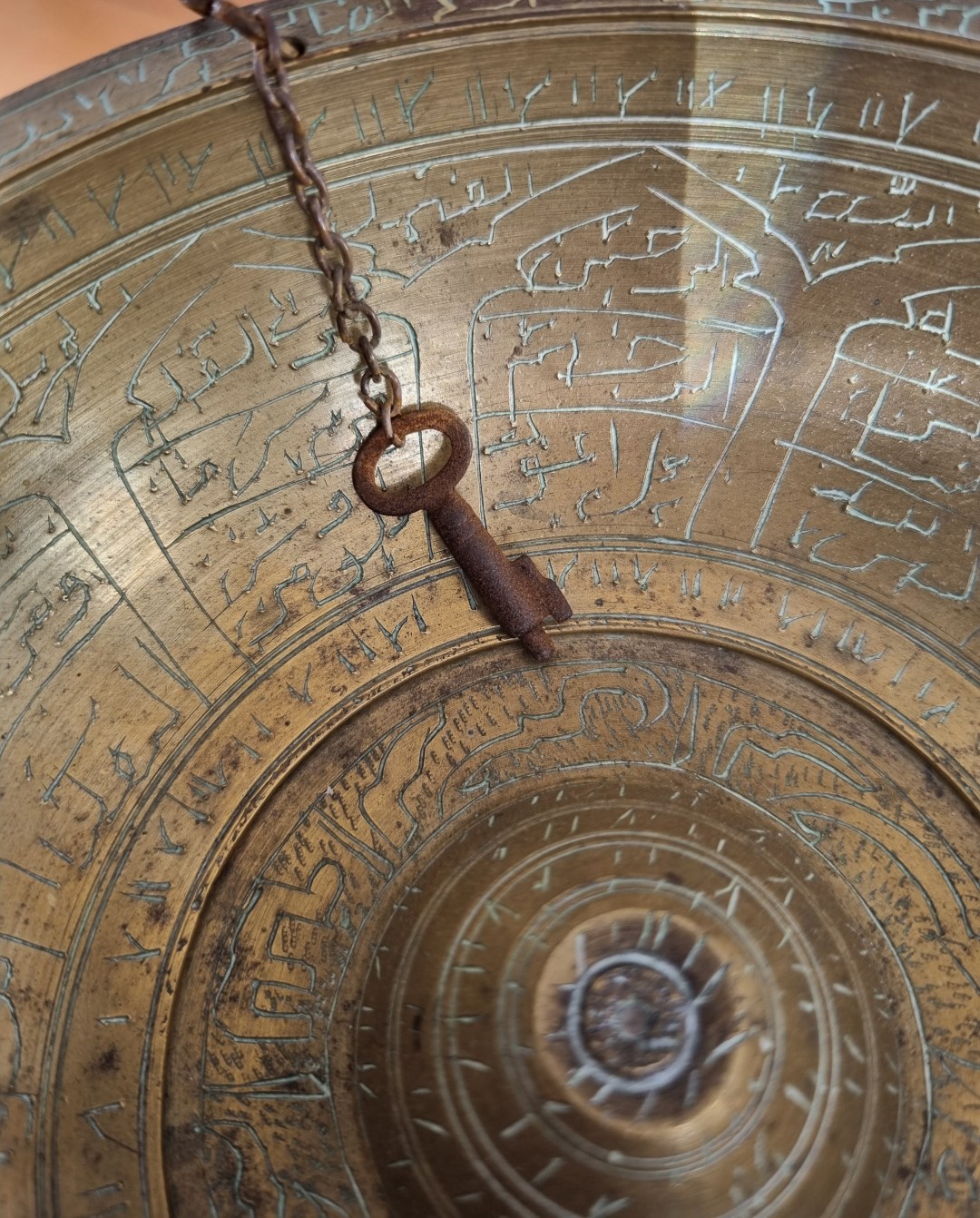
An Islamic magic bowl with a tiny iron key attached

Keys in ritual: protection and knowledge

Keys are also symbolic of accessing protection and knowledge. An example of that are the magical bowls of the Yezidi, where tiny amulet plaquettes are attached to its rim. These are called kilit, which literally means ‘key’ in Kurdic. [5] These amulet plaquettes can also take the form of an actual key, such as shown above.

The general idea is that the key amulet would enhance the efficacy of the bowl by submerging it into the water of the bowl. [6] Bowls like these were used in informal ritual aimed, again, at securing healthy pregnancy and safe births, as well as protection from evil forces. [7]

Keys as amulets: the magic in everyday objects

A seemingly simple household item may hold deep significance on a supernatural level: this example of keys shows how ‘magic’ is not something alien or mysterious, but something that is expressed in forms and shapes most familiar to us.


What kinds of amulets exist in North Africa and the Middle East?

Curious as to what other everyday objects may be used as amulets, and what their meaning is? Find out more about the histories behind amulets in the e-course on Amulets and Magic in Jewellery!

Or start by downloading the free e-book on amulets and jewellery here.

More posts on jewellery and amulets? Browse them all here!

Join the Jewellery List and receive new articles, jewellery news and more in your inbox!

References

[1] Hansmann, L. and L. Kriss-Rettenbeck 1977. Amulet und Talismann. Erscheinungsform und Geschichte. Verlag Georg D.W. Callwey, Munchen, p. 240.

[2] Hilton-Simpson, M.W. 1915. Some Algerian Superstitions Noted among the Shawia Berbers of the Aures Mountains and their Nomad Neighbours, in: Folklore Vol. 26, no. 3, p. 233 and p. 240.

[3] Hansen, N. 2006. Motherhood in the Mother of the World, PhD-thesis, University of Chicago, p. 116.

[4] Idem

[5] Biesterfeld, H. & D. Pielow (eds) 2019. Die Geheimnisse der Oberen und Unteren Welt. Magie im Islam zwischen Glaube und Wissenschaft, Brill, Leiden. p. 469-470 for a description of these bowls.

[6] Idem, p. 469

[7] Idem, p. 472-473


Sigrid van Roode

Sigrid van Roode is an archeologist, ethnographer and jewellery historian. Her main field of expertise is jewellery from North Africa and Southwest Asia, as well as archaeological and archaeological revival jewellery. She has authored several books on jewellery. Sigrid has lectured for the National Museum of Antiquities in Leiden, Turquoise Mountain Jordan, and many others. She provides consultancy and research on jewellery collections for both museums and private collections, teaches courses and curates exhibitions. She is not involved in the business of buying and selling jewellery, and focuses on research, knowledge production, and education only.

Donating to a museum

Donating to a museum

5 steps

Donating your ethnic jewellery collection to a museum

Updated Feb 20, 2025

Thinking of donating your jewellery collection to a museum? That is fabulous! Donating it to a museum is a great way to ensure this heritage is preserved for future generations. But even so, it’s not a decision made lightly, as you entrust the passion of your lifetime to someone else. Therefore, it is very important to explore and carefully weigh your options, so you can decide on a well-informed basis where your collection should go.

I would advise to start that process well in advance, as not every donation is automatically accepted by museums. So how to go about that…?

Here are 5 clear, actionable steps towards donating your jewellery collection.

Step 1: evaluate your reasons

Start by evaluating your reasons for wanting to donate your jewellery collection. For example, you could be downsizing as a result of moving to a smaller home: that happens quite often. Donating for tax reasons is also not unheard of: sizeable donations may come with tax benefits.

When your heirs are not all that interested in your life’s work, the question what should happen to it after you’ve gone becomes all the more pressing, and knowing your collection is safe and cared for provides much needed peace of mind.

What do you envisage their future to be? Do you see them in a jewellery museum, in an ethnographic museum, in an art museum, and could that also be a museum in the communities that these pieces culturally form part of?

Last, but certainly not least, there is your personality to take into account: do you see yourself taking family and friends to a museum to show them your contribution glinting in a showcase, or are you more of a ‘behind-the-scenes’-person?

Just to be clear, both are fine! I can tell you from experience it’s extremely cool to see your jewellery displayed in an actual museum, and also that it’s very, very rewarding to be donating anonymously. When it comes to managing your own expectations, it is very useful to pause for a moment and consider why you would like to donate – do you want to get anything out of it and if so, what would that be?

Once you have a view on the ‘why’ of your plan to donate, it will become easier to find an institution that aligns with your values.

Step 2: contact the museum you have in mind

Ask after their guidelines, policies, criteria and procedures for accepting donations – some museums already have all of this on their website.

Bear in mind that not all museums accept everything: they may decide to accept only a few pieces and leave the rest. And that is a sound decision on their part! Because if all museums accepted everything that was ever collected, what would that mean in terms of storage space and longtime care…?

Contacting the museum of your choice well in advance will be helpful as it allows you to prepare your donation, or to start looking for other museums if your donation should not be a good match.

Don’t forget to ask away when you have contacted a curator to discuss possibilities: what is the museum’s view on deaccession? Do they have plans in place for an open-access database? Will your collection be mainly in storage as reference collection, or will it be visible (even if it is just digitally)?

Step 3: consider tax implications

Donating your collection may have tax implications (both positive and negative), so these should be discussed at an early stage. Getting an appraisal may be useful for tax purposes as well as for providing the museum of your choice with an indication of the value of your donation.

Not every museum requires this though, and you could also decide to simply donate it because of the contribution you’ll make to a shared heritage. Note that laws and legislation vary per country, so consult your tax advisor as well as the museum on this in an early stage.

Step 4: have your documentation up to date

Now this is an important point: increasingly, you’ll be asked to provide documentation of your jewellery, such as its provenance, as well as identifications of the pieces you’re donating.

Museums do not always have the resources available to work on an identification of your pieces themselves, due to budget and time constraints. Notably the provenance documentation will grow in importance over the coming decades.

An up-to-date registration of your collection is also useful in for example an overview of the materials that it consists of: are there materials that require special care in storage?

Another possibility to consider here is making your documentation part of the donation itself. If you own, for example, a library on the topic of your collection (jewellery books, anyone?), adding these to a museum library will effectively turn that into a specialized research library that will benefit students and scholars alike.

Many museums host book sales to support their library or other budgets: any double copies could be sold, and they would still end up in the most appreciating hands.

Worried about that documentation? Check out this free resource on how to get started, or see if the course Organising Your Collection is something for you!

Step 5: talk about terms and conditions you may have for your donation

If you have specific conditions in mind on how your jewellery can or cannot be displayed or used, be sure to discuss these with the museum in advance. Is it enough for you if your collection is not put on display, but available to whoever wants to study it? Do you want your name attached to your collection?

It’s good to be aware that some museums accept only unconditional gifts, meaning they can do with your collection as they please. That may include selling parts of it.

Too many restrictive conditions will make it less desirable for a museum to accept your donation, so this is a point that requires careful consideration and negotiation.

The main thing to keep in mind when donating your collection though is the inevitable transfer from ‘your’ collection to ‘their’ collection. That can be a tough one: a museum may not value the pieces you love the most in the same way you do, and once the collection has been donated, it is no longer yours.

Donating your ethnic jewellery collection to a museum: peace of mind

But when a curator has taken the time to walk you through the donation process, explained the possible future of your pieces in the collection (including deaccession), or made a selection of pieces that are truly an addition to the museum, you can rest assured you will have done everything you can to give your collection a secure, meaningful future.

Never miss a thing on jewellery discoveries? Join the Jewellery List and find them in your inbox each month!

Looking for background information on your jewellery? Have a look at the courses – there’s so much available on the world of the jewellery you love!

More tips on collection management? Check this free resource or download the e-book!

Would you like to quote this article? Please do! Here’s how:

S. van Roode, [write the title as you see it above this post], published on the Bedouin Silver website [paste the exact link to this article], accessed on [the date you are reading this article and decided it was useful for you].

The Bedouin Silver Jewellery Blog: Sigrid van Roode

Sigrid van Roode is an archeologist, ethnographer and jewellery historian. Her main field of expertise is jewellery from North Africa and Southwest Asia, as well as archaeological and archaeological revival jewellery. She has authored several books on jewellery, and obtained her PhD at Leiden University on jewellery, informal ritual and collections. Sigrid has lectured for the National Museum of Antiquities in Leiden, Turquoise Mountain Jordan, and many others. She provides consultancy and research on jewellery collections for both museums and private collections, teaches courses and curates exhibitions. She is not involved in the business of buying and selling jewellery, and focuses on research, knowledge production, and education only. Sigrid strongly believes in accessibility of knowledge, and aims to provide reliable and trustworthy content: that’s why the Bedouin Silver blog provides references and citations.

What is ‘research’?

What is ‘research’?

learning about jewellery

What is ‘research’?

Updated Jan 9, 2024

Giving it to you straight: searching online for half an hour is not ‘research’.

Because as I wrote earlier, your online search results are first of all determined by the language you use to search in (see more about that and how to navigate languages here). Second, the results shown to you are filtered themselves, based on popularity…so you see how that is scratching the surface of everything there is to explore.

Research is the many years spent comparing, finding parallels, diving deep into the cultural background of adornment, speaking with original wearers, learning vernacular names and oral histories, understanding how adornment functions in the world that it comes from.

Don’t get me wrong, the digital world is an excellent place to start! After all, that is where you found me, and there are many platforms and sites that we can all benefit from. My point is that this beautiful online world should be a starting point, there is much more out there. So, here are 5 pointers.

Jewellery research: visit museums and galleries

If you can at all, visit museums and galleries. This is a great way to see many different pieces, from the perfect to the ordinary, and to study techniques and materials used.

An advantage of galleries is that many owners will let you handle pieces, so you can get a feel for their weight and execution. I have learned so much sitting on gallery floors! (it’s not that they don’t offer chairs….somehow I always end up sitting on the floor, surrounded by jewellery)

Another excellent way to learn is to visit other collectors: nothing beats a shared passion for jewellery.

Jewellery research: read

Reading articles and books is so incredibly important, especially scholarly ones. Now these latter are notoriously hard to get by, although more and more academic publishers are seeing the benefits of open access publishing. Look for sources on sites like academia.edu: with a free account, there is much to be found here.

Check your local library, and if you are living near a university, see if their library offers access to a reading room – they probably won’t let you take books home, but some universities actually welcome a larger audience. Museum libraries are a great resource, too!

Jewellery research: read about more than just jewellery

Bear with me: reading about more than jewellery does make sense. After all, jewellery is part of the society that produced it, so diving into its world will help you understand your jewellery better.

When I was preparing my online courses, I found myself reading everything from micro-economic developments to ancient stargazing, and from ancient history to marriage dynamics. Honestly, it’s fascinating!

Jewellery research: talk with people

Attend lectures, workshops, seminars….and ask questions! There are so many possibilities these days, both online and offline, to speak with experts in the field of jewellery.

Attending talks by curators, historians or other experts can provide valuable insights, and if these are live-events, you get to meet other jewellery enthousiasts, too!

But even more important is to talk with people from the communities that this jewellery is part of. Ask, listen, and learn what this jewellery means to its original community.

Jewellery research: yes…do use online resources

That’s what they’re here for! My advice however would be to be aware of the credibility of the source you’re using: who is the author? Is there any form of reference backing up claims? Do you keep finding the same tidbit of information over and over again? That almost certainly points to copy-paste behaviour to fill a blog quickly, or worse, the use of an AI like ChatGPT – you may want to dig a little deeper.

Jewellery research: a neverending story

Finally, research is an ongoing process. It literally never ends. Your views may change as new information surfaces, and your understanding of jewellery may shift continously. But that, in my view, is the beauty of it: I’ve been in this field for over 25 years now and still learn something new every day!

Never miss a thing on jewellery discoveries? Join the Jewellery List and find them in your inbox each month!

More tips on collection management? Check this free resource or download the e-book!

Would you like to quote this article? Please do! Here’s how:

S. van Roode, [write the title as you see it above this post], published on the Bedouin Silver website [paste the exact link to this article], accessed on [the date you are reading this article and decided it was useful for you].

Sigrid van Roode

Sigrid van Roode is an archeologist, ethnographer and jewellery historian. Her main field of expertise is jewellery from North Africa and Southwest Asia, as well as archaeological and archaeological revival jewellery. She has authored several books on jewellery. Sigrid has lectured for the National Museum of Antiquities in Leiden, Turquoise Mountain Jordan, and many others. She provides consultancy and research on jewellery collections for both museums and private collections, teaches courses and curates exhibitions. She is not involved in the business of buying and selling jewellery, and focuses on research, knowledge production, and education only.