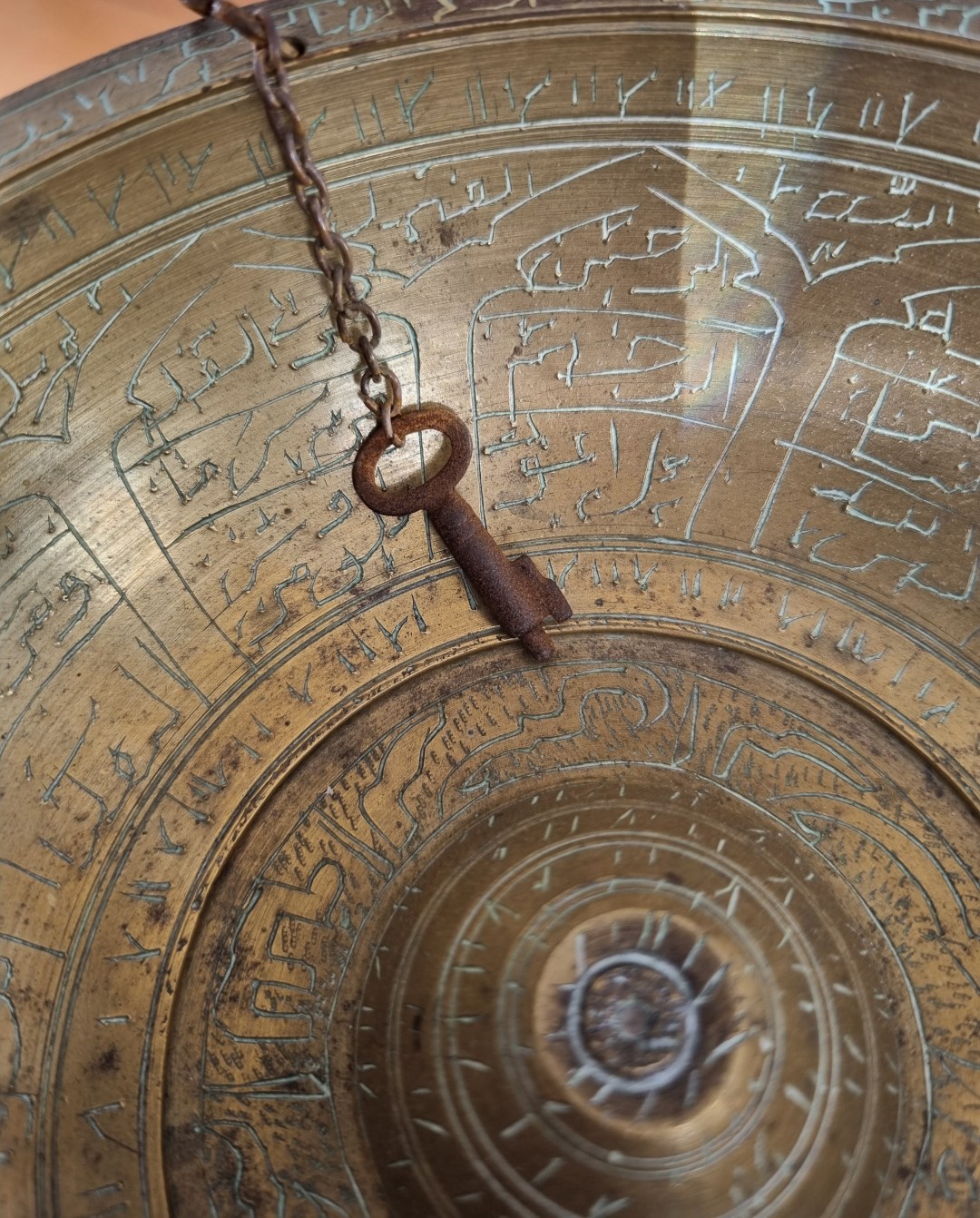
Iron in folklore and jewellery: amulets and belief
iron as amulet
Iron in folklore and jewellery: amulets and belief
Updated September 14, 2025
Iron is unlike any other metal used in amulets and jewellery. While gold and silver are prized for beauty and value, iron has long been associated with protection and power. In Middle Eastern traditions and beyond, iron objects were thought to ward off unseen forces and safeguard the wearer.
This reputation made iron an important material in amulet traditions: from small protective pendants to everyday objects carried as charms. Folklore around blacksmiths, meteoric iron, and sacred texts adds to the sense that iron was never just a practical material, but a deeply symbolic one.
Interested in amulet traditions in jewellery? This blog explores how amulets in jewellery work!
Iron’s reputation as protective metal in folklore
For centuries, communities across Europe, the Middle East, and Asia have believed that iron had the power to repel harmful or unseen forces. Horseshoes hung above doors, iron nails driven into thresholds, and small iron objects worn on the body were all part of a long-standing tradition of using the metal to keep misfortune at bay.
In the Middle East, iron was often linked with strength and resilience. Its ability to be forged into weapons and tools set it apart from softer metals. Unlike gold or silver, which were associated with wealth and beauty, iron was the everyday metal of farmers, soldiers, and craftsmen. Its strength gave rise to the idea that it could also protect in unseen ways, forming an invisible barrier between the wearer and potential harm.

Iron and the supernatural
There is a lot of ambivalence towards iron in the human world. That is visible in the contradictory nature of sources when it comes to its uses and status.
One of the hadith states that the Prophet Muhammad wished for his personal signet ring to be made of silver. An iron ring was inacceptable to him, as it was ‘emblematic of souls condemned to eternal fire’. [2]
But on the other hand, king Solomon wore a ring said to be partly of brass and partly of iron. Solomon, widely seen as a wise and just king, used the ring to command all spirits: the iron however was used to seal orders for evil spirts. [3]
Iron and the supernatural are associated, too, but we come across conflicting statements: spirits are scared of it, yet they wear it as adornment, they use it as weapon themselves but can be harmed by it in turn.
So, let’s look beyond folklore, and turn to the invention of ironworking itself.

Iron and its meteoric origins
In the Qur’an, sura al-Ḥadīd states that iron was ‘sent down’ to the earth by God. [1] This brings the earliest form in which iron was available t0 mind: meteoric iron. It literally fell from the sky.
Smaller and larger lumps of iron, remnants of meteorites, can be found all over the Sahara, for example. You can see several of these meteoric iron lumps in the image below. The key pendant is from Oman: keys allude to iron, and that is one of the reasons they are used as amulets. (click here to see more about keys as amulets)
This type of iron was easier to work than iron ore that had to be mined, and so may have been the first type of iron to be worked. One of Tutankhamun’s daggers, dating from around 1350 BCE, was confirmed to have been made of meteoric iron. [4]
And not only was the first iron to be used by humans literally from out of this world, and so may have installed itself in our collective memory, the invention of ironworking had a profound effect in virtually every culture where it was first discovered. [5]

Blacksmiths, fire, and the power of iron
Because when you zoom out, you’ll find that around the world the working of iron is surrounded by myths and legends.
The person of the blacksmith or ironmonger is as ambivalent as the material itself: in many societies, blacksmiths exist on the fringes of their community, both literally and metaphorically.
Literally, because ironworking requires the use of fire. Workshops were often located at the border of a settlement, and preferably downwind. That would minimize the risk of the settlement catching fire: a necessary precaution in times when buildings as well as temporary structures were made of materials that would easily go up in flames.
And metaphorically, because those blazing fires were often associated with otherworldly realms. Any person working in those circumstances, withstanding the extreme heat, seemingly bending fire to their will and creating things of a previously unmatched hardness and durability surely had to be in league with invisible forces!
Because, just picture it: there’s a person emerging from the furnace on the edge of your community, black as the devil, or a demon, or any frighting supernatural being one believes in, surrounded by unpleasant smells of sweat and dirt, and holding something only a few could create but many wanted, like a sword or a tool…that goes against all manifestations of cleanliness and purity you could imagine. Blacksmiths were highly suspicious, but much-needed people.
And so, they were both admired and feared. Edmond Doutté writes for Algeria that ‘son of a blacksmith’ was intended as an insult and records how blacksmithing across the Maghreb was widely regarded as a profession that was looked down upon and associated with magic. [6] The same fate befell blacksmiths across the Arab Peninsula. [7]
It would seem that both the material itself as well as the persons working with it have been treated ambiguously, ever since the use of iron was first discovered.
Amulets and jewellery made of iron
I think it is quite likely that this association of iron with the supernatural is much older than any of the three monotheistic religions, and is something that has lingered in our collective memory for as long as iron has been forged by hand.
Iron is something we can defend ourselves with against very visible enemies, but also a mysterious commodity associated with the supernatural: perhaps it could be used to defend ourselves against invisible beings, too?
In the Middle East, jewellery sometimes incorporated elements not for decoration but for protective symbolism. In the case of iron, that could be actual iron objects such as keys, but also objects that refer to iron such as miniature tools. The reference to iron itself would be powerful enough to protect the wearer.
The value here lay not in material worth but in cultural meaning: iron was cheap compared to silver or gold, yet powerful in what it was believed to do.
Why iron still matters in material culture
Today, iron may seem too ordinary to deserve much attention in jewellery or museum collections. Yet its cultural role makes it important. Iron objects, from keys and tools to amulets and ornaments, remind us that jewellery and adornment are not only about beauty or wealth. They are also about belief, protection, and the way people have understood their world.
For collectors, curators, and historians, iron offers a fascinating case of how an everyday material became extraordinary in the imagination of those who used it.
A small iron ring may not sparkle like gold, but its value lies in the stories it carries: of protection, of cosmic origins, of blacksmiths who wielded fire to create it.
Iron: more than metal
Iron stands apart in the history of jewellery and adornment. It carries a weight of meaning of its own. As folklore, sacred texts, and everyday practice all show, iron was believed to protect, to guard, and to symbolise strength.
When we look at iron in amulets and jewellery, we are reminded that the stories and beliefs surrounding a material are as important as the object itself. Here, we see a technological advancement that created ripples across the world, reflected in popular beliefs: once again, magical beliefs point to actual events in the past, and to me that really is their greatest power!
—
Find out more about the histories behind amulets in the e-course on Amulets and Magic in Jewellery!
Or start by downloading the free e-book on amulets and jewellery here.
More posts on jewellery and amulets? Browse them all here!
Join the Jewellery List and receive new articles, jewellery news and more in your inbox!
—
-
Sale!

Bundle: Middle Eastern Jewellery courses
Original price was: €128.00.€94.50Current price is: €94.50. -

Jewellery of Ancient Egypt
€39.50 -

Amulets and charms in jewellery
€39.50 -

Organising your collection
€29.50 -

Scents of the Middle East
€29.50 -

Dowry and status
€29.50 -

Ancient Jewellery
€29.50 -

Egyptian zar jewellery (mini-course)
€14.95 -

Jewellery Talks: Omani amulet pendants
€5.00
References
1] Ruska, J., “al-Ḥadīd”, in: Encyclopaedia of Islam, Second Edition, Edited by: P. Bearman, Th. Bianquis, C.E. Bosworth, E. van Donzel, W.P. Heinrichs. Consulted online on 02 October 2023. http://dx.doi.org.ezproxy.leidenuniv.nl:2048/10.1163/1573-3912_islam_SIM_2588
[2] J. Allan, D. Sourdel and Ed., “K̲h̲ātam, K̲h̲ātim”, in: Encyclopaedia of Islam, Second Edition, Edited by: P. Bearman, Th. Bianquis, C.E. Bosworth, E. van Donzel, W.P. Heinrichs. Consulted online on 02 October 2023 <http://dx.doi.org.ezproxy.leidenuniv.nl:2048/10.1163/1573-3912_islam_SIM_4232>
[3] Walker, J. and Fenton, P., “Sulaymān b. Dāwūd”, in: Encyclopaedia of Islam, Second Edition, Edited by: P. Bearman, Th. Bianquis, C.E. Bosworth, E. van Donzel, W.P. Heinrichs. Consulted online on 02 October 2023 <http://dx.doi.org.ezproxy.leidenuniv.nl:2048/10.1163/1573-3912_islam_SIM_7158>
[4] D. Cornelli et. al. 2016. The meteoritic origin of Tutankhamun’s iron dagger blade, in: Meteoritics & Planetary Science Vol 51, issue 7, pp 1301-1309
[5] Doutté, E. 1909. Magie et Religion dans l’Afrique du Nord, p. 42.
[6] Doutté, E. 1909. Magie et Religion dans l’Afrique du Nord, p. 42-44.
[7] Chelhod, J., “Ḳayn”, in: Encyclopaedia of Islam, Second Edition, Edited by: P. Bearman, Th. Bianquis, C.E. Bosworth, E. van Donzel, W.P. Heinrichs. Consulted online on 02 October 2023 <http://dx.doi.org.ezproxy.leidenuniv.nl:2048/10.1163/1573-3912_islam_SIM_4063>
The Bedouin Silver blog gives credit where credit is due! Transparent referencing and citing sources helps us all grow. Would you like to do the same and quote this article? Here’s how:
S. van Roode, [write the title as you see it above this post], published on the Bedouin Silver website [paste the exact link to this article], accessed on [the date you are reading this article and decided it was useful for you].
The Bedouin Silver Jewellery Blog: Sigrid van Roode
Sigrid van Roode is an archeologist, ethnographer and jewellery historian. Her main field of expertise is jewellery from North Africa and Southwest Asia, as well as archaeological and archaeological revival jewellery. She has authored several books on jewellery, and obtained her PhD at Leiden University on jewellery, informal ritual and collections. Sigrid has lectured for the National Museum of Antiquities in Leiden, Turquoise Mountain Jordan, and many others. She provides consultancy and research on jewellery collections for both museums and private collections, teaches courses and curates exhibitions. She is not involved in the business of buying and selling jewellery, and focuses on research, knowledge production, and education only. Sigrid strongly believes in accessibility of knowledge, and aims to provide reliable and trustworthy content: that’s why the Bedouin Silver blog provides references and citations.