Rings as amulets

Rings as amulets

rings of power

The Magic of Rings

Updated Jan 1, 2024

If there is any piece of jewellery that has been associated with magical powers, it has to be the ring. Rings carry a lot of meaning, and a lot has been written about Classical and European rings: how about rings in North Africa and Southwest Asia? Can a ring be an amulet? In this article, I’ll show you 5 ways rings can work as amulets.

Rings on our fingers

Rings are very prominent items of jewellery. They sit on our finger, where they are visible to both ourselves and the people around us. They can be used to attract attention or to show off riches, but at the same time their presence is very personal, felt on our fingers by our every move.

And that is an even more important symbiosis: rings move along with every gesture of our hands. As such, they are almost active jewels. This symbiosis is of influence on the placement of rings on the finger.

In Oman, a pointed ring is worn on the index finger: it reminds the wearer of her daily prayer. But in Morocco on the other hand, the index finger is left unadorned for precisely the same reason. [1]

That is always something to bear in mind: just like any other form of informal ritual, the magic of rings differs from region to region and also over time.

Ring power: sealing

The significance of rings is reflected in the Arabic word for ring, khatim. Originally, this referred to a seal. That brings along that symbiosis again: when the wearer seals something, they will need to move both their hands and fingers, as well as the ring itself. The ring becomes an inextricable part of that act.

In everyday life, this seal would be an engraved seal with the owner’s name, or a pious text. In magic, it could be a particular design that was assumed to hold power, such as the seal of Solomon or magic squares.

This practice of wearing rings with images or texts that were considered powerful, was already widespread in ancient Egypt and Mesopotamia. In that respect, rings with inscriptions are a continuation of a practice that is millennia old.

Ring power: inscriptions

Over time, the use of rings for sealing was joined by inscriptions that were not meant to seal: they are legible when worn, instead of engraved in a mirror image.

Engraving a text in a ring would enhance its efficacy: Edmond Doutté, when writing about North Africa in the early 20th century, mentions a spell to attract prosperity in business, which needed to be engraved in a ring. When worn, this would lead to an increase in profit. [2]

So, a ring was something to seal with, but also something that held power of its own.

Ring powers: shape

That is also due to its shape. A ring has no beginning and no end, it is the perfect symbol for eternity and cyclical events. That makes it the perfect symbol for, for example, love and friendship, or to designate a space.

But because of their power to encircle, in some cases rings were believed to do more harm than good. That works along the same lines as knot magic. Just like anything knotted (see more about that here), pilgrims to Mecca were advised not to wear rings on their person. [3]

Ring power: material

The material of which a ring was made, contributes to its power, too. Iron is believed to keep evil at a distance as jinn are afraid of it (see more here on conflicting views on iron and adornment), and silver was the material of the Prophet’s own signet ring. [4] Besides the ring itself, materials used in its setting were also chosen for their properties.

A ring set with a carnelian stone was believed to bring continuous blessings to the wearer [5], and the three varieties of a stone named yaqut were believed to protect against the plague when set in a ring or a necklace. [6]

Here, the power of the material chosen to be set in a ring is combined with the power of the ring itself, and of course of the image or text engraved in that material. Rings are not simply carriers of powerful images or texts, but the entire ensemble including the ring itself is a threefold agent of protection and power.

That is also why many sorcerers and magicians are said to carry signet rings, and rings feature in magical tales [7]: in the 1001 Nights, it is a ring that binds a jinn to do as the owner of the ring commands. [8]

Ring power: magical creating

Making rings could also be part of the process that imbued them with special powers. Not only should they be created on a particular moment in time (often calculated based on astrology, see more on that here), but instructions to make rings could also include specific acts to be carried out, such as slaughtering an animal or incensing the finished product. [9]

Ring power: hard to get

And finally, notably the powerful rings are associated with vivid tales on how hard it is to actually get your hands on them. There are many tales in which rings travel long distances or find themselves in seemingly impossible situations.

The trilogy around Lord of the Rings is even based on all these difficulties, and notably on the hardships in destroying that one ring. Tales like these are also found in the Islamic world. King Solomon’s ring was stolen from him, and after many adventures was found inside a fish. [10]

Rings as amulets: a tradition of millennia

There is power in rings: in their shape, their material, their colour, the process of making them and the journey of obtaining them. Rings have fascinated us for thousands of years, and now you have a little more background on why!


Find out more about the histories behind amulets in the e-course on Amulets and Magic in Jewellery!

Or start by downloading the free e-book on amulets and jewellery here.

More posts on jewellery and amulets? Browse them all here!

Join the Jewellery List and receive new articles, jewellery news and more in your inbox!

References

[1] See my book Desert Silver; in prayer, the index finger is pointed upward.

[2] Doutté, E. 1909. Magie et Religion dans l’Afrique du Nord, p. 264.

[3] Doutté, E. 1909. Magie et Religion dans l’Afrique du Nord, p. 88.

[4] See Iafrate, A. 2016. Solomon, Lord of the Rings: fashioning the signet of power from Electrum to Nuhas, in: Al-Masaq 28:3, pp. 221-241 for a discussion of the material of the Ring of Solomon.

[5] Doutté, E. 1909. Magie et Religion dans l’Afrique du Nord, p. 84, see also Porter,V., Saif , L.and E. Savage-Smith, 2017. Medieval Islamic Amulets, Talismans, and Magic, in: Flood, B. and Necipoglu 2017. A Companion to Islamic Art and Architecture, p. 543.

[6] Content, D. 2016. Ruby, Sapphire & Spinel: An Archaeological, Textual and Cultural Study, p. 18-19, discussing the Stone Book of Aristotle which dates back to the 9th century. This lapidary is not by Aristotle, but has been composed in the Middle East. The varieties of Yaqut are ruby and two varieties of sapphire.

[7] Gunther, S. and D. Pielow, eds, 2018. Die Geheimnisse der Oberen und Unteren Welt, p. XXII

[8] Idem, p. 405 and 407, referring to the story of Aladdin.

[9] Porter,V., Saif , L.and E. Savage-Smith, 2017. Medieval Islamic Amulets, Talismans, and Magic, in: Flood, B. and Necipoglu 2017. A Companion to Islamic Art and Architecture, p. 522-523, discussing an example from the Arab Middle Ages.

[10] Doutté, E. 1909. Magie et Religion dans l’Afrique du Nord, p. 157.

Sigrid van Roode

Sigrid van Roode is an archeologist, ethnographer and jewellery historian. Her main field of expertise is jewellery from North Africa and Southwest Asia, as well as archaeological and archaeological revival jewellery. She has authored several books on jewellery. Sigrid has lectured for the National Museum of Antiquities in Leiden, Turquoise Mountain Jordan, and many others. She provides consultancy and research on jewellery collections for both museums and private collections, teaches courses and curates exhibitions. She is not involved in the business of buying and selling jewellery, and focuses on research, knowledge production, and education only.

Binding magic in jewellery

Binding magic in jewellery

keeping it together

Binding magic in jewellery: pins

Updated Jan 28, 2024

The most mundane, everyday things can be transformed into magical objects simply by analogy, and that is what makes this form of magical activities so relatable. Fastening something is one of those acts that can carry a deeper meaning, and the object that goes with it becomes important, too. And clothing pins, also known as fibulas, are perfect for that goal!

Pinning a fibula: the magic behind it

This is basically a specific form of binding magic, where pins to keep clothing together gain a different meaning.

I talked about the magic of tying and girding in another blog post, and pinning your clothing together works along the same lines. The clothing pins that are used to keep fabric together, can be transformed into very powerful magical objects when they are used in ritual.

The analogy is of course very clear: a clothing pin holds two separate pieces of dress together, and so it would also be very useful in rituals to keep persons together.

When you fasten a fibula (see how to do that here), you actually have to carry out a number of steps: it does not close automatically by itself. And that is where the magic is, in those acts of deliberately fastening…clothing pins are the perfect object for love-magic!

Fibula magic in ancient times

The Romans already used their pins or fibulas (the Latin word is still in use to indicate these pins) as such. Some 2,000 years ago, you could buy an inscribed fibula to present to a lady: it would say something like ‘Hello, gorgeous!’, or, if you were bolder, ‘mix yourself with me’ – I’ll leave it up to you to figure out what they meant by that!

The point is that the fibula would work as a magical tool. [1] Once the lady in question would pin her clothes with it, it was hoped your relationship with her would immediately grow stronger.

Some 1,000 years earlier, three imported bronze fibulas were left behind in a shallow pit on the edge of a moor in The Netherlands. They were a gift to the gods, or whatever beings were believed to inhabit that place, and they were a precious gift, too.

Those fibulas were imported from Scandinavia and did not form part of traditional dress in what later would become The Netherlands: a treasure worthy of the gods. [2] You’ll see it in the collage below.

Gloomy photo of a swamp with a Bronze Age jewellery hoard

Fibula magic in North Africa

In a different world and a different time, fibulas have a very similar protective power. In Morocco, clothing pins are considered powerful because their sturdy pin has the power to harm the evil eye, a meaning also found widely in the rest of the Maghreb. [3]

Many shapes on fibulas are designed to attract good fortune and to keep evil at a distance, while their triangular form alludes to the powers of the number 3 (see more about the magic of numbers in this blog post). Fibulas are also the perfect piece of jewellery to attach amulet boxes to, which would be suspended from either the fibula itself or from the chain between them.

But here as well, their importance as something that holds to halves together, shines through.

The fibulas are part of the dowry, given to the bride by her husband and his family, and here the magic of pinning reinforces the bond between both the husband and wife and their respective families.

Adorning the bride with her jewellery, including fastening her fibula set, was part of the transformative magic in Libya, which would accompany the bride during her transition from unmarried girl to married woman. [4]

Belt buckle magic in Europe

And that power of fastening is found as a theme in other parts of the world, too.

Belt buckles function in much the same way: they, too, hold something together. As such, it became very popular as a form in European rings from the 17th century onwards. The belt buckle symbolized eternal love and loyalty – even beyond death, which is why you will also find it in mourning rings. Together with the shape of the ring itself as an endless cycle, the belt buckle firmly connects two halves for all eternity.

Pinning, fastening, closing: magic in adornment

So whether it is clothing pins or belt buckles: by fastening something, humans have tried to influence the natural course of events for millennia!


Find out more about the histories behind amulets in the e-course on Amulets and Magic in Jewellery!

Or start by downloading the free e-book on amulets and jewellery here.

More posts on jewellery and amulets? Browse them all here!

Join the Jewellery List and receive new articles, jewellery news and more in your inbox!

References

[1] Peter Wells notes that fibulas in Europe’s prehistory, when they are depicted, are always shown ‘open’, and wonders if that has something to do with magic: nothing is definitive yet, nothing is sealed, the future is open. Wells 2012, How Ancient Europeans Saw the World, p.111.

[2] I wrote about these in Bos, J. & S. van Roode 2019. Landschap vol Leven. BLKVLD Uitgevers Publishers.

[3] Cynthia Becker, Amazigh Textiles and Dress in Morocco. Metaphors of Motherhood, in: African Arts vol 39 no. 6 (2006), p. 44

[4] Elena Schenone Alberini, Las mujeres Libias en la litteratura oral. Ritos de paso y roles de genero, in: Orafrica no 6, 2010.

Would you like to quote this article? Please do! Here’s how:

S. van Roode, [write the title as you see it above this post], published on the Bedouin Silver website [paste the exact link to this article], accessed on [the date you are reading this article and decided it was useful for you].

Sigrid van Roode

Sigrid van Roode is an archeologist, ethnographer and jewellery historian. Her main field of expertise is jewellery from North Africa and Southwest Asia, as well as archaeological and archaeological revival jewellery. She has authored several books on jewellery. Sigrid has lectured for the National Museum of Antiquities in Leiden, Turquoise Mountain Jordan, and many others. She provides consultancy and research on jewellery collections for both museums and private collections, teaches courses and curates exhibitions. She is not involved in the business of buying and selling jewellery, and focuses on research, knowledge production, and education only.

Keys as amulets

Keys as amulets

magic of keys

Keys as amulets

Among the forms that are not immediately associated with amulets, is that of a key. Yet they appear as amulet in several ways throughout the Middle East and North Africa, from actual keys to images of keys. You will see them dangling from necklaces, included as miniature charm on charm necklaces, and alluded to in embroidery for example. What is the symbolic meaning of a key? In this article, I will introduce three ways keys hold significance as amulets in the Middle East.

Detail of a silver somt necklace, leather amulet pouches, bright beaded necklaces and keys worn by a Bedouin woman from Oman.

Power of keys: materials and amulets

First off, the material that keys were traditionally made of, is powerful in itself. Jinn are known to be afraid of iron, (see here why that is) and so anything made from iron would keep them at a distance. Keys, which for a long time were made of iron, fit that criterium perfectly. The image of the necklaces worn by a Bedouin woman from Oman shows her wearing a set of keys amidst leather amulet pouches: most likely, the keys also serve an apotropaic function.

A more recent version of a key as amulet is the silver key from Oman, shown below, which is shaped after a modern key. In North Africa, tiny keys sewn on to children’s clothing help prevent an early death. [1] (see here which spirits were feared for harming children). In 1915, a baby boy in Algeria was seen adorned with a series of amulets, including two iron keys, and the author observing that practice also noticed that keys were worn commonly as a charm. [2]

Silver Omani amulets, including a silver key

Key symbolism: locking and unlocking

There is more to keys than just the material they are made of, and is where their function comes into view. Keys, of course, lock and unlock things. The concept of locking and unlocking is closely related to a woman’s fertility: not so much in terms of chastity, but in the context of spirits blocking her from getting pregnant or causing a miscarriage. In that respect, keys function in a similar fashion to knots and knotting (see more about that here).

Here, keys are often combined with locks: amulets in the shape of locks were believed to prevent miscarriage in Egypt, as these ‘lock’ the womb until the time of birth has come. [3] When a birth is difficult, the reverse principle is used, and the key to a saint’s tomb is placed on the lower back of the mother to ease the birth. [4]

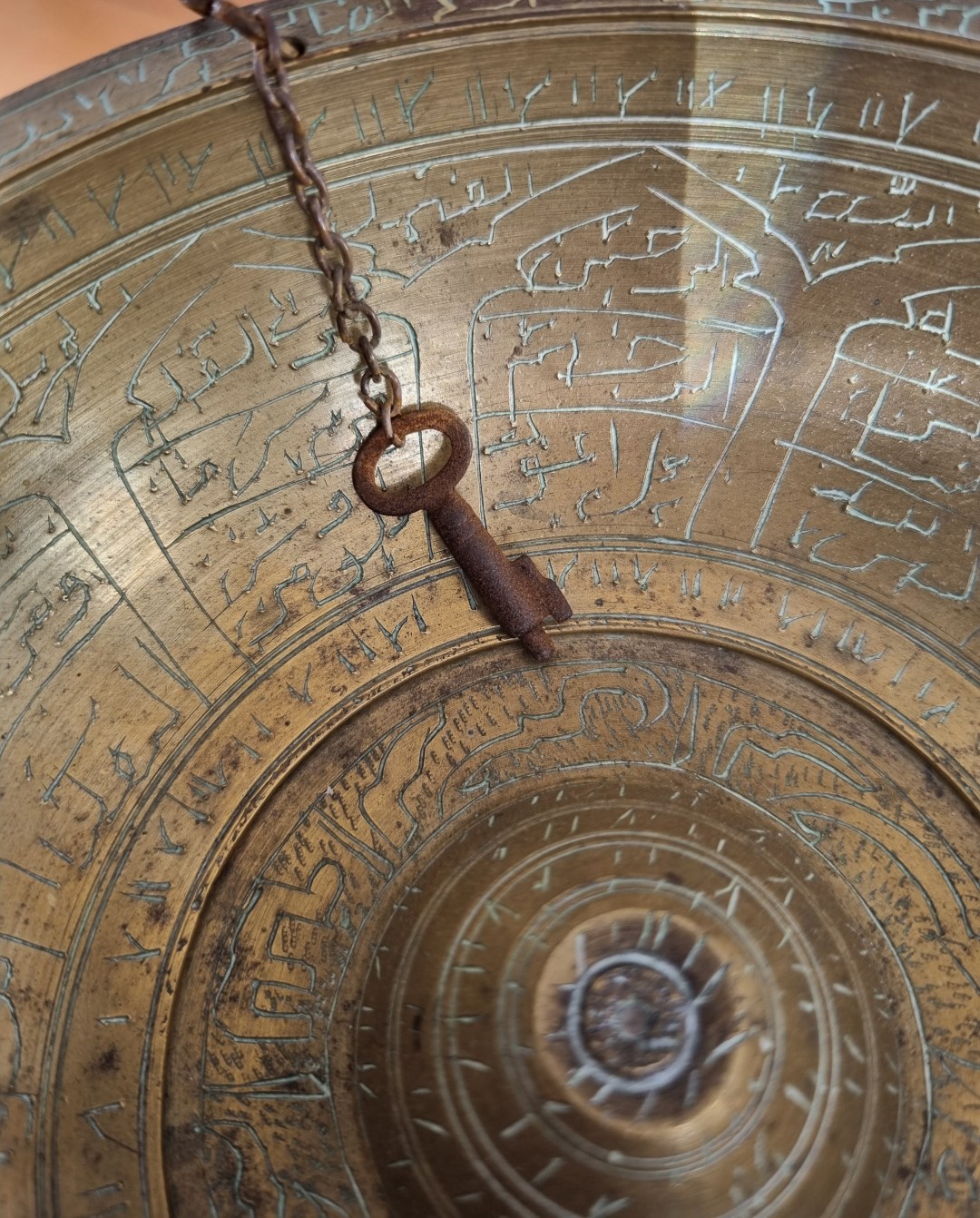
An Islamic magic bowl with a tiny iron key attached

Keys in ritual: protection and knowledge

Keys are also symbolic of accessing protection and knowledge. An example of that are the magical bowls of the Yezidi, where tiny amulet plaquettes are attached to its rim. These are called kilit, which literally means ‘key’ in Kurdic. [5] These amulet plaquettes can also take the form of an actual key, such as shown above.

The general idea is that the key amulet would enhance the efficacy of the bowl by submerging it into the water of the bowl. [6] Bowls like these were used in informal ritual aimed, again, at securing healthy pregnancy and safe births, as well as protection from evil forces. [7]

Keys as amulets: the magic in everyday objects

A seemingly simple household item may hold deep significance on a supernatural level: this example of keys shows how ‘magic’ is not something alien or mysterious, but something that is expressed in forms and shapes most familiar to us.


What kinds of amulets exist in North Africa and the Middle East?

Curious as to what other everyday objects may be used as amulets, and what their meaning is? Find out more about the histories behind amulets in the e-course on Amulets and Magic in Jewellery!

Or start by downloading the free e-book on amulets and jewellery here.

More posts on jewellery and amulets? Browse them all here!

Join the Jewellery List and receive new articles, jewellery news and more in your inbox!

References

[1] Hansmann, L. and L. Kriss-Rettenbeck 1977. Amulet und Talismann. Erscheinungsform und Geschichte. Verlag Georg D.W. Callwey, Munchen, p. 240.

[2] Hilton-Simpson, M.W. 1915. Some Algerian Superstitions Noted among the Shawia Berbers of the Aures Mountains and their Nomad Neighbours, in: Folklore Vol. 26, no. 3, p. 233 and p. 240.

[3] Hansen, N. 2006. Motherhood in the Mother of the World, PhD-thesis, University of Chicago, p. 116.

[4] Idem

[5] Biesterfeld, H. & D. Pielow (eds) 2019. Die Geheimnisse der Oberen und Unteren Welt. Magie im Islam zwischen Glaube und Wissenschaft, Brill, Leiden. p. 469-470 for a description of these bowls.

[6] Idem, p. 469

[7] Idem, p. 472-473


Sigrid van Roode

Sigrid van Roode is an archeologist, ethnographer and jewellery historian. Her main field of expertise is jewellery from North Africa and Southwest Asia, as well as archaeological and archaeological revival jewellery. She has authored several books on jewellery. Sigrid has lectured for the National Museum of Antiquities in Leiden, Turquoise Mountain Jordan, and many others. She provides consultancy and research on jewellery collections for both museums and private collections, teaches courses and curates exhibitions. She is not involved in the business of buying and selling jewellery, and focuses on research, knowledge production, and education only.

Food ceremonies & amulets

Food ceremonies & amulets

magic of food

Food ceremonies, rituals and amulets

Updated Jan 1, 2024

Not turning this jewellery blog into a foodie feed…but did you know there is a strong relation between food, ritual and personal adornment in North Africa and Southwest Asia? I have rounded up several examples of jewellery and adornment to show you how food and personal adornment are interrelated.

Food and magic: a connection on many levels

Food is something we depend on. We can’t live without it, and so it is hardly surprising to find the importance of growing, raising and preparing of food resonating in the realm of magic and amulets. This is often related to growth, wealth, health and having children.

The opposite is also true: poisonous foods or animals feature in magic, too, with the aim of fighting evil influences.

Another link between food and magic is medicine: many ingredients used for food preparations are also found in medicine, a field originally closely linked to magic.

There are countless rituals involving beans, sprouts and such aimed at becoming pregnant or keeping spirits away from the house.

And everyday acts from the culinary domain take on new meaning in ritual, such as the pounding of coffee beans [1] referring to sexual relations. Yes, you read that right….do check the reference with this, the story is amazing!

Back to jewellery: that close relation between food and magic can take material form in personal adornment in several ways. First, there are actual edible things that may be worn on the body, but you could also think of imitations of those, both lifelike and in abstract shapes, the names given to jewellery elements and even more indirect connections such as through colours. So how does that work?

Food & amulets: actual ingredients

Starting with actual ingredients, to protect children in Egypt, a small pouch filled with bread and salt would be worn as an amulet to keep spirits away, a practice recorded up until the last century. [2]

A naming ceremony for a baby among the Bisharin, living in Sudan, had visiting guests write down a name suggestion and put that in a dish containing milk, bread and sugar. [3]

The fragrance of cloves was believed to be an aphrodisiac throughout North Africa and Southwest Asia, and so adornment made of cloves was regarded as a powerful means to attract the love of a husband.

Throughout Southwest and Central Asia, red chili peppers are dried and strung on cord to protect houses from evil spirits; tiny peppers in plastic are strung in between evil eye beads (see more about those here) as a powerful amulet. Here, the general idea is that just like peppers irritate your eyes (ever rubbed your eyes after chopping a pepper? You’ll know what I mean…!), they will irritate the evil eye as well.

Food & amulets: imitations of food

Those plastic mini peppers are an example of imitations of food. Another example are silver amulets from the area of Tetuan, Morocco, in the shape of peas in a pod. It’s the first image in the photo gallery with this article: click on the image to enlarge it, they are something special!

This amulet is called arhaz, and it was believed to be bring good luck and fertility to the wearer. [4] The amulets are very recognizable as pea pods, with a slight curve and bulging peas inside. What makes them stand out as an amulet is visible on the example on the right: the zigzag-border is characteristic of amulets and talismans.

Each pod is shown with 5 peas. Renderings of the number 5 in jewellery are known to bring good luck in general, as 5 is the most powerful number. (click here to read more on numerology in jewellery) That number is repeated again on each pea of the pendant on the left, where each pea is further decorated by 4 intersecting lines and a square in the centre. That is also a rendering of the number 5. This repetition of the number 5 and the imagery of the pea pod bursting with fat peas is what would bring good luck and abundance to the wearer.

The peas in the pod also serve as fertility amulet. That is a rather obvious metaphor of course, and one that is used in many cultures.

Food & amulets: names and shapes

In other cases, the relation is more subtle. Oak leaf lettuce (ifrawen ukerush) is rendered in the shape of Kabyle pendants from Algeria, and other pendants from the same region are named after melon seeds (iyes afeqqus). [5]

These are regular pendants on necklaces. They have not separately created as amulet, but still work their magic: melon seeds, as there are so many of them, are often associated with fertility beliefs as well.

Sometimes it is the visual similarity between food and jewellery that is reflected in the name: the habbiyat (chickpea) bracelets derive their name from the many granules on them. One example is shown above: click on the image to enlarge it.

Click here to read more on a special amulet that is actually named after food, which no one seems to remember…!

Food & amulets: embroidery, motifs and colours

Food finds its way into personal adornment in other forms as well.

In Siwa Oasis, Egypt, the colours chosen for embroidery on dresses, pants, shawls and scarves all reflect the colour palette of the dates that Siwa is famous for. The life cycle of date productions directs the rhythm of everyday life in the oasis, and so the embroidery on personal adornment brings that cycle of growth and abundance to the wearer. Palm branches themselves form part of the pattern repertoire.

The Palestinian tatreez elements of wheat stalks, coffee beans, pomegranates and more all form part of the connection with the land [6].

In some cases, it’s impossible to tell whether a magic connotation of an element is related to food, or that that is entirely by coincidence. Doves and fish for example are featured often in jewellery, and are related to blessings, happiness and abundance, but they appear equally often in delicious regional dishes.

The power of everyday life

That close connection does show one thing, though: forms and shapes chosen in personal adornment are rooted in everyday life to a level where distinguishing ‘magic’ as something different from regular existence is impossible.

Incorporating food themes in jewellery shows how its wearers aligned themselves with the rhythm of nature, with the endless cycles of sowing and harvesting, the same cycle that is at the basis of many amulets.

It is in motifs like these that we not only catch a glimpse of the most fervent wishes of women, but also of how they thought of themselves: connected with their world.

More on amulets, charms and magic in jewellery? Download your free e-book here, read other posts, or enroll in the e-course on Magic of Jewellery!

Never miss a new article? Join the Jewellery List and have them delivered to your inbox!

References

[1] See a fascinating article about female Bedouin poetry here, including the reference to pounding coffee beans.

[2] Hansen, N. 2006, Motherhood in the Mother of the World, pp. 222.

[3] Hansen 2006, p. 241.

[4] These three silver amulets are in the collection of the Museu Etnològic I de Cultures del Món in Barcelona, where I photographed them on their Montjuïc location.

[5] Camps Fabrer, H. 1990. Bijoux berbères d’Algérie, Edisud, pp. 44-45.

[6] Ghnaim, W. 2018. Tatreez and Tea.

Sigrid van Roode

Sigrid van Roode is an archeologist, ethnographer and jewellery historian. Her main field of expertise is jewellery from North Africa and Southwest Asia, as well as archaeological and archaeological revival jewellery. She has authored several books on jewellery. Sigrid has lectured for the National Museum of Antiquities in Leiden, Turquoise Mountain Jordan, and many others. She provides consultancy and research on jewellery collections for both museums and private collections, teaches courses and curates exhibitions. She is not involved in the business of buying and selling jewellery, and focuses on research, knowledge production, and education only.

A shackled jinn from Oman

A shackled jinn from Oman

jewellery as protection

A shackled jinn from Oman

Updated June 25, 2025

Jewellery regularly doubles as protection, as it is worn so close to the body. Often this form of protection is of general nature, but every now and then it makes uses of specific elements to ward off a particular evil. This pendant from Oman hides such an element on its reverse side: a tiny figure of a shackled human form. What does this mean, and what does it tell us about the women who wore this necklace?

The image of a jinn on the Omani kirsh kitab

The disc-shaped pendant is known by several names. The most often used name is somt, which is also used for other round pendants of the same size. [1] In one publication it is called kirsh kitab. [2] A similarly shaped pendant with a comparable reverse side is called kokh, again in one publication: this pendant is decorated with gold leaf on its front side rather than an inscription. [3]

The pendant carries an inscription on its front side. This is the Throne Verse, one of the most powerful verses of the Quran and often used for protection. You will find it often on amulets throughout the Middle East and North Africa.

On the reverse side, in many cases you will find a stylized depiction of a human-shaped figure. This is an image only known to the woman wearing it. You would not be able to see it from the outside. Mostly, this figure is explained as a jinn, held captive by the power of the Throne Verse.

As such, these pendants offer protection from evil spirits in general. The figure however is in some cases said to carry a name. This jinn is not any jinn, but a very particular one. So which jinn is this, and why is it engraved on the back side of an Omani pendant?

The jinn on an Omani pendant: the Bahla Witch?

Forster explains the figure as a representation of the Bahla Witch.[4] Bahla, a fortress town in Oman, has a reputation for the presence of both jinn and witches. [5] The pendant would protect the wearer from witchcraft and jinn alike. As this pendant was worn in a much larger area than just Bahla however, this interpretation may well be true for the inhabitants of the town itself, but there is another possibility that would make sense to many women.

The jinn on an Omani pendant: Umm as-Subyān

This other explanation is that of the human figure as Umm as-Subyān, ‘Mother of Children’. [6] This female jinn is well known beyond Oman and appears also further on the Arab Peninsula. But who is Umm as-Subyān?

In the most benign version, she is said to cause nightmares in children and uncomfortable wet dreams for boys in particular. But, there is more to her than just a night filled with bad dreams. She may be really dangerous.

Anne Regourd has researched how this jinn features in Yemeni oral traditions. [7] These tales share a more gruesome side to Umm as-Subyāns character: she lures young children away from their mothers and eats them, and she also takes newborns. Another tale records how she is capable of possessing young men and women, who then can’t seem to marry, no matter how much they try.

Regourd concludes that Umm as-Subyān is intent on preventing the arrival of children. She tries to prevent marriage altogether, and if a union does succeed, she takes and kills the offspring.

In short, Umm as-Subyān embodies what every woman feared: the inability to have children. [8]

Having children: fertility amulets in the Middle East

Why is not having children something to be afraid of? Fertility was one of the most fundamental aspects of a woman’s life. Having children was important: they assisted from a young age in the daily running of household and work, and would take care of their parents when these grew old. Remember, this is a past in which no retirement funds or care-homes existed!

Not having children could even be reason for divorce. Add to that a high infant mortality rate, and the pressure women were undeer becomes apparent. All over the Arab world, jealous jinn were thought to obstruct attempts at getting pregnant and bearing healthy children.

In this respect, Umm as-Subyān is comparable to for example the Qarina in Egypt [9] and La Taba in Morocco [10]. All three target newborns and young children, and cause infertility or miscarriages in young women.

Many women took precautions to make sure these jinn were rendered harmless, and these precautions often took the form of personal adornment. Jewellery is worn close to the body, and so forms a barrier between you, and the outer world full of dangers.

An Omani pendant with a hidden message

In the case of Umm as-Subyān, two ways of averting her are in both the name humans use when talking about her, and the way she is depicted on the pendant. The name ‘Mother of Children’ uses reverse magic. She is called by the exact opposite of her actions, a form often seen in informal magical practices around the world.

In the image on the pendant, the stylized figure is shackled around her ankles and wrists. Immobilized, she is not able to come for the wearers’ children or prevent her from getting married.

Jewellery reveals a woman’s world of worry

As with anything jinn-related, there is not one definitive identification or final explanation. With the presence of the Throne Verse, the pendant protects against evil influences in general.

The tiny shackled figure, in the story of Umm as-Subyān, reveals a world of worry for women, and so the pendant protects them from what well may have been one of their worst fears.

Where can I find more on women and amulets in the Middle East?

Find out more about the historic value of amulets in the e-course on Amulets and Magic in Jewellery!

Or start by downloading the free e-book on amulets and jewellery here.

More posts on jewellery and amulets? Browse them all here!

Join the Jewellery List and receive new articles, jewellery news and more in your inbox!

References

See the book chapter on these amulets by James Redman, which discusses the texts and context of precisely this pendant type in much more depth. This chapter was published in Nov 2020, after the writing of this blog post. Highly recommended reading!

 [1] A. Forster 2000. Disappearing Treasures of Oman. Archway Books, Somerset, p. 38-39

[2] P. Shelton, R. Richmond & M. Morris, Oman Adorned.

[3] J.S. Rajab 1998, Silver Jewellery of Oman. Tareq Rajab Museum, Kuwait, p. 63

[4] Forster 2000, p. 40

[5] See L.J. Borger 2011, By the Pricking of My Thumbs, Something Wicked This Way Comes: Omani Perceptions of the Supernatural. Independent Study Project (ISP) Collection. 1039., for a discussion of the supernatural in Omani society.

[6] P. Shelton, R. Richmond & M. Morris, Oman Adorned, p. 102; L. Mols, Kunst uit Zilver. Traditionele sieraden van Oman, in: L. Mols & B. Boelens (red) Oman, p. 137

[7] A. Regourd 2012, Représentations d’Umm Sibyan dans les contes yéménites : de la dévoreuse d’enfant à la djinniyya possédant les humains, in: A. Caiozzo & N. Ernoult (eds), Femmes médiatrices et ambivalentes. Mythes et imaginaires, Paris, Colin, pp. 63 – 72

[8] Regourd 2012, p. 72

[9] See my article in RAWI Magazine for the qarina

[10] J. Bois, La Sorcellerie au Maroc, nouvelle édition 2014, Dar al-Amane, Rabat p. 198.

The Bedouin Silver blog gives credit where credit is due! Transparent referencing and citing sources helps us all grow. Would you like to do the same and quote this article? Here’s how:

S. van Roode, [write the title as you see it above this post], published on the Bedouin Silver website [paste the exact link to this article], accessed on [the date you are reading this article and decided it was useful for you].

The Bedouin Silver Jewellery Blog: Sigrid van Roode

Sigrid van Roode is an archeologist, ethnographer and jewellery historian. Her main field of expertise is jewellery from North Africa and Southwest Asia, as well as archaeological and archaeological revival jewellery. She has authored several books on jewellery, and obtained her PhD at Leiden University on jewellery, informal ritual and collections. Sigrid has lectured for the National Museum of Antiquities in Leiden, Turquoise Mountain Jordan, and many others. She provides consultancy and research on jewellery collections for both museums and private collections, teaches courses and curates exhibitions. She is not involved in the business of buying and selling jewellery, and focuses on research, knowledge production, and education only. Sigrid strongly believes in accessibility of knowledge, and aims to provide reliable and trustworthy content: that’s why the Bedouin Silver blog provides references and citations.