Horniman Museum

Horniman Museum

anthropological collection

Horniman Museum and Gardens

The Horniman Museum and Gardens in London (UK) houses a wonderful anthropology collection. Over 3,000 objects are on display, offering a wide view into how people all over the world experience their life and seek to understand their surroundings. I had the pleasure of visiting the museum and browse its gallery!

The museum was founded by Frederick Horniman, a tea trader who made a fortune with the company his father started. The museum is very clear about the colonial past of the museum and its collections: the collection of ethnographic objects to educate and inform people in Britain about other cultures was only possible in a colonial setting and with a fortune earned by the exploitation of others. The museum actively works with community researchers, artists and creatives on a continuous basis, and it will be interesting to see how this translates into choices and decisions, for example in regard to the Benin bronzes on display.

The central part of the museum, and the part I came to visit in particular, is the World Gallery. Here, showcases form cubicles that each address a continent. Africa, the Americas, Oceania, Asia and Europe are represented by a selection of objects that highlight varying themes. You will find many beautiful examples of ethnographic art, ranging from clothing and adornment to utensils and tools. What I particularly liked is that these are not only aimed at seeing, but at hearing, smelling and touching as well. With the display of Tuareg craftmanship you will find worked leather and a veil weight which are meant to be touched: feeling the patterns below your fingers makes an object come more to life than just by looking at it. The Asian section offers the possibility to smell the medicine of a Bhutan doctor, and throughout the exhibition sounds of song and music are present. These latter can cause somewhat of a drawback though: as they are audible throughout the Gallery, they create permanent more or less noisy surroundings.

The section on Perspectives shows how people aim to understand, control and categorize their world. Lots of amulets and other meaningful objects illustrate the problems and challenges people faced and how they sought to deal with those. I loved the showcase with all sorts of amulets from Great Britain: holed flint as a charm against nosebleeds, ‘hag stones’ to avert witches and pigeon’s feet against cramp are just a few of those. That did bring me to another drawback (well, at least, to me): the museum shop has many lovely and sustainable gift ideas, but nothing relating to the anthropological collection. There are no museum or exhibition catalogues to offer a deeper level of understanding to visitors wanting to learn more. While the museum works hard to engage visitors during their stay, by offering several moments to reflect on one’s own beliefs, values and thoughts in the exhibition, this ends at the door.

The museum website does offer more information, though. It has a great and searchable overview of the collections: providing the collections with a more detailed description is a work in progress and will provide a great resource for research. On the website, you will also find information on ongoing collaborations, projects under way and an extensive blog with a wide variety of background stories (found more on those ‘hag-stones’ here!), inviting to keep on reading and exploring.

The museum is surrounded by beautiful gardens, and boasts a really good museum café where I enjoyed a lovely outdoor lunch with a view on the conservatory. It also houses a Butterfly House, an Aquarium and a Natural History Gallery: I did not have a chance to visit those, but I will definitely be back to explore more of this beautiful, colourful and lively museum!

Horniman Museum and Gardens: find out more on the museum website

More on exhibitions and museums in the field of personal adornment, archaeology, ethnography and Islamic art? Find more here, or join the Jewellery List to receive new interesting tips in your inbox!

Sigrid van Roode

Sigrid van Roode is an archeologist, ethnographer and jewellery historian. She considers jewellery heritage and a historic source. She has authored several books on jewellery from North Africa and Southwest Asia, and on archaeological jewellery. Sigrid has lectured for the Society of Jewellery Historians, the National Museum of Antiquities in Leiden and the Sultan Qaboos Cultural Center, among many others. She curates exhibitions and teaches online courses on jewellery from North Africa & Southwest Asia.

Lover’s Eyes

Lover’s Eyes

miniature art

Lover’s Eyes

The eye has been a powerful motif since the earliest pieces of adornment were created. It protects the wearer and features in either stylized or natural form. At the end of the 18th and beginning of the 19th century, a new category was added to this millennia-old repertoire: miniature portraits of the eye of an actual person, so-called ‘Lover’s Eyes’. The book ‘Lover’s Eyes’ presents a superb private collection of these tiny masterpieces.

‘Lover’s Eyes’ is the name given to these jewels, as a love story is what first comes to mind. That is because the most famous commissioner of such a portrait was the Prince of Wales, later to be King George IV: he sent a jewel with an image of his eye to his beloved Maria Fitzherbert. They married secretly and she commissioned a similar portrait for him to carry with him at all times. Over the years, they exchanged several of these jewels, and of the 10 pieces Maria had had created for him, nine were returned to her after his death – the 10th piece is still with him following his final wishes. But there is much more to them than secret love interests, and that is what makes this book such a wonderful read.

More than 130 eye-jewels from the collection of Nan and David Skier are presented in this book. The book is based on the exhibition catalogue that appeared in 2012 alongside the exhibition ‘The Look of Love’ in the Birmingham Museum of Art, but has now significantly been updated, expanded with four new chapters and additional jewellery pieces. The new chapters open up a treasure of history and background details against which to interpret these pieces.

One of these new essays deals with the settings of these portraits. The eye miniatures themselves are exquisite, but their setting adds to their meaning. In the spirit of Georgian expression, gemstones formed a language as well. The essay ‘Symbol and Sentiment’ explores these added capacities. I found it fascinating to learn that in this timeframe, too, coral was highly valued because of its protective capacities, and as the author writes it is indeed interesting to wonder if a coral setting of an eye miniature protects the person wearing the piece or the person depicted in the piece, or perhaps both (p. 48). Garnets, as a symbol of friendship, may indicate a piece was intended as gift to a close friend rather than to a lover, while pearl points more to love, and so the variety of gemstones present in eye miniatures is discussed.

That same added visual language is also present in the flowers depicted, which is explored in the essay on Floriography. Here, we learn about the history of floral symbolism in England. As the author remarks, there are relatively few pieces that combine floral motifs with eyes (p. 71), which is noteworthy for such a longstanding tradition. I could not help but wonder if the absence of floral language is informative in itself and tells us a little about how these eye portraits were perceived. Flowers communicate virtues and values about a person depicted to the onlooker. The eye jewellery however, while publicly worn, balances on the threshold between private and public: it combines presence with absence, identity with anonymity: could it be the use of added messages was mostly refrained from, so as to not give away too much to the onlooker? It’s just a thought, but this and other topics show how these eye portraits remain enigmatic objects in certain respects. Another tradition that is very much present in eye miniatures is the use of hairwork, as present in the second half of the essay on Symbol and Sentiment. These are not only to be understood as mourning or memorial jewellery – the gifting of hairlocks also occurred among friends and relatives.

The advent of photography is one of the factors that contributed to the dwindling popularity of eye miniatures. Yet, they never disappeared completely, as the last essays ‘Fake or Fashion and ‘Love never Dies’ explore. Eye jewellery was again popular in the late 19th and in the beginning of the 20th century, but these miniatures were no longer portraits of actual persons. The book walks us through the differences and development of styles, into the area of falsifications. As with all fakes, forgers are increasingly ingenious, and I found the section on methods to reveal fakes very enlightening: I would not be able to discern an authentic piece from a fake with the naked eye (no pun intended), but I found the discussion very helpful, also in its regard of what actually constitutes a fake. After all, eye miniatures continue to be made today: the exhibition in 2012 itself sparked another round of interest in these objects and inspired new creations reflecting our own timeframe. Here, the original Lover’s Eyes merge with older forms and meaning of eye depictions. The Eye of Time as designed by Dalí for example (p. 105) recalls both eye jewellery from the Mediterranean in its shape as the lover’s eyes in the addition of a teardrop, and the large eyes painted on the cassette ceiling of Blenheim Palace mix the other way around: their general shape is reminiscent of the watchful eye, but they are related to the eye jewellery miniatures in their depiction of the actual eyes of the Duke and Duchess of Marlborough (p. 103).

Jewellery, especially talismanic jewellery, tells us a lot about its wearer. This category of jewellery does even more so, as it captures traits of actual persons. They speak of love and loss, and as such hold incredibly personal stories that we may never know in detail. I loved the amount of detail this book provides to place these pieces in context: the other imagery of the time, such as the language of gemstones and flowers or their use as sentimental jewellery. The essays on the ‘Artist’s Eye’ and ‘The Intimate Gaze’ on Richard Cosway, who painted the eye miniatures for the Prince of Wales, shed light on the practical sides of this artistic genre – like the prince ordering, but rarely if ever actually paying.

The design of the book itself reminds me of a jewellery cassette: square and, upon careful opening, filled with wonderfully photographed pieces. The catalogue takes up about half of the book and showcases each piece against a dark background: I found it particularly helpful that the text consistently refers to catalogue entries, which makes for easy comparison. Many of the catalogue entries are discussed in detail in the main text, and where needed, extra information is added in the catalogue section. The book is referenced throughout with endnotes with each essay – don’t miss out on the notes, they contain even more fascinating tidbits!

This is a very complete, accessible overview of one of the most intriguing jewellery types of the last centuries, that should definitely be on the shelf of anyone interested in Georgian and Victorian jewellery, sentimental jewellery or European jewellery!

Lover’s Eyes. Eye miniatures from the Skier collection. Edited by Elle Sushan. Giles Art Books, 2021. 280 pages, full colour. In English

Available with the publisher and online stores such as Amazon.

The book was gifted as advance reading copy by the publisher

More on the symbolism of eyes in jewellery is in the e-course on Amulets, Charms and Jewellery: see more here!

Find dozens of other book titles on adornment to explore here.

A free e-book on amulets in jewellery is ready for you here: enjoy!

Never miss out on new books, exhibitions and other jewellery news? Join the Jewellery List and stay in the know!

Sigrid van Roode

Sigrid van Roode is an archeologist, ethnographer and jewellery historian. She considers jewellery heritage and a historic source. She has authored several books on jewellery from North Africa and Southwest Asia, and on archaeological jewellery. Sigrid has lectured for the Society of Jewellery Historians, the National Museum of Antiquities in Leiden and the Sultan Qaboos Cultural Center, among many others. She curates exhibitions and teaches online courses on jewellery from North Africa & Southwest Asia.

Numerology in jewellery

Numerology in jewellery

magic of numbers

Numerology in jewellery from the Middle East

Updated November 21, 2025

Numerology and jewellery: an introduction to numbers in adornment

Numerology—the belief that numbers carry symbolic meaning—has played a subtle yet powerful role in jewellery design across the Middle East and North Africa. In this post, I explore how numbers like three, five and seven are woven into the forms of adornment.

These are not decorative choices alone: they reflect magical thinking, protection, and deeply held cultural associations. From dangling elements arranged in odd-numbered clusters to elements alluding to the heavens, numerology has left its imprint on the very structure of traditional jewellery.

Odd and even: why uneven counts matter in Middle Eastern jewellery

That visualization of numerology starts with the difference between even and uneven numbers. Why is there often an uneven number of dangles on a pendant, for example? In jewellery, symmetry and evenness are preferably avoided. Usually, the number of bells and dangles on a particular pendant or amulet will be uneven, which is believed to be a way of warding off the evil eye.

In some regions, an even number is considered to be outright dangerous as the symmetric perfection of an even number will, it is believed, attract the evil eye. Click here to read more about the evil eye in jewellery.

The power of three: triads, triplets and jewellery symbolism

Three is considered to denote the sacred cycle of life (birth, existence and death) and spells are often recited three times.

Many festivities last for three days to enhance their efficacy and good fortune, and triangles, having three sides, are considered a powerful charm. Three is also the old conjunction of man, woman and child and as such was an important number in Antiquity.

Many deities were grouped into trinities or triads, and one deity could also be venerated in three forms. Those three forms would be based on the cycle of life and death, and usually are some manifestation of beginning, middle and end.

In jewellery, three-sided symbols or forms made of three’s are said to have great power: the six-pointed star of hexagram is a double triangle, for example. The threefold repetition of decorative motifs is another way to include the power of this number in jewellery.

Five and the khamsa: the number 5 in amulets and protection

Five is the number most commonly used in jewellery, and some cultures consider the fifth day of the week, Thursday, to be sacred, believing that anything undertaken on this day has more chance of success than activities undertaken on other days of the week.

That is because the number five is associated with the five pillars of Islam, the five fingers of the hand and the five daily prayers.

Five also has a profound cosmic meaning: it visualizes humankind in the center of the four cardinal directions, and as such is a beautiful metaphor for Creation itself.

In jewellery design, five becomes apparent through the arranging of elements in groups of five, or the number of dangles underneath pendants.

And of course it manifests in the khamsa: click here to read more about the powers and history of the khamsa!

Seven and the starry sky: celestial numbering in jewellery design

Seven has been symbolically meaningful since ancient Egypt, where the goddess Isis, renowned for her magical powers, is surrounded by seven scorpions.

Many shrines in North Africa and Southwest Asia need to be circumambulated seven times. This also holds true for the Kaaba in Mecca, which pilgrims circle seven times counterclockwise.

Seven has a cosmic meaning as well: in Antiquity, the seven visible planets were an important element of astronomy and astrology. Click here to read more about astrology in jewellery.

How numerology operates in Middle Eastern jewellery design

All these numbers are repeatedly worked into general jewellery decoration as well, and that is how numerology influences jewellery design. [1] Take a moment to closely at your favourite piece of jewellery. Count its dangles, observe its design: do you notice a motif often occurs in three’s, five’s or seven’s?

Triangles with three points, squares with four points, crosses with five points (the intersection is seen as a point as well), and their combinations, all provide geometrical decorations generally designed to ward off evil.

When actual, written numbers are worked into a magic square, they combine their powers into an effective amulet tailored for the person wearing it.

Understanding jewellery through numbers: a closing reflection

So you see, the arrangement of elements in jewellery may look general, and even be standardized patterning, but it finds its origin in the highly meaningful rendition of numbers.

The use of numerology in jewellery offers a key to understanding how form and meaning intertwine in traditional adornment of the Middle East and North Africa. Numbers such as three, five and seven are embedded in amulets, pendants and jewellery structures—not simply as decoration, but as carriers of cultural logic, ritual purpose and protective power. For collectors, museum curators or anyone drawn to the material culture of the region, recognising these numeric patterns opens a richer appreciation of both jewellery and the societies that produced it.

Where can I learn more about symbolism in jewellery design?

Six ways how magic influences jewellery design: want to know how? Download your free e-book on amulets here!

Other jewellery & magic blogs? Browse them all here!

Find out more about the magic of numbers in the e-course on Amulets and Magic in Jewellery!

This post is based on the chapter ‘The Evil Eye and Other Problems’ in my book Desert Silver.

References

[1] Westermarck, E, 1904. The magic origin of Moorish designs, in: The Journal of the Anthropological Institute of Great Britain and Ireland, Vol 34

Lead image has been created adapting works from The British Libary and HmmlOrientalia.

The Bedouin Silver blog gives credit where credit is due! Transparent referencing and citing sources helps us all grow. Would you like to do the same and quote this article? Here’s how:

S. van Roode, [write the title as you see it above this post], published on the Bedouin Silver website [paste the exact link to this article], accessed on [the date you are reading this article and decided it was useful for you].

The Bedouin Silver Jewellery Blog: Sigrid van Roode

Sigrid van Roode is an archeologist, ethnographer and jewellery historian. Her main field of expertise is jewellery from North Africa and Southwest Asia, as well as archaeological and archaeological revival jewellery. She has authored several books on jewellery, and obtained her PhD at Leiden University on jewellery, informal ritual and collections. Sigrid has lectured for the National Museum of Antiquities in Leiden, Turquoise Mountain Jordan, and many others. She provides consultancy and research on jewellery collections for both museums and private collections, teaches courses and curates exhibitions. She is not involved in the business of buying and selling jewellery, and focuses on research, knowledge production, and education only. Sigrid strongly believes in accessibility of knowledge, and aims to provide reliable and trustworthy content: that’s why the Bedouin Silver blog provides references and citations.

This blog is free: if you’d like to support independent research, please consider enrolling in a course or a jewellery talk. The proceeds directly fund my research work: thank you so much for your support!

Magic of Amber

Magic of Amber

Magic of amber

amber throughout history

Amber Amulets

Updated Jan 17, 2024

One of the most used components in jewellery from North Africa and Southwest Asia is amber. This fossilized resin has been popular as adornment since prehistoric times, and has been attributed with a variety of magical capacities throughout millennia. What is the significance of amber? Let’s explore how amber has been the go-to substance in a surprisingly large field of problems!

The power of amber: the Roman period

Amber was already highly valued by the Romans, who attributed a great deal of capacities to this material. It was thought to help against throat diseases, to alleviate fever, solve ear aches and problems with sight, and cure stomach pains and problems in the urinary trajectory. [1]

Notably, amber was believed to be specifically effective for women and children; when a woman dreamt of amber ringer rings, this was considered a beneficial omen. [2]

Its scent may also have played a role in its magical powers: rubbing an amber object firmly produces a resinous fragrance. Evidence of amber dice that have been rubbed vigorously in the past may show that gamers sought to influence their throw by activating the magical powers of amber [3], although, as we shall see, I think its static capacity may also have helped to attract winners’ luck.

The fragrance of amber may also be the reason why it was sometimes burned in ritual settings: archaeology only recovers the remains, but it may have been its smell that was the key behind this practice.

Amber in medieval amulets

Amber continued to be much appreciated in the Middle Ages. What people in Europe thought of its powers only becomes clear in the 13th century, when it is listed in a book on the healing capacities of stones as excellent remedy against stomach ache. [4]

A piece of amber was to be put in wine, beer or water and left to sit there for some time, after which you would take it out and drink the fluid – this method of transferring the magical capacity of a substance to a fluid that can be consumed has existed for millennia.

The use of amber against urinary problems was also still very much alive in the Middle Ages: imbuing milk with amber as described above would lighten your load. Here again, the magic works following the lines of analogy, this time because of its yellow hues.

Amber in amulets from the Middle East

In Arabic, amber is called kahramān. Here another magical use reveals itself: the name is related to kahrabah, meaning electricity. When real amber is rubbed, it becomes slightly static. This makes it an excellent substance to attract the love of a husband, as the Bedouin in Palestine believed. [5]

And who knows, maybe the amber carving of Amor, the god of love, from the Roman period served the same purpose…?

Amber also is very powerful against the evil eye in general. The combination of its fragrance (as was already the case with the Romans) and its quality to keep evil at a distance makes it a highly valued prayer bead: these are also held, rubbed and passed through the fingers many times. [6]

Amber in amulets from North Africa

Like in many other parts of the world, amber is used to dispel teething pains. [7] In a way of analogous magic similar to that of earlier periods and cultures, it is considered a warming and invigorating substance. This is why the Amazigh also consider it very useful against rheuma and respiratory inflictions, as well as against skin diseases.

Additionally, to the Amazigh amber represents the warmth of the sun, and as such forms a natural pair with silver elements that invoke the power of the moon. As amber was so highly valued for its beneficial properties as well as visual expression of wealth, amber beads were often strung with small felt pieces in between to keep the beads from damaging. [8]

The long history of amber as an amulet

So what you see, is that the qualities of amber occur in more or less similar forms time and again. It was believed to be useful against ear aches in both ancient Rome and modern Egypt, it works its magic against stomach aches and respiratory problems from the Maghreb to the Levant, and has helped babies through their teething pains since the Middle Ages. Amber has captivated the human imagination since forever!

What other materials were used in amulets?

Want to see more? Check out the video page, where I’m showing a stunning necklace from Morocco with absolutely gorgeous amber beads!

Find out more about the magic of materials in the e-course on Amulets and Magic in Jewellery!

There is a free e-book on amulets in jewellery ready for you here…discover how they work!

Articles like these in your inbox? Join the Jewellery List today and stay in the loop on all things jewellery.

References

[1] Koster, A. 2013. The Cemetery of Noviomagus, p. 174

[2] Davis, G. 2018. Rubbing and Rolling, Burning and Burying: The Magical Use of Amber in Roman London, in: Parker, A. & S. McKie 2018. Material Approaches to Roman Magic. Occult Objects and Supernatural Substances. Oxbow Books, Oxford, p. 71

[3] Idem, p. 75

[4] Hildegard von Bingen, Heilsame Schöpfung, übersetzt und eingeleitet von Ortrun Riha, Beuroner Kunstverlag 2016, p. 278

[5] Biasio, E. 1998. Beduinen im Negev, Zürich, p. 221

[6] Idem, p. 221-222

[7] Draguet, M. 2021. Berber Memories, p. 350

[8] Berber Women of Morocco, Fondation Pierre Bergé/Yves Saint Laurent 2014, p. 73

Would you like to quote this article? Please do! Here’s how:

S. van Roode, [write the title as you see it above this post], published on the Bedouin Silver website [paste the exact link to this article], accessed on [the date you are reading this article and decided it was useful for you].

Sigrid van Roode

Sigrid van Roode is an archeologist, ethnographer and jewellery historian. Her main field of expertise is jewellery from North Africa and Southwest Asia, as well as archaeological and archaeological revival jewellery. She has authored several books on jewellery. Sigrid has lectured for the National Museum of Antiquities in Leiden, Turquoise Mountain Jordan, and many others. She provides consultancy and research on jewellery collections for both museums and private collections, teaches courses and curates exhibitions. She is not involved in the business of buying and selling jewellery, and focuses on research, knowledge production, and education only.

Bahariya discs: Coptic magic

Bahariya discs: Coptic magic

Bahariya discs

connecting cultures

The Bahariya discs: Coptic magic in jewellery

Updated July 28, 2024

The decoration on a piece of jewellery sometimes is puzzling. An example is the round disc worn by women in the Bahariya oasis in Egypt’s Western Desert until the 1960’s. Because the origin of this jewellery item has long been subject of discussion, it is a very illustrative case to discuss in more detail.

What do the disc pendants from Bahariya Oasis look like?

The image below shows a pendant from Bahariya Oasis. Like all its siblings, it is made of blank metal instead of silver. They are quite rare: in the last 25 years, I have come across an original Bahariya ornament only once. [1]

This probably is due to the fact that they were a ‘limited production’: they are known to have been made by two Coptic silversmiths, who lived in the oasis until one of them died. At that point, the other one decided to move out of the oasis and settled in Cairo. They were the only ones that created these discs: with their demise and relocation, no other discs were made.

From that moment onwards, the people of the oasis had to buy their jewellery from elsewhere; the two Copts were the last silversmiths in Bahariya. But what do the engravings on these discs represent?

Decoding the symbolism on the Bahariya discs

These discs have been interpreted as derivates of Egyptian zār-amulets, or as Nubian imitation coins, and their possible relation to the Siwa adrim has been investigated as well. But none of these are right. They are not zār, they are not coins, they are not related to the adrim.

So where does the unique decoration on the amulets finds its source…?

It has been suggested that the two silversmiths may not have been as well versed in both technique and decoration, since they were Copts and had little rapport with Islam. [2] So basically, the silversmiths just didn’t get it? That can’t be it.

Because it is not uncommon for silversmiths to be of another social group or faith than the group the smith is catering to. Most of the silversmiths in the Middle East were Jews up until 1948, and they made jewellery for Muslim, Jewish and Christian clients.

But the silversmiths may still be the cental clue here….

Coptic magic: papyri and images

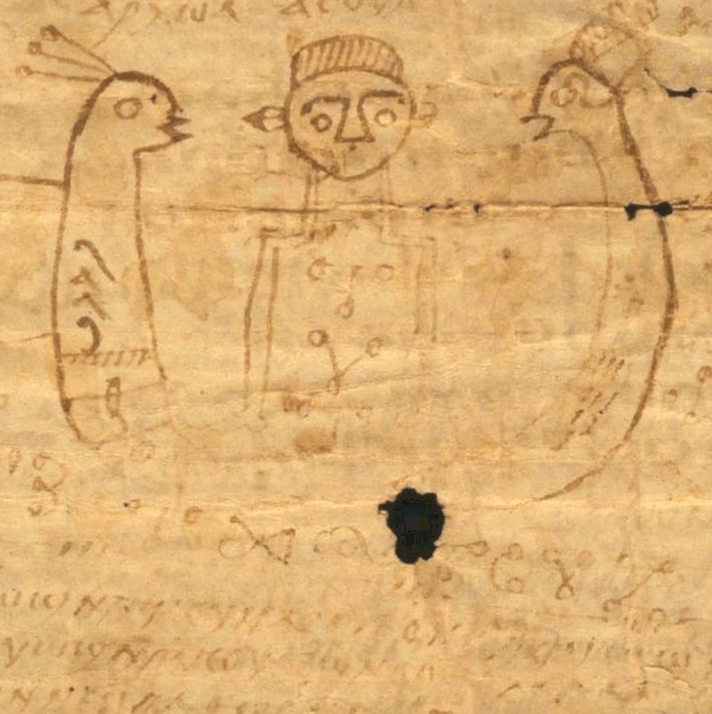
Let’s have a closer look at the image on this disc shown above. In the middle, a standing figure is visible, hands raised, flanked by two amorph blobs. The head of the figure is detailed with wide open eyes, a broad nose, and curious horizontal strikes through the head.

On top of the head, a few vertical lines are visible. Imagine my surprise when I saw a page of a Coptic magical book, featuring a very similar setup, notably in the detailing of the head! [3]

The two ‘blobs’ in the magical book appear to be creatures with the head of birds, while the arrow through the head and the headgear itself are also recognizable in their watered-down rendering on the pendant.

Papyrus RMO inv. F 1964/4.14, 11th century

Another form often found on the Bahariya discs is that of a square with a human neck and head, flanked by two vegetal motifs. This representation as well features in Coptic magical papyri, such as visible in Pap. Heidelberg Kopt. 685. [4] Might the iconography of the Bahariya amulets be based on Coptic charms?

Coptic smiths, Coptic charms in traditional jewellery?

I feel that one fact has been overlooked in determining what the depiction on the Bahariya pendant could mean. It is the simple fact that the smiths were Copts that may prove to be the explanation for the iconography on the amulets.

Not because they were less skilled than Muslim smiths, nor because they had no interest in creating amulets for rituals outside their faith, but because they based their designs on the iconography that was well-known and used in their religion.

With this possible origin however, we still don’t know what these pendants meant to their wearers, who were largely Muslim. As both silversmiths have passed away, they can no longer share their story.

Did they use a magical papyrus as their sourcebook? Was there any other reason to decide for this type of decoration? In this particular case, it is too late to find out for sure.

What this example does illustrate however is the importance of regarding jewellery in its wider sociocultural context instead of only as adornment.

Where can I find more on the historical background of amulets in the Middle East?

Find out more about the social meaning of amulets in the e-course on Amulets and Magic in Jewellery!

Or start by downloading the free e-book explaining 6 ways amulets work here.

More articles on jewellery & amulets? Browse them all here!

Always the first to get new articles? Join the Jewellery List and bling up your inbox!

This post is based on the chapter ‘The Evil Eye and Other Problems’ on magic and jewellery in my book Desert Silver.

References

[1] Weissenberger, M., 1998. Les bijoux des oasis égyptiennes, in: Bliss, F. 1998. Artisanat et artisanat d’art dans les oasis du desert occidental egyptien, Rüdiger Köppe Verlag, Köln p. 319, also mentions that these amulets have completely disappeared from the markets.

[2] Weissenberger 1998, p. 319

[3] Raven, M. 2012. Egyptian Magic. AUC Press, Cairo, p. 172

[4] Heidelberg Inv. Kopt. 685 (Meyer) Lage 5 Seite 12 and 9, digitally available on the website of the Papyrological Institute of Heidelberg university here

The Bedouin Silver blog gives credit where credit is due! Transparent referencing and citing sources helps us all grow. Would you like to do the same and quote this article? Here’s how:

S. van Roode, [write the title as you see it above this post], published on the Bedouin Silver website [paste the exact link to this article], accessed on [the date you are reading this article and decided it was useful for you].

Sigrid van Roode

Sigrid van Roode is an archeologist, ethnographer and jewellery historian. Her main field of expertise is jewellery from North Africa and Southwest Asia, as well as archaeological and archaeological revival jewellery. She has authored several books on jewellery, and obtained her PhD at Leiden University on the jewellery of the Egyptian zar-ritual. Sigrid has lectured for the National Museum of Antiquities in Leiden, Turquoise Mountain Jordan, and many others. She provides consultancy and research on jewellery collections for both museums and private collections, teaches courses and curates exhibitions. She is not involved in the business of buying and selling jewellery, and focuses on research, knowledge production, and education only.