The evil eye in jewellery

The evil eye in jewellery

power of the eye symbol

The evil eye in jewellery

Updated August 08, 2024

What is the point of evil eye jewellery? Beads in the shape of an eye are a familiar sight all over the world, and it is a shape that goes back at least 3,500 years. What does it represent, and which other forms may eye jewellery take? In this article, I’ll explore how the symbol of the eye appears in jewellery, and what it means.

Let’s start by addressing what the evil eye is…

In essence, the evil eye is nothing else than jealousy or envy. I suppose we can all relate to what that feels like: that moment when you realize someone is jealous of you, or something you have achieved, or something you own, that moment makes the hairs on your arms stand up and your spine tingle. You awkwardly try to divert their attention to something else by changing the topic of your conversation, but the harm has been done.

And the thing is, you have seen it in their eyes as well as in their behaviour. That glance, that look, that split second? That was the evil eye being cast at you.

Jealousy may leave us feeling anxious, threatened, insecure or even betrayed – jealousy affects our basic need of feeling safe and valued, so no wonder this feeling has been believed to bring visible and material harm as well.

A telling example comes from the Aures Mountains, Algeria. Here, it was reported that with every glance cast a jinn traveled along with it, and that jinn would harm the person or the thing that the glance was directed at. [1]

Evil eye symbolism draws on that looking and staring.

The eye is called ‘ayn al -hasad (‘eye of envy’) or nazar (‘glance, look)’ The concept of envy has been visualized in a symbol that captures it all: the eye. Envy and jealously arise from something you’ve seen, and it is transmitted through glares and glances. The eye represents both aspects: becoming jealous, and showing it.

Incidentally, you may have experienced that openly staring at something or someone for too long is considered inappropriate in many cultures: that is that same act of looking that may make a person feel uneasy. Even if it is not because of jealousy, but out of admiration!

Staring too long in either case is inappropriate, and being too vocal about your admiration of someone or something may alert jinn, who are known to turn jealous easily…and we’re back to square one.

The eye is a universal symbol that has been in use since the early civilizations, so it is not unique to Islam only, and it is not unique to one particular country either. The history of the eye in jewellery can be traced back to the distant past: in Egypt and Mesopotamia, the concept of the evil eye was already known. [2] Eye beads have been found in archaeological excavations across the Mediterranean and throughout Europe.

How and why is the evil eye used in jewellery?

And that brings me to the question how the evil eye is integrated into jewellery, and what its purpose is. Here, I will focus on jewellery in the shape of an eye only.

The eye symbol is not just a symbol, putting a shape to that complex, uneasy feeling, but is sometimes also thought of as an entity of its own.

And jewellery counteracts that concept of the evil eye through a huge variety of forms, shapes and guises: this blog series highlights many of those amuletic capacities of jewellery. One of those is jewellery in the shape of an actual eye, so let’s look at that next.

What is evil eye jewellery?

Basically, jewellery in the shape of an eye is the first line of defense against such malicious glances. The idea is not that the wearer is casting the evil eye herself, but it works more along the lines of mirroring and deflecting. The moment ‘that’ look is shot in your direction, it will be met with a counter-gaze. That is where jewellery in the form of an actual eye gets its power from.

Usually, these will be glass beads in the shape of an eye, but there are a few other forms as well that take the form of an eye. Banded agate for example can be fashioned into eye-beads, and has been used as such for at least two millennia.

Cowrie shells may be used as a ‘stand-in’ for an eye too, as they resemble the shape of a half-closed eye. [3]

Are evil eye beads bad, then?

That’s a question I hear a lot. The term ‘evil eye jewellery’ or ‘evil eye beads’ has become so commonplace that we would almost forget that this is a contraption of two different things: the evil eye itself (a bad thing), and the eye symbol that is believed to work against it (a good thing).

The eye beads on charm bracelets and necklaces are not evil themselves – they deflect evil.

Whether you feel comfortable wearing them is a matter of your own values, but historically, eye beads and eye jewellery are not designed as evil. They serve to counteract evil.

And what about the blue in evil eye jewellery?

Historically, these evil eye beads appear as blue eyes. That is of course related to the cultural importance of the colour blue, to the relative rarity of people with blue eyes around the Mediterranean (‘relative’, mind you – they did and do exist), but also to the limits of technical possibilities in the past.

Nowadays, you’ll find eye beads in all colours including yellow, pink, orange or green. These are marketed with nifty sales pitches, promoting various amuletic capacities for every colour: I found pink eye beads plugged as serving ‘love’, but also to ‘neutralize disorder’ or ‘protecting friendships’.

Here, it would seem the millennia old eye symbol is now being merged with modern-day interpretations of colours and their perceived powers. This is more of a marketing concept than embpodying actual beliefs that are rooted in history – these forms of the evil eye are often mass-produced in China and serve no other purpose than profit.

The evil eye is perhaps oldest amulet symbol in the world. It is still being used and acquiring new meanings today, developing along with the changing needs, spiritual convictions and economic savy of today’s world – but in doing so, it is at risk of becoming a commodity only.

Very specific forms of eye beads

There are several specific forms of eye beads throughout North Africa and Southwest Asia: in many regions, unique traditions have developed that take their own spin on evil eye beads. Some examples are here on the blog:

The ‘Seven Eyes’ blue bead that you’ll find throughout Southwest Asia…but what is it, and what are those seven eyes?

Khalili glass eye beads from Hebron were popular from Southwest Asia to Italy: how were they worn? This article explores.


Where can I learn more about evil eye beads and jewellery?

Find out more about the histories behind amulets in the e-course on Amulets and Magic in Jewellery!

Or start by downloading the free e-book on amulets and jewellery here.

More posts on jewellery and amulets? Browse them all here!

Join the Jewellery List and receive new articles, jewellery news and more in your inbox!

References

[1] Hilton-Simpson, 1915. Some Algerian superstitions noted among the Shawia Berbers of the Aures Mountains and their nomad neighbours, in: Folklore Vol. 26 No. 3, p. 228.

[2] S. Gunther & D. Pielow (eds) 2018. Geheimnisse der Oberen und Unteren Welt. Magie im Islam zwischen Glaube und Wissenschaft, p. 29.

[3] Hilton-Simpson, 1915. Some Algerian superstitions noted among the Shawia Berbers of the Aures Mountains and their nomad neighbours, in: Folklore Vol. 26 No. 3, p. 229.

Would you like to quote this article? Please do! Here’s how:

S. van Roode, [write the title as you see it above this post], published on the Bedouin Silver website [paste the exact link to this article], accessed on [the date you are reading this article and decided it was useful for you].

Sigrid van Roode

Sigrid van Roode is an archeologist, ethnographer and jewellery historian. Her main field of expertise is jewellery from North Africa and Southwest Asia, as well as archaeological and archaeological revival jewellery. She has authored several books on jewellery, and obtained her PhD at Leiden University on the jewellery of the Egyptian zar-ritual. Sigrid has lectured for the National Museum of Antiquities in Leiden, Turquoise Mountain Jordan, and many others. She provides consultancy and research on jewellery collections for both museums and private collections, teaches courses and curates exhibitions. She is not involved in the business of buying and selling jewellery, and focuses on research, knowledge production, and education only.

Iron in folklore and jewellery: amulets and belief

Iron in folklore and jewellery: amulets and belief

iron as amulet

Iron in folklore and jewellery: amulets and belief

Updated September 14, 2025

Iron is unlike any other metal used in amulets and jewellery. While gold and silver are prized for beauty and value, iron has long been associated with protection and power. In Middle Eastern traditions and beyond, iron objects were thought to ward off unseen forces and safeguard the wearer.

This reputation made iron an important material in amulet traditions: from small protective pendants to everyday objects carried as charms. Folklore around blacksmiths, meteoric iron, and sacred texts adds to the sense that iron was never just a practical material, but a deeply symbolic one.

Interested in amulet traditions in jewellery? This blog explores how amulets in jewellery work!

Iron’s reputation as protective metal in folklore

For centuries, communities across Europe, the Middle East, and Asia have believed that iron had the power to repel harmful or unseen forces. Horseshoes hung above doors, iron nails driven into thresholds, and small iron objects worn on the body were all part of a long-standing tradition of using the metal to keep misfortune at bay.

In the Middle East, iron was often linked with strength and resilience. Its ability to be forged into weapons and tools set it apart from softer metals. Unlike gold or silver, which were associated with wealth and beauty, iron was the everyday metal of farmers, soldiers, and craftsmen. Its strength gave rise to the idea that it could also protect in unseen ways, forming an invisible barrier between the wearer and potential harm.

Learn to read jewellery! Four colourful images of online courses.

Iron and the supernatural

There is a lot of ambivalence towards iron in the human world. That is visible in the contradictory nature of sources when it comes to its uses and status.

One of the hadith states that the Prophet Muhammad wished for his personal signet ring to be made of silver. An iron ring was inacceptable to him, as it was ‘emblematic of souls condemned to eternal fire’. [2]

But on the other hand, king Solomon wore a ring said to be partly of brass and partly of iron. Solomon, widely seen as a wise and just king, used the ring to command all spirits: the iron however was used to seal orders for evil spirts. [3]

Iron and the supernatural are associated, too, but we come across conflicting statements: spirits are scared of it, yet they wear it as adornment, they use it as weapon themselves but can be harmed by it in turn.

So, let’s look beyond folklore, and turn to the invention of ironworking itself.

Iron and its meteoric origins

In the Qur’an, sura al-Ḥadīd states that iron was ‘sent down’ to the earth by God. [1] This brings the earliest form in which iron was available t0 mind: meteoric iron. It literally fell from the sky.

Smaller and larger lumps of iron, remnants of meteorites, can be found all over the Sahara, for example. You can see several of these meteoric iron lumps in the image below. The key pendant is from Oman: keys allude to iron, and that is one of the reasons they are used as amulets. (click here to see more about keys as amulets)

This type of iron was easier to work than iron ore that had to be mined, and so may have been the first type of iron to be worked. One of Tutankhamun’s daggers, dating from around 1350 BCE, was confirmed to have been made of meteoric iron. [4]

And not only was the first iron to be used by humans literally from out of this world, and so may have installed itself in our collective memory, the invention of ironworking had a profound effect in virtually every culture where it was first discovered. [5]

Lumps of meteoric iron from the Sahara, with a silver amulet in the shape of a key.

Blacksmiths, fire, and the power of iron

Because when you zoom out, you’ll find that around the world the working of iron is surrounded by myths and legends.

The person of the blacksmith or ironmonger is as ambivalent as the material itself: in many societies, blacksmiths exist on the fringes of their community, both literally and metaphorically.

Literally, because ironworking requires the use of fire. Workshops were often located at the border of a settlement, and preferably downwind. That would minimize the risk of the settlement catching fire: a necessary precaution in times when buildings as well as temporary structures were made of materials that would easily go up in flames.

And metaphorically, because those blazing fires were often associated with otherworldly realms. Any person working in those circumstances, withstanding the extreme heat, seemingly bending fire to their will and creating things of a previously unmatched hardness and durability surely had to be in league with invisible forces!

Because, just picture it: there’s a person emerging from the furnace on the edge of your community, black as the devil, or a demon, or any frighting supernatural being one believes in, surrounded by unpleasant smells of sweat and dirt, and holding something only a few could create but many wanted, like a sword or a tool…that goes against all manifestations of cleanliness and purity you could imagine. Blacksmiths were highly suspicious, but much-needed people.

And so, they were both admired and feared. Edmond Doutté writes for Algeria that ‘son of a blacksmith’ was intended as an insult and records how blacksmithing across the Maghreb was widely regarded as a profession that was looked down upon and associated with magic. [6] The same fate befell blacksmiths across the Arab Peninsula. [7]

It would seem that both the material itself as well as the persons working with it have been treated ambiguously, ever since the use of iron was first discovered.

Amulets and jewellery made of iron

I think it is quite likely that this association of iron with the supernatural is much older than any of the three monotheistic religions, and is something that has lingered in our collective memory for as long as iron has been forged by hand.

Iron is something we can defend ourselves with against very visible enemies, but also a mysterious commodity associated with the supernatural: perhaps it could be used to defend ourselves against invisible beings, too?

In the Middle East, jewellery sometimes incorporated elements not for decoration but for protective symbolism. In the case of iron, that could be actual iron objects such as keys, but also objects that refer to iron such as miniature tools. The reference to iron itself would be powerful enough to protect the wearer.

The value here lay not in material worth but in cultural meaning: iron was cheap compared to silver or gold, yet powerful in what it was believed to do.

Why iron still matters in material culture

Today, iron may seem too ordinary to deserve much attention in jewellery or museum collections. Yet its cultural role makes it important. Iron objects, from keys and tools to amulets and ornaments, remind us that jewellery and adornment are not only about beauty or wealth. They are also about belief, protection, and the way people have understood their world.

For collectors, curators, and historians, iron offers a fascinating case of how an everyday material became extraordinary in the imagination of those who used it.

A small iron ring may not sparkle like gold, but its value lies in the stories it carries: of protection, of cosmic origins, of blacksmiths who wielded fire to create it.

Iron: more than metal

Iron stands apart in the history of jewellery and adornment. It carries a weight of meaning of its own. As folklore, sacred texts, and everyday practice all show, iron was believed to protect, to guard, and to symbolise strength.

When we look at iron in amulets and jewellery, we are reminded that the stories and beliefs surrounding a material are as important as the object itself. Here, we see a technological advancement that created ripples across the world, reflected in popular beliefs: once again, magical beliefs point to actual events in the past, and to me that really is their greatest power!


Find out more about the histories behind amulets in the e-course on Amulets and Magic in Jewellery!

Or start by downloading the free e-book on amulets and jewellery here.

More posts on jewellery and amulets? Browse them all here!

Join the Jewellery List and receive new articles, jewellery news and more in your inbox!

References

1] Ruska, J., “al-Ḥadīd”, in: Encyclopaedia of Islam, Second Edition, Edited by: P. Bearman, Th. Bianquis, C.E. Bosworth, E. van Donzel, W.P. Heinrichs. Consulted online on 02 October 2023. http://dx.doi.org.ezproxy.leidenuniv.nl:2048/10.1163/1573-3912_islam_SIM_2588

[2] J. Allan, D. Sourdel and Ed., “K̲h̲ātam, K̲h̲ātim”, in: Encyclopaedia of Islam, Second Edition, Edited by: P. Bearman, Th. Bianquis, C.E. Bosworth, E. van Donzel, W.P. Heinrichs. Consulted online on 02 October 2023 <http://dx.doi.org.ezproxy.leidenuniv.nl:2048/10.1163/1573-3912_islam_SIM_4232&gt;

[3] Walker, J. and Fenton, P., “Sulaymān b. Dāwūd”, in: Encyclopaedia of Islam, Second Edition, Edited by: P. Bearman, Th. Bianquis, C.E. Bosworth, E. van Donzel, W.P. Heinrichs. Consulted online on 02 October 2023 <http://dx.doi.org.ezproxy.leidenuniv.nl:2048/10.1163/1573-3912_islam_SIM_7158&gt;

[4] D. Cornelli et. al. 2016. The meteoritic origin of Tutankhamun’s iron dagger blade, in: Meteoritics & Planetary Science Vol 51, issue 7, pp 1301-1309

[5] Doutté, E. 1909. Magie et Religion dans l’Afrique du Nord, p. 42.

[6] Doutté, E. 1909. Magie et Religion dans l’Afrique du Nord, p. 42-44.

[7] Chelhod, J., “Ḳayn”, in: Encyclopaedia of Islam, Second Edition, Edited by: P. Bearman, Th. Bianquis, C.E. Bosworth, E. van Donzel, W.P. Heinrichs. Consulted online on 02 October 2023 <http://dx.doi.org.ezproxy.leidenuniv.nl:2048/10.1163/1573-3912_islam_SIM_4063&gt;

The Bedouin Silver blog gives credit where credit is due! Transparent referencing and citing sources helps us all grow. Would you like to do the same and quote this article? Here’s how:

S. van Roode, [write the title as you see it above this post], published on the Bedouin Silver website [paste the exact link to this article], accessed on [the date you are reading this article and decided it was useful for you].

The Bedouin Silver Jewellery Blog: Sigrid van Roode

Sigrid van Roode is an archeologist, ethnographer and jewellery historian. Her main field of expertise is jewellery from North Africa and Southwest Asia, as well as archaeological and archaeological revival jewellery. She has authored several books on jewellery, and obtained her PhD at Leiden University on jewellery, informal ritual and collections. Sigrid has lectured for the National Museum of Antiquities in Leiden, Turquoise Mountain Jordan, and many others. She provides consultancy and research on jewellery collections for both museums and private collections, teaches courses and curates exhibitions. She is not involved in the business of buying and selling jewellery, and focuses on research, knowledge production, and education only. Sigrid strongly believes in accessibility of knowledge, and aims to provide reliable and trustworthy content: that’s why the Bedouin Silver blog provides references and citations.

Keys as amulets

Keys as amulets

magic of keys

Keys as amulets

Among the forms that are not immediately associated with amulets, is that of a key. Yet they appear as amulet in several ways throughout the Middle East and North Africa, from actual keys to images of keys. You will see them dangling from necklaces, included as miniature charm on charm necklaces, and alluded to in embroidery for example. What is the symbolic meaning of a key? In this article, I will introduce three ways keys hold significance as amulets in the Middle East.

Detail of a silver somt necklace, leather amulet pouches, bright beaded necklaces and keys worn by a Bedouin woman from Oman.

Power of keys: materials and amulets

First off, the material that keys were traditionally made of, is powerful in itself. Jinn are known to be afraid of iron, (see here why that is) and so anything made from iron would keep them at a distance. Keys, which for a long time were made of iron, fit that criterium perfectly. The image of the necklaces worn by a Bedouin woman from Oman shows her wearing a set of keys amidst leather amulet pouches: most likely, the keys also serve an apotropaic function.

A more recent version of a key as amulet is the silver key from Oman, shown below, which is shaped after a modern key. In North Africa, tiny keys sewn on to children’s clothing help prevent an early death. [1] (see here which spirits were feared for harming children). In 1915, a baby boy in Algeria was seen adorned with a series of amulets, including two iron keys, and the author observing that practice also noticed that keys were worn commonly as a charm. [2]

Silver Omani amulets, including a silver key

Key symbolism: locking and unlocking

There is more to keys than just the material they are made of, and is where their function comes into view. Keys, of course, lock and unlock things. The concept of locking and unlocking is closely related to a woman’s fertility: not so much in terms of chastity, but in the context of spirits blocking her from getting pregnant or causing a miscarriage. In that respect, keys function in a similar fashion to knots and knotting (see more about that here).

Here, keys are often combined with locks: amulets in the shape of locks were believed to prevent miscarriage in Egypt, as these ‘lock’ the womb until the time of birth has come. [3] When a birth is difficult, the reverse principle is used, and the key to a saint’s tomb is placed on the lower back of the mother to ease the birth. [4]

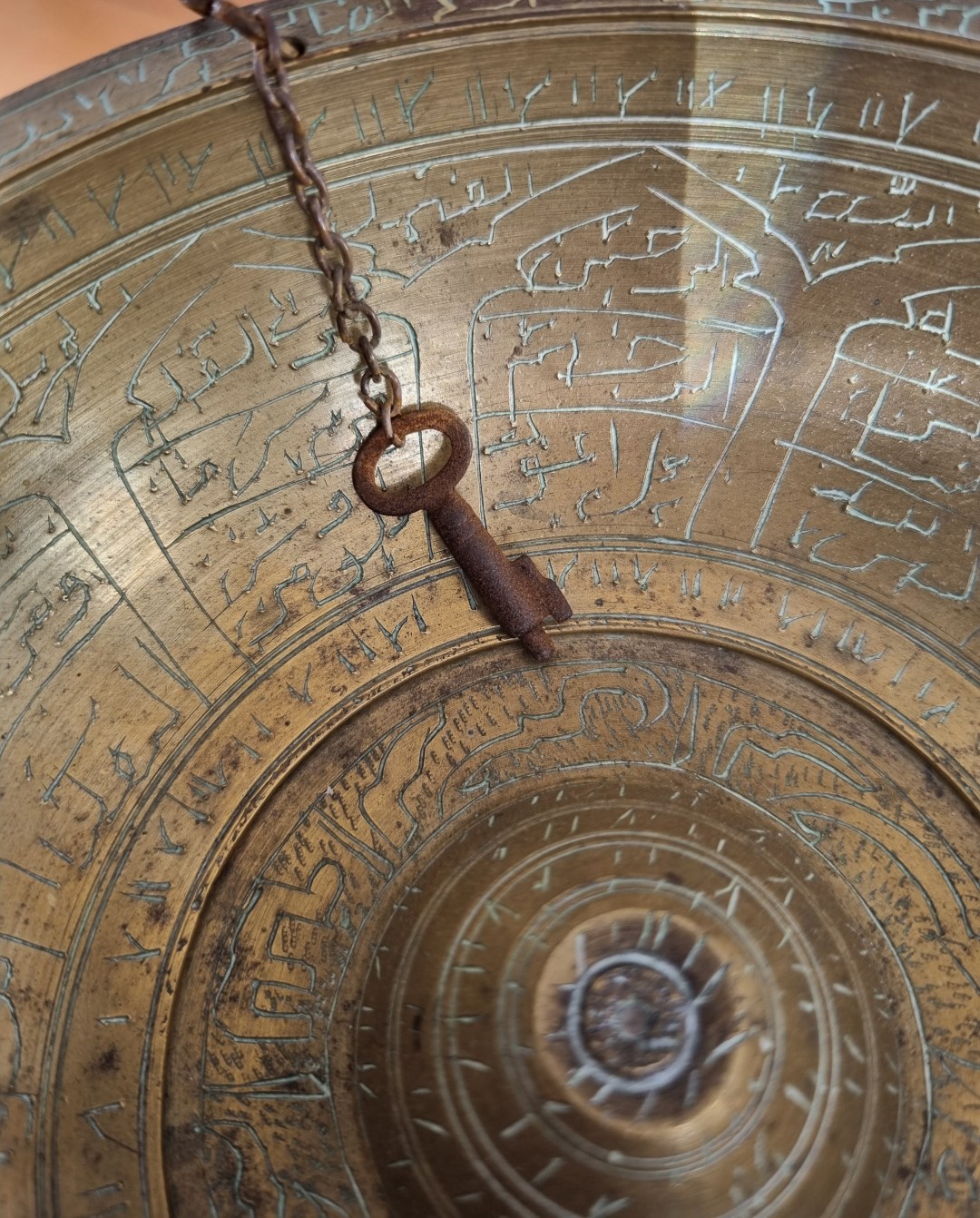
An Islamic magic bowl with a tiny iron key attached

Keys in ritual: protection and knowledge

Keys are also symbolic of accessing protection and knowledge. An example of that are the magical bowls of the Yezidi, where tiny amulet plaquettes are attached to its rim. These are called kilit, which literally means ‘key’ in Kurdic. [5] These amulet plaquettes can also take the form of an actual key, such as shown above.

The general idea is that the key amulet would enhance the efficacy of the bowl by submerging it into the water of the bowl. [6] Bowls like these were used in informal ritual aimed, again, at securing healthy pregnancy and safe births, as well as protection from evil forces. [7]

Keys as amulets: the magic in everyday objects

A seemingly simple household item may hold deep significance on a supernatural level: this example of keys shows how ‘magic’ is not something alien or mysterious, but something that is expressed in forms and shapes most familiar to us.


What kinds of amulets exist in North Africa and the Middle East?

Curious as to what other everyday objects may be used as amulets, and what their meaning is? Find out more about the histories behind amulets in the e-course on Amulets and Magic in Jewellery!

Or start by downloading the free e-book on amulets and jewellery here.

More posts on jewellery and amulets? Browse them all here!

Join the Jewellery List and receive new articles, jewellery news and more in your inbox!

References

[1] Hansmann, L. and L. Kriss-Rettenbeck 1977. Amulet und Talismann. Erscheinungsform und Geschichte. Verlag Georg D.W. Callwey, Munchen, p. 240.

[2] Hilton-Simpson, M.W. 1915. Some Algerian Superstitions Noted among the Shawia Berbers of the Aures Mountains and their Nomad Neighbours, in: Folklore Vol. 26, no. 3, p. 233 and p. 240.

[3] Hansen, N. 2006. Motherhood in the Mother of the World, PhD-thesis, University of Chicago, p. 116.

[4] Idem

[5] Biesterfeld, H. & D. Pielow (eds) 2019. Die Geheimnisse der Oberen und Unteren Welt. Magie im Islam zwischen Glaube und Wissenschaft, Brill, Leiden. p. 469-470 for a description of these bowls.

[6] Idem, p. 469

[7] Idem, p. 472-473


Sigrid van Roode

Sigrid van Roode is an archeologist, ethnographer and jewellery historian. Her main field of expertise is jewellery from North Africa and Southwest Asia, as well as archaeological and archaeological revival jewellery. She has authored several books on jewellery. Sigrid has lectured for the National Museum of Antiquities in Leiden, Turquoise Mountain Jordan, and many others. She provides consultancy and research on jewellery collections for both museums and private collections, teaches courses and curates exhibitions. She is not involved in the business of buying and selling jewellery, and focuses on research, knowledge production, and education only.

The Mineral and the Visual

The Mineral and the Visual

Precious Stones in Medieval Secular Culture

The Mineral and the Visual

Stones have always held meaning for people. They were believed to hold certain powers, worn as amulet or talisman, and they were even thought to cure diseases. The Mineral and the Visual explores the role of precious stones during the Middle Ages, and particularly in a non-religious context. And it is a fascinating read!

The Mineral and the Visual centers around the notion that precious stones in the Middle Ages were looked upon decidedly different than we now are accustomed to. They were not merely decorative embellishments in pieces belonging to the realm of what we now regard as ‘decorative arts’, but they represented a world of art, meaning and science. They were powerful in and of themselves, and studying them was a highly valued discipline that required literacy and knowledge. Contrary to our times, where we select precious stones based on their financial value and appearance, for the medieval purpose mattered what a stone could do (p. 6). That is hardly a new concept; the agency of stones is of prime importance among for example the Bedouin [1], but here it is applied to medieval objects.

This book approaches this agency of stones through three case-studies: bejeweled crowns, illustrated texts on stones (the so-called lapidaries) and illustrated travel accounts. And in these three themes, a multifaceted, brightly coloured world emerges of living stones, knowledge about those stones, and trade and commerce in acquiring these stones. Before I take you through the book, here are a few observations. First off, the emphasis of the book is on medieval use of stones in the West, as is clearly mentioned on the back cover. Of course, there is attention for the intersection with the Islamic world, for example in the part on illustrated lapidaries where knowledge exchange is touched upon, but the geographical scope of the book is mainly Western Europe. Where sources from the Islamic world and beyond are used, this is to confirm European practices. As the trade in gemstones itself, but notably also the ideas and beliefs associated with these have always spanned continents, that half the story is left out is something to be aware of as reader. Within that European perspective, the emphasis seems to be on the German-speaking world, which narrows it down further. An example is how the German language is mentioned as recognizing ‘the gender-neutral and class-specific conmingling of human and mineal, for it links Edelmann and Edelfrau to Edelstein…’ (p. 14) – I’m no linguist, but the use of ‘edel’ with objects or notions deemed noble seems to me not limited to people and stones and not specific to the German language, either. Early medieval Anglo-Saxon names such as Aethelflaed ‘noble beauty’ and Aethelred ‘noble counsel’ employ the same form, after all. And second, be advised that this is an academic study, not a publication for a wider audience: I fear the language used may discourage non-academic readers, which is too bad, as there is so much this book offers. Having said that: onwards to the world of stones!

The first part presents the power of bejeweled medieval crowns. We expect royalty to bedazzle and shine, and that was no different for the Middle Ages: kings and queens were covered in jewellery and precious materials. But whereas nowadays that is more of an expression of status already present, in the Middle Ages the use of precious stones was what created that status in the first place. I found that a fascinating notion: the stones themselves have the power to imbue a person with royalty and its accompanying virtues. The few remaining medieval crowns are discussed and analyzed, and placed in their historic context. Here, I could not help but wonder in how far we might interpret crowns as ‘secular’ given the close, inseparable power of royalty and church in the periods under discussion, even with the definition of secular given on p. 10. The 26 early medieval votive crowns from Guarrazar, Spain, for example have been left out of this book. These are excellent examples of the continuation of Byzantine styles and its gem use, and it would be interesting to see if the theory developed by the author on the function of the Leitstein on crowns is also applicable to votive crowns.

In the second part, the author adds another layer to the reality of living, powerful stones, and that is what contemporary literature tells us about knowledge of these stones and their powers. Lapidaries are an encyclopedia of sorts, presenting knowledge about stones, and they have existed from Antiquity onwards. During the Islamic Middle Ages, many works including lapidaries from the classical world, but also from Buddhist and Hindu libraries as well as sources from further afield in Asia were translated into Arabic and improved upon. [2] It is in this context that I missed a closer examination of eastern sources in particular, as it would be intriguing to see if most lapidary knowledge was indeed based in Classical Antiquity, as the author assumes (p. 75, 83), or that there is evidence to the contrary. [3] This part traces the development of the lapidary in the Middle Ages and explores how knowledge about precious stones was interwoven with not only geology, but astrology, medicine and magic. I enjoyed the elaborate exploration into observation: not just names and colours, but also shades and hues of colours, the touch of stones and even their taste (I can’t help but wonder what stone tastes like rotten fish….!) (p. 99) The knowledge present in lapidaries is presented and discussed, and this journey into the medieval mind and the dangerous world it found itself in is fascinating – what to think of a coral table ornament hung with fossilized shark teeth set in gold, that guests could use to test their food for poison?

From what was originally learned, medical knowledge it is but a small step to magical knowledge, and that is where the knowledge contained in these scholarly books finds its way to a wider audience. An entire chapter is devoted to ancient carved gemstones such as cameos and intaglios: not only were these made of stones that had powers themselves, but they contained ancient engravings that carried meaning, too, and might be at odds with Christianity – here, lapidaries show traces of redaction, and the author walks us through the wider world behind those religious convictions and the developing of other viewpoints regarding the powers assumed to be present in stones.

The third part sees the expansion of all this knowledge into the practical realm: how to get one’s hands on these precious, and often foreign stones? Travel books share insights in how difficult it was to obtain stones mined in faraway lands – or so they would have us believe. The author elaborates on the idea that precious stones in the Middle Ages were coveted because of their powers and magical properties: travel accounts relaying knowledge seen and heard in distant lands confirmed that information on the one hand, and on the other hand emphasized the many dangers one had to face to acquire such precious stones, which in turn was reflected in their price. Here again, we see how world history is incredibly important. These jewels and precious materials could only be imported into Europe from Asia when trade routes were secure: both during the early Middle Ages and the later Middle Ages those circumstances were provided, first by the stability of the young Islamic realm and later by the Mongol conquests. Tracing merchant routes and traders’ inventories, this chapter paints a vivid picture of the gem trade in the Middle Ages.

I enjoyed this book. The way the author combines stones with ideas about those and the economics behind them over a longer period of time is innovative, and based on a richness in sources that is as dazzling as the medieval artworks discussed themselves. In doing so, she departs from general art historian books (which are often limited to one period only), and instead follows the long lines of history through several centuries. It would have made for an even more interesting read if the long geographical lines were also followed, but I do understand that would have presented a massive scope. By looking at precious stones through the eyes of the Medieval person, that person and their world comes to life. It’s a world that I would very much like to see presented in a more easily accessible book for a larger audience, too: there is so much to see and learn in this gem-studded, medieval world of wonders!

This is a fascinating read for curators and medievalists, but certainly also for gemmologists and jewellery historians interested in the agency and life of jewels and bejeweled objects.

The Mineral and the Visual. Precious Stones in Medieval Secular Culture. Brigitte Buettner, 2022

Colour/B&W, 256 pages, in English. Published by The Pennsylvania State University Press

The book was received as review copy from the publisher.

More book recommendations on personal adornment and history…? Click here to see my other picks for you!

Never miss out on a new book review? Join the Jewellery List and have them sent to your inbox!

References

[1] Popper-Giveon, A., Abu Rabia, A. & J. Ventura, From White Stone to Blue Bead: materialized beliefs and sacred beads among the Bedouin in Israel, in: Material Religion 10-2, pp. 132-135

[2] See Starr, S.F. 2013. Lost Enlightenment. Central Asia’s Golden Age from the Arab Conquest to Tamerlane. Princeton University Press

[2] As for example in Content, D. 2016. Ruby, Sapphire & Spinel: An Archaeological, Textual and Cultural Study. Part I. Text. Brepols, Turnhout

Sigrid van Roode

Sigrid van Roode is an archeologist, ethnographer and jewellery historian. Her main field of expertise is jewellery from North Africa and Southwest Asia, as well as archaeological and archaeological revival jewellery. She has authored several books on jewellery. Sigrid has lectured for the National Museum of Antiquities in Leiden, Turquoise Mountain Jordan, and many others. She provides consultancy and research on jewellery collections for both museums and private collections, teaches courses and curates exhibitions. She is not involved in the business of buying and selling jewellery, and focuses on research, knowledge production, and education only.

Across Asia

Across Asia

the walters art museum

Across Asia and the Islamic World

At the heart of human history is interconnectivity. People, and as a result their cultures, have always been in contact, and the result of those connections are visible in material culture. The Walters Art Museum is kicking off a new series of publications focusing on their collections, and the first volume Across Asia and the Islamic World illustrates the interconnectivity on the Asian continent.

Across Asia and the Islamic World accompanies the installation of the new gallery Arts of Asia and the Islamic World. In the new gallery, visitors can experience the many cultural expressions from this vast continent in one space, and more importantly, see how they are all interrelated. That interconnectivity is also the focus of the book. As it is expressed in the foreword: ‘Movement is an intrinsic part of the life of most art objects.’ (p. 6). This simple statement is such an incredibly important notion, yet it is one that is often overlooked. We are somehow used to objects being static, in their movement but also in their identity.

The first essay in the book explores that notion in fascinating detail, using objects from the collection. On the first page of that essay, we travel along with a Qur’an made in India, moving to Istanbul a century later, and now on display in Baltimore. In each of its locations, it held significance and had a role to play. A jade chime from China, used at the court to instill heavenly harmony on earth, also reflects conquest and colonization (p. 17-18), and in a similar manner, this essay presents a variety of objects that each hold several stories. This is an essay that gets you thinking on how there is so much more to ‘a teapot from China’ if we actively start considering its biography. I appreciated in particular that the essay ends with a note on how further research continues to shed light on these complex, often tangled layers of identity and history in a single object.

The second essay explores spiritual and social movement as expressed by objects. An example is a jar with a carp swimming in a lotus pond. (Fig. 8) Nothing remarkable at first sight if you’re (like me) not a connoisseur of Chinese art, but the carp swimming upstream reflects the impossibility in Chinese society for people to move up on the social ladder: the desire to ‘make it’ is so very relatable today. This particular vase has an even deeper meaning, but instead of bringing you more spoilers here, I recommend you read this book yourself! The essay continues to compare and analyze objects associated with spiritual movement: in a person, through meditation and prayer, but also in the visible act of processions and pilgrimage.

The third and last essay delves into movement across the continent: of people, goods and ideas. I really enjoyed the introduction to this chapter, presenting a Chinese statue of a camel (Fig. 18): the most important animal in caravans, but originally an ‘import’ to China itself. Portable objects, like jewellery or personal amulets, show the length and width of traveling ideas: a Buddhist locket in Japan, a tiny Qur’an from sub-Sahara Africa. Paper, a Chinese invention, was used for fans but also changed the world of book production forever, and I loved how the essay ends with a copy the famous Book of Navigation by Piri Reis. This 17th century map ties the entire book together: expansion and imperialism, travel and exploration, techniques and trade, forms and ideas permeate the history of Asia and the Islamic world in a continuous perpetuum mobile.

This may be a small book with its 64 pages, but it covers so much ground. The map on pages 8 and 9 allows you to take in the scale of the geographical region presented in the book. The many photographs are beautiful and a joy to see. And what these photos and essays leave you with is a new understanding of looking at historic objects: as material output of cultures continuously on the move. That is of course not a groundbreaking new insight itself, but the way this book has made it its central theme results in a presentation of the collection highlighting its cultural and historic interrelatedness, instead of segmenting it according to contemporary countries and their respective histories. I’m looking forward to the future publications in this series!

Across Asia and the Islamic World. Edited by Adriana Proser, 2023.

Full colour, 64 pages, in English. Published by GILES in association with The Walters Art Museum, Baltimore

The book was received as review copy from the publisher.

More book recommendations on personal adornment and archaeology…? Click here to see my other picks for you!

Sigrid van Roode

Sigrid van Roode is an archeologist, ethnographer and jewellery historian. She considers jewellery heritage and a historic source. She has authored several books on jewellery from North Africa and Southwest Asia, and on archaeological jewellery. Sigrid has lectured for the Society of Jewellery Historians, the National Museum of Antiquities in Leiden and the Sultan Qaboos Cultural Center, among many others. She curates exhibitions and teaches online courses on jewellery from North Africa & Southwest Asia.